In detection tests, the enrichment broth is typically inoculated with a predetermined concentration of the target organism sourced from the Certified Reference Material (CRM).
(Read more)

Certified Reference Materials (CRM) serve as internal controls to continuously monitor the quality of existing analytical methods and validate/verify new ones. Each CRM is accompanied by a certificate ensuring metrological traceability to the specific target organisms, expected level, and range with a 95% confidence interval.
Eurofins offers CRMs containing multiple target organisms simultaneously. They are available in two formats; powdered or freeze-dried. The powdered format is presented as a set of 5 sachets while the freeze-dried material is presented as a set of 3 vials. Regular testing with these materials, yielding satisfactory results, builds confidence in the laboratory’s ability to consistently produce reliable results.
The reference materials are user-friendly, and applicable for both quantitative and qualitative analyses. They serve as a positive control for the method in question, while also serving as negative controls and/or background flora. They can be utilized as a stand-alone test, or they can be added to a chosen matrix. They are ideal for training of new staff.
CRM can be used with most techniques within microbiology, such as direct counting, surface plating, pour plate methods, rapid methods, PCR, membrane filtration etc.
| CRM | Purpose | Format | Set | Target organisms | Examples of analysis |
|
MV0029 |
Universal control |
Freeze-dried |
3 vials |
Bacillus cereus Clostridium perfringens Enterococcus faecalis Escherichia coli Klebsiella aerogenes Pseudomonas aeruginosa |
Plate count |
|
FM0046 |
Pathogen control |
Powder |
5 sachets |
Listeria monocytogenes Salmonella Hofit |
Quantitative or qualitative |
|
FM0030 |
Hygiene control |
Powder |
5 sachets |
Klebsiella aerogenes Escherichia coli Aspergillus niger Candida utilis |
Plate count |
|
FM0031 |
Gram positive control |
Powder |
5 sachets |
Bacillus cereus Lacticaseibacillus rhamnosus Staphycococcus aureus |
Plate count |
|
MV0037 |
Legionella control |
Freeze-dried |
3 vials |
Fluoribacter bozemanae Legionella pneumophila SG1 |
Legionella total |
In detection tests, the enrichment broth is typically inoculated with a predetermined concentration of the target organism sourced from the Certified Reference Material (CRM).
(Read more)

This spiked sample undergoes the complete analytical process, it simultaneously checks the enrichment broth and the incubator, a PCR step or any other rapid method, if used, and selective agars. The certified reference material is accompanied by a certificate containing crucial information regarding its composition.
An example of the level of target organisms from a certificate:
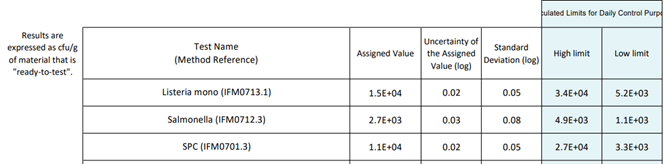
The quantity in this certificate is given in CFU/g. If you intend to verify the method for detecting Salmonella spp., follow these steps: Accurately weigh the material (10 grams) and add diluent in buffered peptone water. While the standard procedure involves a 1/10 dilution, you can adjust the dilution ratio to suit your specific requirements. The expected level (assigned value) according to this certificate is 2700 CFU/g of Salmonella spp., with a range spanning from 1100 to 4900 CFU/g. If diluted at a 1/10 ratio, the expected level becomes 270 CFU/ml with a range of 110 to 490 CFU/ml. By inoculating your control sample with 100 µl of this solution, you will have an approximate level of 27 CFU. Adjust the level as necessary and adhere to your standard procedure. Inoculate the enrichment broth that fits your target organism. The same primary dilution may be used for both L. monocytogenes and Salmonella spp.
In summary: Check the certificate’s expiry date. Review the expected level and tolerance limits. Determine the desired inoculation level and adjust the dilution accordingly.
The material can also be used to spike a chosen matrix. This is beneficial for validating/verifying a new method or verifying an existing one. Alternatively, it can be used alongside the analysis of a customer's sample. This proves especially valuable when the sample material is unfamiliar to the laboratory or where, for some reason, there is uncertainty whether the target organism can be recovered from the particular matrix. In this process, one of the customer's samples undergoes standard analysis, while the other is spiked with the desired level of CRM. Both analyses are carried out simultaneously. This approach ensures a potential recovery of the target organism from this specific material, accounting for its inherent properties and natural flora. Unknown sample materials may contain competing flora and/or unidentified inhibitory substances, and spiking provides insights into these factors.