
















































Using secondary pharmacology panels to predict clinical safety risks

Verena Albert, Scientist III - Group Leader, Verena.Albert@discovery.eurofinsus.com; Mirza Jahic, Associate Director, In Vitro Pharmacology, Mirza.Jahic@discovery.eurofinsus.com; Eurofins DiscoverX, LLC
 Clinical trial failures due to safety concerns remain a major obstacle in drug development. Despite promising preclinical data, many investigational compounds are discontinued. These failures often result from adverse events linked to off-target interactions – effects on receptors, ion channels, transporters, or enzymes outside of the drug’s intended mechanism of action.
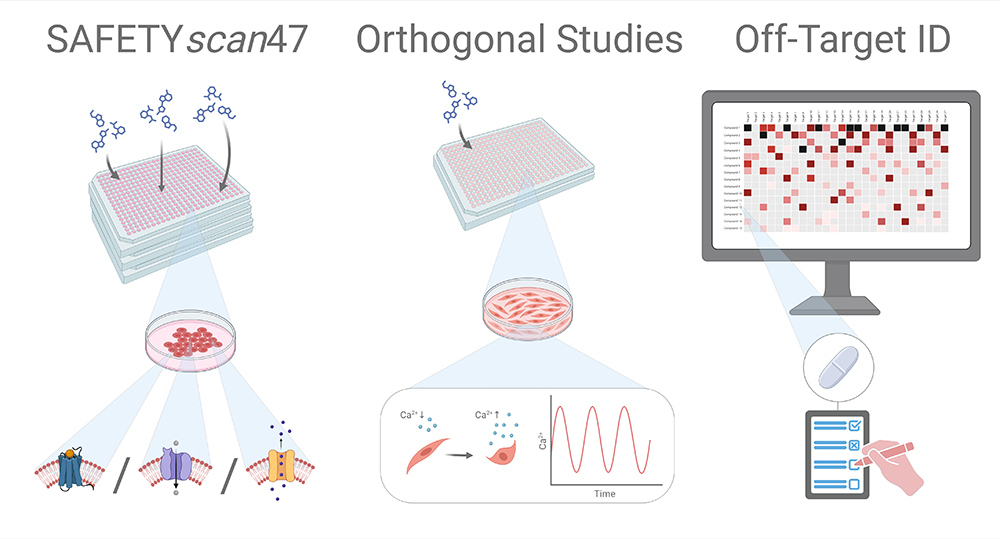
Eurofins Discovery’s recent study published in ACS Pharmacology & Translational Science, “Comprehensive Analysis of Clinically Discontinued Compounds Using an In Vitro Secondary Pharmacology Panel to Predict Potential Safety Risks during Drug Development,” explored whether early secondary pharmacology profiling could help predict these risks. The dataset was comprised of 52 compounds discontinued between 2001 and 2021 due to safety issues. These compounds were screened using Eurofins Discovery’s SAFETYscan®47 panel, a comprehensive selection of in vitro assays that cover key molecular targets, such as GPCRs, ion channels, nuclear receptors, transporters and enzymes relevant to safety pharmacology.
Key Insights:
- Comprehensive target profiling: The SAFETYscan47 panel allows for the detection of diverse off-target effects across multiple target classes, offering a more complete pharmacological profile.
- Translational insight: By linking molecular interactions to reported adverse events, the panel helped bridge the gap between preclinical findings and clinical observations.
- Alignment with clinical adverse events: Several compounds showed activity at targets mechanistically linked to their reported safety issues, such as hERG channel interactions associated with cardiac risks.
Implications for Drug Discovery:
Integrating secondary pharmacology panels earlier in the discovery process, such as during lead optimisation or SAR exploration, can reveal safety liabilities at a stage when chemical structures can still be refined. This proactive approach supports:
- Early risk assessment: Identifying problematic compounds before costly clinical trials.
- Mechanistic and systematic-based decision-making: Informing internal discussions with data-driven hypotheses.
- Regulatory alignment: Meeting FDA and EMA expectations for safety profiling in IND submissions.
- Ethical innovation: Supporting New Approach Methodologies (NAMs) that reduce reliance on animal testing.
- Predictive modeling: Enabling computational tools to predict off-target risk in silico.
Secondary pharmacology panels offer a powerful tool for anticipating clinical safety risks. By capturing mechanistically relevant off-target interactions early, they can reduce late-stage failures, enhance patient safety, and improve R&D efficiency. This recent study illustrates that Eurofins Discovery is at the forefront of safety pharmacology innovation, providing advanced in vitro profiling solutions such as the SAFETYscan47 panel. These comprehensive assays enable researchers to systematically assess off-target activity across diverse target classes, generating actionable insights that inform early-stage decision-making. By partnering with Eurofins Discovery, pharmaceutical companies can leverage these translational tools to minimise safety risks, optimise lead compounds, and accelerate the development of safer, more effective therapeutics; this makes Eurofins Discovery a trusted collaborator in building predictive and efficient drug discovery pipelines.
Read the full publication: DOI: 10.1021/acsptsci.5c00452
Explore SAFETYscan47 target list: SAFETYscan47 LeadHunter Panel (87-1003DR)