

















































Achieve speed and sustainability with new rapid microbiological methods

Tom Lehman, PhD, Vice President, Microbiology Business Unit, Eurofins BioPharma Product Testing, Lancaster, PA, thomas.lehman@bpt.eurofinsus.com; Sara Baroni, Marketing Specialist, Eurofins BioPharma Product Testing Italy, sara.baroni@bpt.eurofinseu.com; Christopher Smith, Manager, Mycoplasma Services, Eurofins BioPharma Product Testing, Lancaster, PA, ChristopherC.Smith@bpt.eurofinsus.com
 Quality control laboratories are under increasing pressure to deliver microbiological results faster than what traditional compendial methods can accommodate. In addition to the demand for speed, laboratories are increasingly expected to align with broader corporate sustainability initiatives. While innovative rapid technologies accelerate the detection and identification of microorganisms, sustainable methods significantly reduce resource consumption, waste generation, and energy use compared to traditional methods. The global regulatory landscape clearly supports the implementation of Rapid and Alternative Microbiological Methods (RMMs) across multiple test categories, from sterility to mycoplasma detection and bioburden control. The European Pharmacopoeia Chapter 5.1.6 and the U.S. Pharmacopeia Chapters <1223> and <1071> explicitly acknowledge that modern technologies, when properly validated, are acceptable alternatives to traditional compendial methods. Global adoption of these technologies has allowed the pharmaceutical and biopharmaceutical industries to meet rigorous regulatory standards, advance their sustainability goals, and enhance both operational performance and environmental stewardship.
Eurofins BioPharma Product Testing (BPT) implements rapid microbiological methods, enhancing our environmental responsibility and our ability to provide results in a shorter timeframe.
Mycoplasma Testing
Compendial mycoplasma testing has been the globally recognised standard for ensuring the absence of mycoplasma contamination in biologics. However, it requires a minimum of 28 days to complete, delaying product release and increasing inventory hold times. Global regulatory agencies have acknowledged and
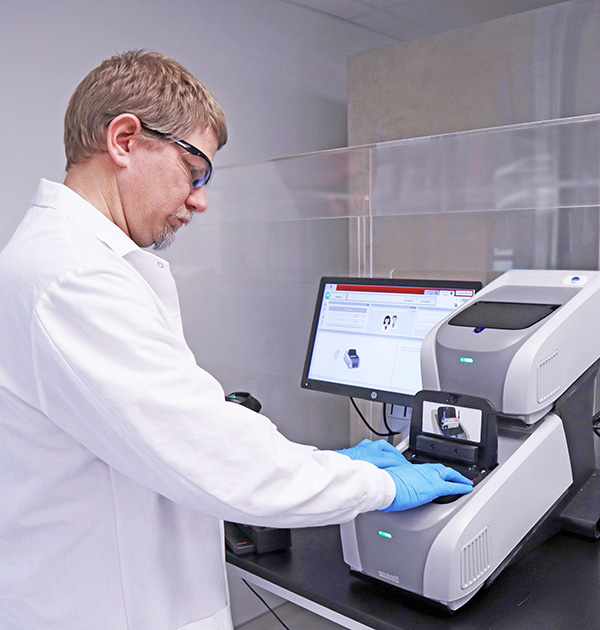
accepted nucleic acid amplification (NAT) methods as alternatives to traditional compendial mycoplasma tests. Acceptance is contingent on rigorous validation to demonstrate that the alternative method offers equivalent or superior sensitivity and specificity compared to the compendial method. Eurofins BPT has validated two NAT-method alternatives to the compendial mycoplasma method, allowing for a significant improvement in testing turnaround times. The MycoSEQ® from Thermo Fisher Scientific employs quantitative PCR (qPCR), enabling delivery of results in under five days. Our team enhanced this method by automating the PCR plating portion of the method using a robotic liquid handler to reduce analyst interaction during processing and improve efficiency. Biofire® Mycoplasma from bioMérieux offers an even faster, cartridge based, multiplex PCR platform that provides results in less than three days, with minimal
hands-on time and reduced risk of analyst error. Both methods are validated to meet regulatory expectations, making them suitable for lot release testing as well as reagents and cell cultures.
Sterility Testing
Eurofins BPT’s multi-technology approach stands as a major advantage in supporting the industry’s transition toward the adoption of rapid sterility testing. By integrating complementary analytical platforms, we address the diverse needs of the pharmaceutical industry — whether the goal is to shorten batch release timelines, or to increase throughput by testing a larger number of lots simultaneously with shorter timelines, all while adapting to different product categories. This includes traditional sterile injectables and small molecules, complex biologics and vaccines, as well as advanced therapies, radiopharmaceuticals, and cell-based products that require tailored analytical strategies and rapid turnaround times.
As an innovative alternative to traditional sterility compendial methods, we offer a diverse and GMP validated portfolio of rapid sterility testing technologies, including Solid Phase Cytometry (RedOne®), ATP Bioluminescence (Celsis®), and automated growth-based systems (BacT/ALERT® 3D).
The recent introduction of dedicated USP chapters <72> and <73>, describing respiration-based (CO₂) and ATP bioluminescence methods for sterility testing of short-life products, together with the forthcoming USP chapter <74> on Solid Phase Cytometry, further strengthens the regulatory foundation for these rapid approaches.
Endotoxin Testing
For over three decades, the Limulus Amoebocyte Lysate (LAL) assay has served as the compendial standard for endotoxin testing. However, growing concerns over the ecological impact on horseshoe crab populations and the long-term security of LAL supply have prompted both the USP and the EP to support the use of recombinant technologies in place of the traditional LAL methods. The recombinant factor C (rFC) and recombinant cascade factor (rCR) offer robust, animal-free alternatives, supporting modern sustainability goals. Eurofins BPT is proud to offer both rFC and rCR methods, providing clients with compliant, reliable, and environmentally responsible options for endotoxin testing.
We are committed to providing our clients with faster, greener and more robust microbiological testing options. By offering validated and regulatory-supported technologies such as rapid mycoplasma testing, rapid sterility platforms, and recombinant endotoxin testing, we can reduce our environmental impact while enhancing our operational efficiency.
For more information, Contact Us.