Residues and contaminants

Residues and contaminants testing
Contaminants and residues can pose health risks in food even at trace levels. Regulatory bodies and consumers demand high standards of safety and quality, making thorough testing essential. At Eurofins Food & Feed Testing New Zealand, we provide advanced analytical testing solutions of various contaminants and residues to help you comply with legal requirements and achieve the highest quality standards.
Pesticide residue testing
Pesticides are chemicals used in agriculture to protect crops against insects, fungi, weeds and other pests. In addition to their use in agriculture, pesticides are also used to protect public health in controlling the vectors of tropical diseases, such as mosquitoes.
Pesticide residue refers to the pesticides that may remain on or in food after pesticide formulations are applied to food crops. As pesticides are potentially toxic to humans, the levels of residues in foods are often stipulated by regulatory bodies in many countries.
New Zealand Ministry for Primary Industries (MPI), Codex, and other regulatory bodies' Maximum Residue Limits (MRLs) are based on Good Agricultural Practice data.
We are able to test the following food matrices:
- Fruits and vegetables
- General foods: sauces, nuts, eggs, processed foods
- Potable water
- Citrus fruits
- Dried or processed fruits
- Non-alcoholic beverages and juices
- Oil seeds
- Cereals
- Dairy products: milk powders, cheese, infant formula
International Convention: Codex Alimentarius
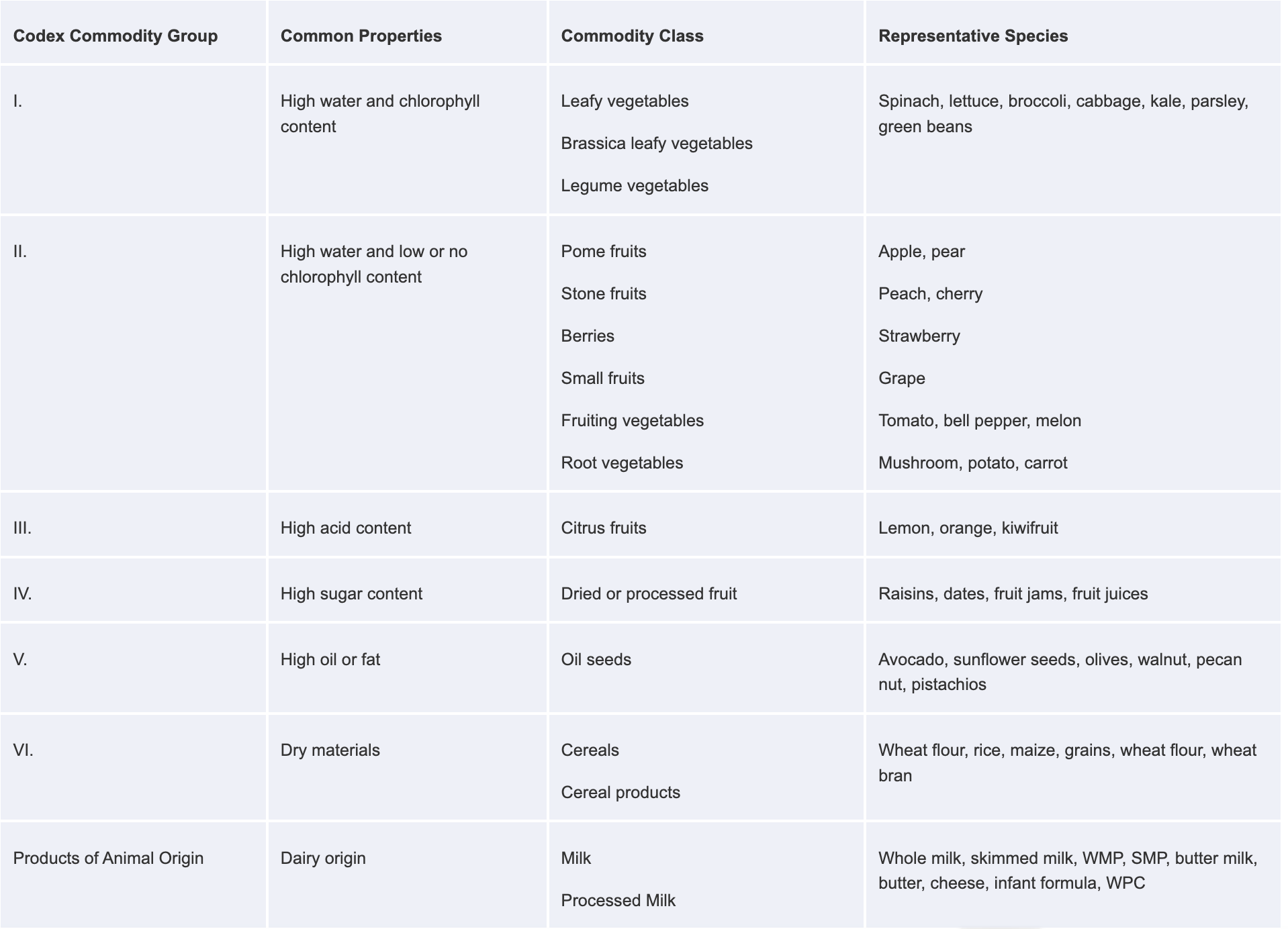
The analytical testing of food products is defined by international convention, published in a document called the Codex Alimentarius. This is published by the Food and Agriculture Organisation of the United Nations World Health Organisation. This 183-page document has been summarised in the table below which represents the food matrices that Eurofins Food and Feed Testing New Zealand is able to test.
Acid herbicides
In recent years the older style of volatile and non-polar residue compounds have been replaced by more polar, thermo-labile, less volatile, easily degradable compounds. Acid herbicides fall into this class and are found in wide use around the world because of their relative cheapness and effectiveness as broad-leaf weed killers in grain crops.
Acid herbicides readily dissolve in water due to their polarity having half-lives in soil and water, ranging from weeks to months depending on the prevailing environmental conditions such as pH and light intensity.
Testing for these compounds is a requirement under many resource consents, for drinking water compliance and for compliance with Ministry for Primary Industries export requirements.
The Eurofins network of Food & Feed Testing laboratories in New Zealand can test your samples in these matrices as well as soil and sludge.
Get in touch
Would you like to find out more about our testing solutions and compound lists, or do you need tailored analytical support? Contact us today to get in touch with our experts.
Find a site near you!
 Clear Filters
 Reset Filters