HACCP for HACCP team members
Build a strong HACCP team and develop a well-founded hazard analysis.

Our practical training courses help professionals work safely, efficiently and in accordance with legislation and regulations. Sessions are delivered by experienced trainers and combine theory with practical examples, exercises and plenty of opportunity to address your own questions.

Below you will find the full range of training courses, from basic to expert level.
Build a strong HACCP team and develop a well-founded hazard analysis.

A strong HACCP team is the foundation of a robust food safety system.
Yet in practice, conducting a HACCP study is not always straightforward. Discussions about hazards and CCPs, uncertainty about validation and verification, or a lack of clarity about everyone's role within the team can make the system less effective than intended.
In addition, HACCP analyses are being scrutinised more closely during audits. How do you ensure that your hazard analysis is properly substantiated, decisions are well documented and that the entire team is well equipped?
In our interactive HACCP team training, teams and team members learn not only the theory behind HACCP, but above all how to apply this theory effectively together in practice.
Practical information:
Learning objectives
You will learn how to:
Who is this training for?
For current and prospective HACCP team members.
Learning outcome
After completing this training, you will be able to analyse risks from the perspective of your area of expertise, make well-founded decisions and actively contribute to a robust HACCP study. This will enable you to fulfil your role within the HACCP team with greater expertise. In short, you will strengthen the quality of the HACCP study and your team will be better prepared for internal and external audits.
Trainer
Emelit Martens

Conduct audits objectively and report findings systematically to drive improvement.
Internal audits are required by various standards, but in practice, conducting them can be more challenging than expected. How do you remain objective when auditing colleagues? How do you ask the right questions without creating resistance? And how do you ensure that your audit report actually contributes to improvement rather than simply becoming a box-ticking exercise?
In this practical training course, you will learn how to conduct internal audits that genuinely add value. We go beyond theory: you will practice with realistic cases and learn observation and interview techniques, as well as how to systematically prepare, conduct and professionally report on audits.
Practical information:
Learning objectives
You will learn how to:
Who is this training for?
This training is intended for anyone who is part of an internal audit team. It is suitable for both new auditors and experienced auditors who want to deepen and refresh their knowledge.
Learning outcome
After completing this training, you will have the knowledge and skills required to conduct internal audits professionally, objectively and systematically. You will be formally qualified to conduct and report on an internal audit. In short, you will conduct internal audits that not only meet standard and certification requirements, but also deliver measurable improvements within your organisation.
Trainer
Emeli Martens

Prepare labels correctly and prevent errors during audits and inspections.
Food labelling legislation may seem straightforward, but in practice it often leads to discussions and questions. When is a claim permitted? How should you deal with compound ingredients? When is QUID mandatory? And how do you prevent a label from being rejected during an inspection or audit? Many professionals know the basics but encounter difficulties with complex cases, differences in interpretation or discussions with marketing teams and suppliers.
In this practical training course, you will learn interactively how to prepare and assess food labels in accordance with applicable legislation and regulations. We combine theory with practical exercises and an innovative game. Take this training and learn how to understand and independently resolve food labelling issues.
Practical information:
Learning objectives
You will learn how to:
Who is this training for?
This training is intended for anyone involved in preparing or checking food labels. It is suitable for both beginners who want to gain practical experience and professionals who already work with food labelling and want to deepen their knowledge through realistic cases and interactive exercises.
Learning outcome
After completing this training, you will be able to assess and prepare food labels correctly in accordance with applicable legislation and regulations. You will know exactly which declarations are mandatory, how to correctly declare ingredients, allergens, claims and nutritional information, and how to apply this knowledge directly when preparing labels within your organisation. You will have practiced with realistic cases, received feedback on your approach and applied your knowledge directly to practical situations. In short, you will prevent costly labelling errors and be a trusted source of expertise within your organisation on food labelling issues.
Trainer
Compliance Specialist

Learn how to develop and substantiate a Listeria study for audits.
Listeria is one of the most critical and challenging microbiological hazards in the food industry. While the legislation is clear, its practical application often raises questions. When is a modelling calculation sufficient? When is a challenge test necessary? How do you substantiate that your product remains below 100 CFU/g throughout its entire shelf life?
During audits, the substantiation of Listeria studies is being scrutinised more closely. An incomplete analysis or weak substantiation can lead to discussions, corrective actions or even health risks.
In this interactive training course, you will learn how to determine whether Listeria growth in your products is adequately controlled. The training has a strong focus on practical application and includes realistic scenarios and directly applicable insights. You will learn how to develop a Listeria study, including a modelling calculation and how to interpret the results of a challenge test.
Practical information:
Learning objectives
You will learn how to:
Who is this training for?
This training is intended for QA professionals, product developers and others who are involved in conducting a Listeria study or developing a Listeria control plan as part of their work.
Learning outcome
After completing this training, you will be able to independently conduct a well-substantiated Listeria study. You will know when a modelling calculation is sufficient, when additional studies are required and how to correctly interpret the results. You will also be able to formulate an effective Listeria control plan that aligns with your product and production environment. In short, you will be well prepared for audits, minimise Listeria risks and develop a robust, practical substantiation for your product(s).
Trainer
Jeff Nikkelen
Quickly find and interpret the relevant food laws and regulations for your daily practice.
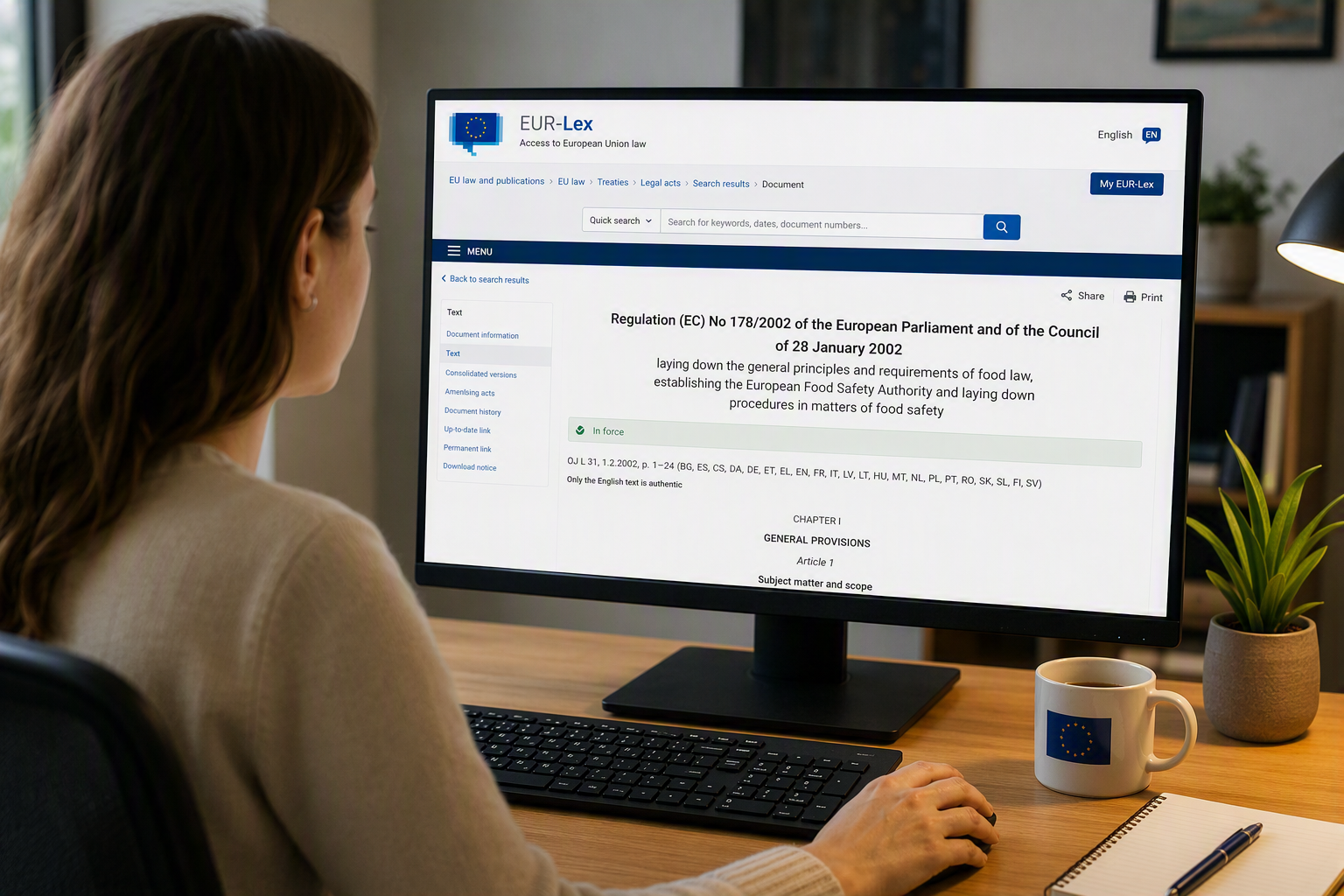
You receive a question about legislation and you know that the answer is somewhere in a regulation or NVWA handbook. But where do you start searching, which rules apply, and how do you know if you have found the right information? In this e-learning, you will become acquainted with the most important European and Dutch food legislation. You will learn how legislation is structured, where you can find relevant rules, and how to apply them in practice. Using realistic examples, you will practice finding the correct legislation via EUR-Lex and the NVWA handbook, enabling you to quickly locate the correct legal requirements in your daily work as well.
Practical details:
Learning objectives
You will learn to:
Who is this training intended for?
The training is intended for professionals in the food industry who regularly need to consult and apply legislation in their work. Consider employees within Quality Assurance, Regulatory Affairs, or Product Development (NPD). The training helps participants quickly find, interpret, and apply the correct regulations to practical issues.
Result / outcome
After this e-learning, you will understand how European and Dutch food legislation is structured and interrelated. You will be better equipped to look up relevant legislation, assess which rules apply to a practical situation, and independently retrieve the correct legal requirements and articles.

Prevent allergen risks and guarantee safe products from raw materials to final labelling.
An incorrectly declared allergen or accidental cross-contamination can have serious consequences for consumers with a food allergy. But managing allergens touches on many different processes: how do you ensure everything goes well from raw material to label?
In this e-learning, you will learn what allergens are, which laws and regulations apply, and how to manage allergen risks effectively. You will receive practical guidance on preventing cross-contamination, correctly declaring allergens, and securing allergen management within your organization.
Practical details:
Learning objectives
You will learn to:
Who is this training intended for?
This training is intended for QA staff and other quality professionals responsible for allergen management within a food company. The training helps you recognize, manage, and assure allergen risks and correctly apply current laws and regulations.
Result / outcome
After this e-learning, you will understand the risks of allergens for consumers and know how to manage allergens effectively within a food company. You will be better equipped to apply allergen legislation correctly, declare allergen information accurately, recognize cross-contamination risks, and take appropriate control measures within the quality management system.

Identify and report suspicious activities in the workplace to prevent product tampering and sabotage.
Food safety is not just about preventing unintended mistakes and contamination. Organizations must also take measures to protect products against intentional contamination, sabotage, or other malicious acts.
As a production worker, you play an important role in this. You are present on the work floor every day and can be the first to notice when something is not right. For example, what do you do if you see an unknown person in a place where they should not be, or if you notice an irregular situation?
In this e-learning, you will learn what food defense is, why it is important, and how you recognize and report suspicious situations. This way, you know what to watch out for and what is expected of you.
Practical details:
Learning objectives
You will learn to:
Who is this training intended for?
This training is for production workers, operators, packers, logistics staff, and other employees working in a production environment within the food industry.
Result / outcome
After this e-learning, you will understand your role within the organization's Food Defense program. You will be better equipped to recognize suspicious situations, recognize and signal risks, and respond in the right way.
Would you like a complete and up-to-date overview of all scheduled live training courses offered by Eurofins Academy? Click the link below for an at-a-glance overview of upcoming training courses and their locations.