Legal changes to honey, jams, fruit juices, and nectars
Upcoming implementation of Directive (EU) 2024/1438 into national law
Dec 2025. On 14 May 2024, Directive (EU) 2024/1438 of the European Parliament and of the Council was published. Among other things, this amended Directive 2001/113/EC on jams, jellies, jams, and chestnut creams, Directive 2001/112/EC on honey, and Directive 2001/113/EC on fruit juices in order to promote the reformulation of foods with high sugar content and facilitate the transition to a healthy and sustainable diet. It is also intended to contribute to better consumer information on honey. Products manufactured and labelled in accordance with the previous regulations before 14 June 2026 may continue to be marketed until stocks are exhausted.
We provide you with an overview of the most important changes for jams, honey, fruit juices, and nectars.
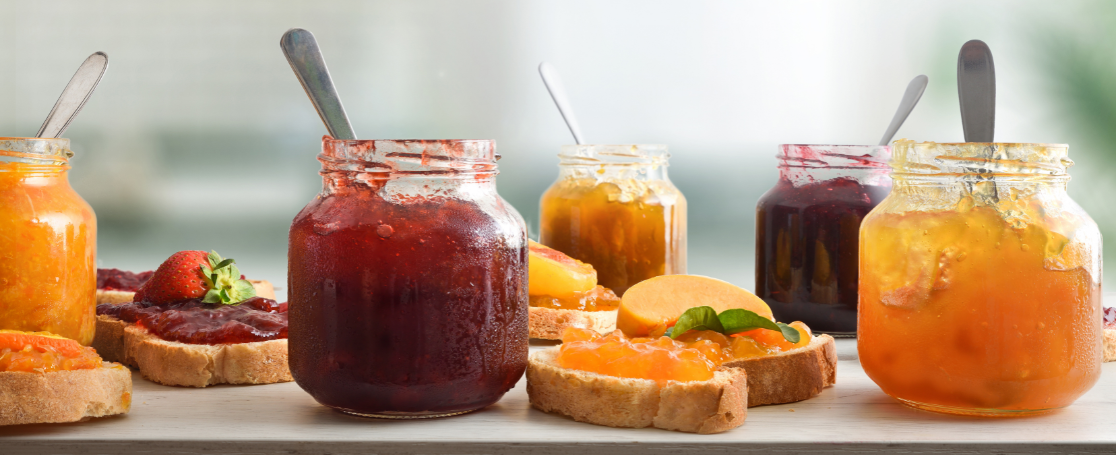
Jams – key changes to labelling and composition
Directive (EU) 2024/1438 amends Directive 2001/113/EC on jams, jellies, jams, and chestnut creams. It is amended to allow EU Member States, in which the term “marmalade” is used as a synonym for ‘jam’ to permit the use of the term “marmalade” for jams made from fruit other than citrus fruit within their territory. The term “citrus marmalade” replaces the current term “marmalade.”
Annex I defines the individual products and specifies the minimum quantities of fruit to be used in the production of one kilogram of finished product. Directive (EU) 2024/1438 amending the Jam Regulation introduces the following changes to the minimum fruit content:
- Jams: the minimum fruit content is increased from 350g/kg to 450g/kg
- Extra jam: the minimum fruit content is increased from 450g/kg to 500g/kg
Annex II contains a list of authorised additives, such as honey, sugar, fruit juice, and spirits. Directive (EU) 2024/1438 introduces several changes to this annex regarding the use of fruit juices, essential oils, and food additives authorised under Regulation (EC) No. 1333/2008.
Honey – key changes to labelling
In accordance with the Honey Regulation, the country of origin where the honey was produced must be indicated on the label. Directive (EU) 2024/1438 introduces the following changes to the labelling of honey:
- It is now stipulated that honey originating from several countries must list these countries in descending order of weight in the main field of vision on the label, together with the respective percentage.
- For packages containing less than 30 g of honey, the names of the countries of origin may be indicated by a two-letter country code instead of the country name.
- For honey blends, a tolerance range of five percent applies to the indication of the countries of origin.
Fruit juices and nectars – overview of the most important changes
The entry into force of the directive also brings about changes to Annex 1 of the Fruit Juice and Soft Drinks Regulation. This section defines or revises the definitions of the following foods:
- No. 5: Fruit nectar (changes in italics)
Fruit nectar is the fermentable but unfermented product obtained by adding water, with or without added sugars or honey, to the products referred to in Nos. 1 to 4, to fruit pulp, concentrated fruit pulp, or to a mixture of these products, and which also complies with Annex 5. The addition of sugars or honey is permitted up to 20 percent of the total weight of the finished product from fruits listed in Annex 5, Part I, up to 15 percent of the total weight of the finished product from fruits listed in Annex 5, Part II, and up to 10 percent of the total weight of the finished product from fruits listed in Annex 5, Part III. [...] - No. 6a: Fruit juice with reduced sugar content (NEW)
A product obtained from the fruit juice defined in No. 1(a), in which the naturally occurring sugar content has been reduced by at least 30 % using a process approved under the conditions set out in Annex 4, Part A, No. 3, and in which all other essential physical, chemical, organoleptic, and nutritional characteristics of an average juice of the fruit from which it was produced are retained. Water may be added to the extent necessary to restore the amount of water removed by the sugar reduction process. [...] - No. 6b: Reduced-sugar fruit juice made from fruit juice concentrate (NEW)
A product obtained from fruit juice from fruit juice concentrate, as defined in point 1(b), in which the naturally occurring sugar content has been reduced by at least 30 % using a process authorised under the conditions set out in Annex 4, Part A, point 3, and in which all other essential physical, chemical, organoleptic, and nutritional characteristics of an average juice from the same fruit are retained, or which is reconstituted from concentrated reduced-sugar fruit juice within the meaning of number 7 with drinking water that meets the requirements set out in the Drinking Water Ordinance, as published on 20 June 2023 (Federal Law Gazette 2023 I No. 159), as amended. Sugar-reduced fruit juice from fruit juice concentrate may be obtained by mixing sugar-reduced fruit juice from fruit juice concentrate with one or more of the following products: fruit juice, fruit juice from fruit juice concentrate, reduced-sugar fruit juice, concentrated fruit pulp, or fruit pulp. Water may be added to the extent necessary to restore the amount of water removed by the sugar reduction process. [...] - No. 7: Concentrated reduced-sugar fruit juice (NEW)
A product obtained from concentrated fruit juice or fruit juice concentrate, as defined in point 2, where at least 30 % of the naturally occurring sugar content has been reduced by a process authorised under the conditions set out in Annex 4, Part A, point 3, while retaining all other physical, chemical, organoleptic, and nutritional characteristics of an average type of the product, or a product obtained from reduced-sugar fruit juice, as defined in point 6(a), by physically removing a certain proportion of the naturally occurring water. If the product is intended for direct consumption, at least 50 percent of the naturally occurring water must be removed. [...]
In addition, the fruit “coconut” and the product “coconut water” are included in the relevant annexes to the regulation.
Get in touch
Would you like to find out more about our testing solutions, or do you need tailored analytical support? Contact us today to get in touch with our experts.
Written by:
Dr. Christiane Wolf
Eurofins Laborservices GmbH