Analysis of THC, CBD and other cannabinoids in food
New EU maximum levels for THC in hemp leaves and hemp infusions adopted
Sep. 2026 (Update). The European Union has established new maximum levels for Δ9-tetrahydrocannabinol (Δ9-THC) in hemp leaves and hemp infusions through Regulation (EU) 2026/1828 [6]. Published on 29 July 2026, the Regulation supplements the existing THC maximum levels set out in the Contaminants Regulation (EU) 2023/915 [1] for hemp seeds and products derived from them. Both Δ9-THC and Δ9-tetrahydrocannabinolic acid (Δ9-THCA) are taken into account and expressed as Δ9-THC equivalents.
New maximum levels from 1 January 2027
- Hemp leaves intended for water-based infusions (tea preparation): 40 mg/kg
- Ready-to-drink hemp leaf infusions, including herbal teas containing hemp leaves: 0.02 mg/kg
Additional labelling requirements
For hemp leaves intended for the preparation of infusions, the following mandatory consumer statements will also be introduced:
- Use only for preparing water-based infusions.
- Not suitable for infants and young children.
- No fatty ingredients (e.g. milk or cream) may be added during preparation.
The Regulation entered into force on 18 August 2026 and will apply from 1 January 2027. Transitional provisions are in place for products that were lawfully placed on the market before this date, allowing them to remain on the market until stocks are exhausted.
One of the key drivers behind these new requirements is the scientific re-evaluation of cannabinoids by the European Food Safety Authority (EFSA). On 18 November 2025, EFSA published its assessment of Δ8-tetrahydrocannabinol (Δ8-THC) and its occurrence in food. Δ8-THC is an isomer of Δ9-THC and exhibits comparable mechanisms of action as well as similar toxicological properties. Consequently, a common acute reference dose (ARfD) of 1 µg/kg body weight was established for the combined sum of Δ8-THC and Δ9-THC.
In addition, EFSA recommended updating the risk assessment for Δ9-THC, conducting further investigations into the transfer of Δ8-THC into foods of animal origin, and carrying out studies on the potential formation of Δ8-THC during food processing and storage. The newly adopted THC maximum levels for hemp leaves and hemp infusions represent another important step towards the harmonisation of food legislation and the strengthening of consumer protection within the European Union.
Regulatory classification of foodstuffs containing hemp
In March 2024, the German Bundestag passed the Cannabis Act (CanG)[2], which came into force in April 2024. With this law, the narcotic status for cannabis is no longer applicable in Germany and a distinction is only made between industrial hemp (THC content <0.3 %), consumer cannabis and medicinal cannabis. Section 1 of the CanG also explains what is defined as cannabis. Synthetic THC continues to fall under the Narcotic Drugs Act (BtMG)[3].
The CanG has no influence on the legal classification of foods containing hemp. With the exception of hemp seeds, hemp flour and hemp seed oil and products that contain them as an ingredient, hemp and CBD products are currently still classified as novel foods (Regulation (EU) 2015/2283)[4] and cannot be marketed without the corresponding authorisation.
Hemp as a crop plant
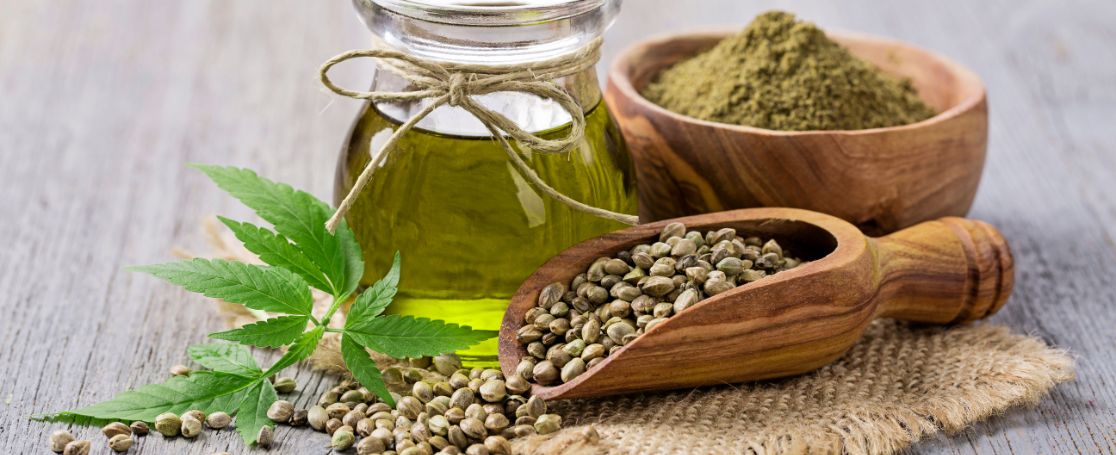
Hemp (Cannabis sativa) is one of the oldest cultivated plants. Due to the presence of the so-called cannabinoids, its preparations have been used since ancient times as medicines and narcotics. Industrially, however, its fibres are also used for the production of textiles. The seeds of the hemp plant are practically free of cannabinoids and are used to produce edible oils and protein powders for food production. The leaves and flowers of the hemp plant, on the other hand, contain over 100 different cannabinoids as secondary phytometabolites. Of the psychoactive cannabinoids, Δ9-tetrahydrocannabinol (Δ9-THC) is the most important component. Other cannabinoids such as cannabidiol (CBD) are said to have health-promoting effects.
Analysis of THC, CBD and other cannabinoids
Our experts from the Competence Centre for organic contaminants within the global Eurofins laboratory network already have many years of experience in LC-MS/MS analysis of organic compounds at trace levels. For the analysis of cannabinoids in food, state-of-the-art chromatographic separation techniques in combination with the latest and most sensitive mass spectrometers are available (LC-ESI-MS/MS). The use of internal standards represents the status quo in terms of precision and accuracy of the analytical results obtained. The daily measurement of calibration standards and food reference materials for critical control of the analysis are additional quality standards that increase the safety of the analysis.
In addition to the analysis of Δ9-THC, Δ9-THC acid and its sum as well as the analysis of CBD, our offer additionally includes the analysis of a wide range of other cannabinoids:
- Δ9-Tetrahydrocannabinol (Δ9-THC)
- Δ9-Tetrahydrocannabinolic acid (Δ9-THCA)
- Δ8-Tetrahydrocannabinol (Δ8-THC)
- Sum Δ9-Tetrahydrocannabinol
- Cannabidiol (CBD)
- Cannabichromene (CBC)
- Cannabidiolic acid (CBDA)
- Cannabidivarin (CBDV)
- Cannabidivarinic acid (CBDVA)
- Cannabigerol (CBG)
- Cannabigerolic acid (CBG-A)
- Cannabinol (CBN)
- Tetrahydrocannabivarin (THCV)
Eurofins currently offers analyses for hemp-containing foodstuffs. The analysis of consumer cannabis according to the German Cannabis Act is also part of our portfolio.
Get in touch
Would you like to find out more about our testing solutions, or do you need tailored analytical support? Contact us today to get in touch with our experts.
Relevant Regulations and Acts
[1] Commission Regulation (EU) 2023/915 (Contaminants-Regulation)
[2] Bundesgesetzblatt Teil I - Gesetz zum kontrollierten Umgang mit Cannabis und zur Änderung weiterer Vorschriften - Bundesgesetzblatt (in German)
[3] "§ 1 Betäubungsmittel" des Gesetzes über den Verkehr mit Betäubungsmitteln (Betäubungsmittelgesetz - BtMG) (in German);
Anlage I (zu § 1 Abs. 1) (nicht verkehrsfähige Betäubungsmittel) zum Gesetz über den Verkehr mit Betäubungsmitteln (Betäubungsmittelgesetz - BtMG) (in German)
[4] Regulation (EU) 2015/2283 of the European Parliament and of the Council of 25 November 2015 on novel foods
[5] Derivation of a health‐based guidance value for Δ8‐tetrahydrocannabinol (Δ8‐THC) and its occurrence in food - 2025 - EFSA Journal - Wiley Online Library
Written by:
Sindy Böhme
Eurofins WEJ Contaminants GmbH