The Nutri-Score
All important facts and novelties at a glance
March 2026 (update). The Nutri-Score is an additional and simplified presentation of nutritional information on the front of food packaging and is intended to make it easier for consumers to choose healthy foods. The Nutri-Score was officially introduced in September 2020 with the addition of Article § 4a to the German Food Information Implementing Regulation (Lebensmittelinformations-Durchführungsverordnung). Foods labelled with the Nutri-Score may be marketed in Germany since autumn 2020.
In summer 2021, the Nutri-Score Steering Committee initiated consultations on the changes to the Nutri-Score, which were finalised and published in 2023. Accordingly, the Nutri-Score algorithm was adapted to implement the latest scientific findings and more clearly distinguish healthy foods from unhealthier foods.
Below we have summarised information for you on the declaration and calculation of the Nutri-Score, the special regulations and exceptions in the Nutri-Score calculation as well as changes and innovations on this topic.
Themenübersicht
- Official launch in 2020
- Nutri-Score update 2023: what were the goals of thr updatet?
- The 10 most important facts about using the Nutri-Score
- For which foods is the Nutri-Score applicable?
- How do I calculate the Nutri-Score?
- How is the Nutri-Score calculated after the algorithm update?
- All food categories in detail
- Evaluation scheme for the foof categories
Official launch in 2020
On behalf of the Federal Ministry of Food and Agriculture (BMEL), INFO GmbH conducted representative consumer research from July to September 2019. The majority of respondents chose the Nutri-Score as their preferred model out of four possible models, as it was perceived as the most helpful and easiest to understand. The extended nutritional labelling is intended to provide consumers with additional benefits and make healthy eating easier.
The notification for the use of the Nutri-Score label has been completed since September 2020. According to the Food Information Implementation Ordinance, foodstuffs may be placed on the market with the Nutri-Score logo in accordance with Section 4a since autumn 2020.
Nutri-Score-Update 2023: what were the goals of the update?
- Improving the categorisation of fatty fish
- Improving the distinction between
- high-fibre wholemeal bread and white bread
- vegetable oils
- products due to their sugar content (especially those with a high sugar content)
- products due to their salt content
- red meat compared to poultry
- beverages with regard to their sugar content
- Improved differentiation of milk in terms of saturated fatty acids and calorific value and of milk-based drinks in terms of sugar
- Consideration of the use of sweeteners in beverages. Their classification is harmonised so as not to encourage consumption through the Nutri-Score
The 10 most important facts of the Nutri-Score
- The labelling system was developed by independent scientists and has been in use in France since 2017.
- The trade mark owner is the national public health agency of the French Ministry of Health, Santé publique France. The trademark statutes contain conditions of use of the Nutri-Score logo as well as further information and current original documents in English and French.
- Registration is required before using the Nutri-Score. This is done as follows:
• for marketing in France only:
https://www.demarches-simplifiees.fr/commencer/nutri-score_enregistrement_france
• for international marketing:
https://www.demarches-simplifiees.fr/commencer/ns_international_registration_procedure - There are no user fees.
- The Nutri-Score is a voluntary labelling.
- Cherry picking is not permitted. As soon as the Nutri-Score is introduced, there is an obligation to use it for all categories of products sold under the brand(s) registered for the Nutri-Score.
- The Nutri-Score logo may be used online or in product catalogues after registration. The logo must then be applied to the product packaging within 24 months (36 months for over 2000 products).
- Je nach Produkt werden für die Nutri-Score-Ermittlung unterschiedliche Berechnungsformeln und -tabellen herangezogen. (Siehe: How is the Nutri-Score calculated after the algorithm update?)
- The Nutri-Score is currently not used throughout the EU. So far, France, Belgium, Germany, Luxembourg, the Netherlands, Spain and Switzerland have agreed to use the Nutri-Score. Accordingly, legal certainty does not exist in all EU countries (keyword: multilingual labelling).
- Be careful when using online databases, such as Open Food Facts: In general, databases for determining nutritional values are permitted. However, it is not yet clear how valid these data can be used. The fibre content of wheat flour according to the Souci-Fachmann-Kraut database, for example, is 4.2% (modified AOAC method for determining fibre) and 3.5% according to the German Federal Food Code (§ 64 method). Ultimately, we recommend a nutritional value analysis in case of compound foodstuffs in order to obtain valid values for the Nutri-Score calculation.
For which foods is the Nutri-Score applicable?
- Applicable for:
- foods with nutrition labelling that are not excluded below
- Not applicable for:
- foods without nutritional labelling (e.g. fruit, vegetables, salt, flavourings, additives, table sweeteners, herbs, spices, ...)
- baby food (for babies and toddlers from 0 to 3 years)
- sports nutrition
- food for special medical purposes
- food and dietary supplements
- replacement meals for weight control and daily rations for weight control nutrition
- meal replacement products that are not aimed at weight control
How do I calculate the Nutri-Score?
- Classification of the food in the correct food category
All foods must be categorised as 'General foods', 'Red meat', 'Cheese', 'Fats/oils/nuts/seeds' or 'Drinks (including milk and plant drinks)'. - Calculation of the Nutri-Score based on the declared nutritional values and ingredients and the applicable algorithm.
How is the Nutri-Score calculated after the algorithm update?
General calculation rules for the Nutri-Score 2023
- The Nutri-Score is calculated on the basis of the nutritional values per 100 g or 100 ml, taking into account the declared decimal places.
It is recommended to follow the rounding rules according to the "Guidance Document for Competent Authorities for the Control of Compliance with EU legislation with regard to the setting of tolerances for nutrient values declared on a label". - Dietary fibre content
According to the LMIV, the fibre content is not mandatory in the nutritional value table, but is required for the calculation of the Nutri-Score. All methods listed in the European Commission's "Guidance Document [...] with regard to methods of analysis for determination of the fibre content declared on a label" (2012) may be used to analyse the fibre content. These are mainly the common AOAC methods. - For liquid foods (e.g. soups, oils) - calculation per 100 g or per 100 ml?
The Nutri-Score is calculated using the numbers and units given in the nutritional table; if the nutritional values are given per 100 g and per 100 ml, the data per 100 g is used. - Nutri-Score calculation after preparation?
The declared nutritional values are always used to calculate the Nutri-Score. If these are stated by preparation and a detailed preparation is declared, it is recommended that the Nutri-Score is also stated by preparation (e.g. instant soup powder). In addition, it is recommended to indicate that the Nutri-Score refers to the prepared product. - Products with deep-frying as the recommended preparation method
The following information should be indicated on the packaging: "The deep-frying process reduces the Nutri-Score by one or two levels (letters)."
Favourable and unfavourable nutritional components compared
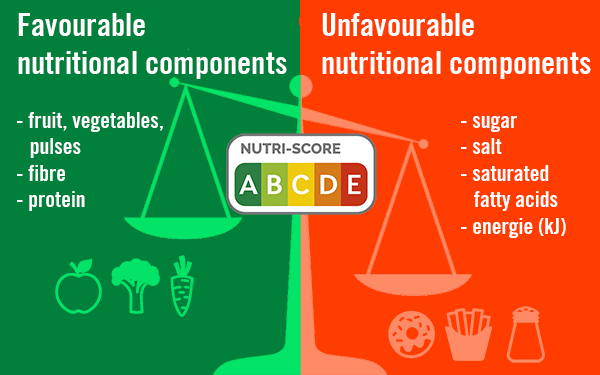 Nutritionally "unfavourable" nutritional values N are offset against "favourable" nutritional values P (Nutri-Score = N – P). The resulting score gives the food's Nutri-Score according to the evaluation scheme.
The unfavourable components (N) include the sugar content, the calorific value (in kJ), the saturated fatty acids and the salt content (and certain sweeteners in drinks).
The favourable components (P) include fruit, vegetables, pulses, fibre and protein. In addition to the calculation table for the old algorithm, the current calculation table for the new algorithm is available for download in English on the Santé Republique France website.
Get in touch
Would you like to find out more about our testing solutions, or do you need tailored analytical support? Contact us today to get in touch with our experts.
Written by:
Susanne Conrad
Eurofins Food & Feed Testing Leipzig GmbH
Important documents and links
… can be found on the website of Santé Publique France:
- Conditions for the use of the Nutri-Score logo
- Graphic Charter (specifications for the way the Nutri-Score is applied)
- FAQ
- Nutri-Score calculation table in the version for the original algorithm and the version for the new algorithm (update 2023).