In the food industry, rapid and reliable detection of STEC (Shiga toxin-producing E. coli) is increasingly critical for food safety testing programs. Traditionally, confirming a positive E. coli result requires growing bacteria in a lab culture. While considered the gold standard, this process takes multiple days. For perishable items like meat and fresh produce, these delays disrupt supply chains, slow down time-to-market, and cost companies money.
This study evaluated two advanced molecular testing workflows to see if they could replace or speed up traditional culture testing:
- PEC (Screening): A rapid molecular tool used right after an initial positive screen to quickly rule out negative samples.
- ddPCR (Droplet Digital PCR): A cutting-edge technology that splits a sample into thousands of microscopic droplets to look for specific E. coli safety-risk genes right inside individual bacteria cells.
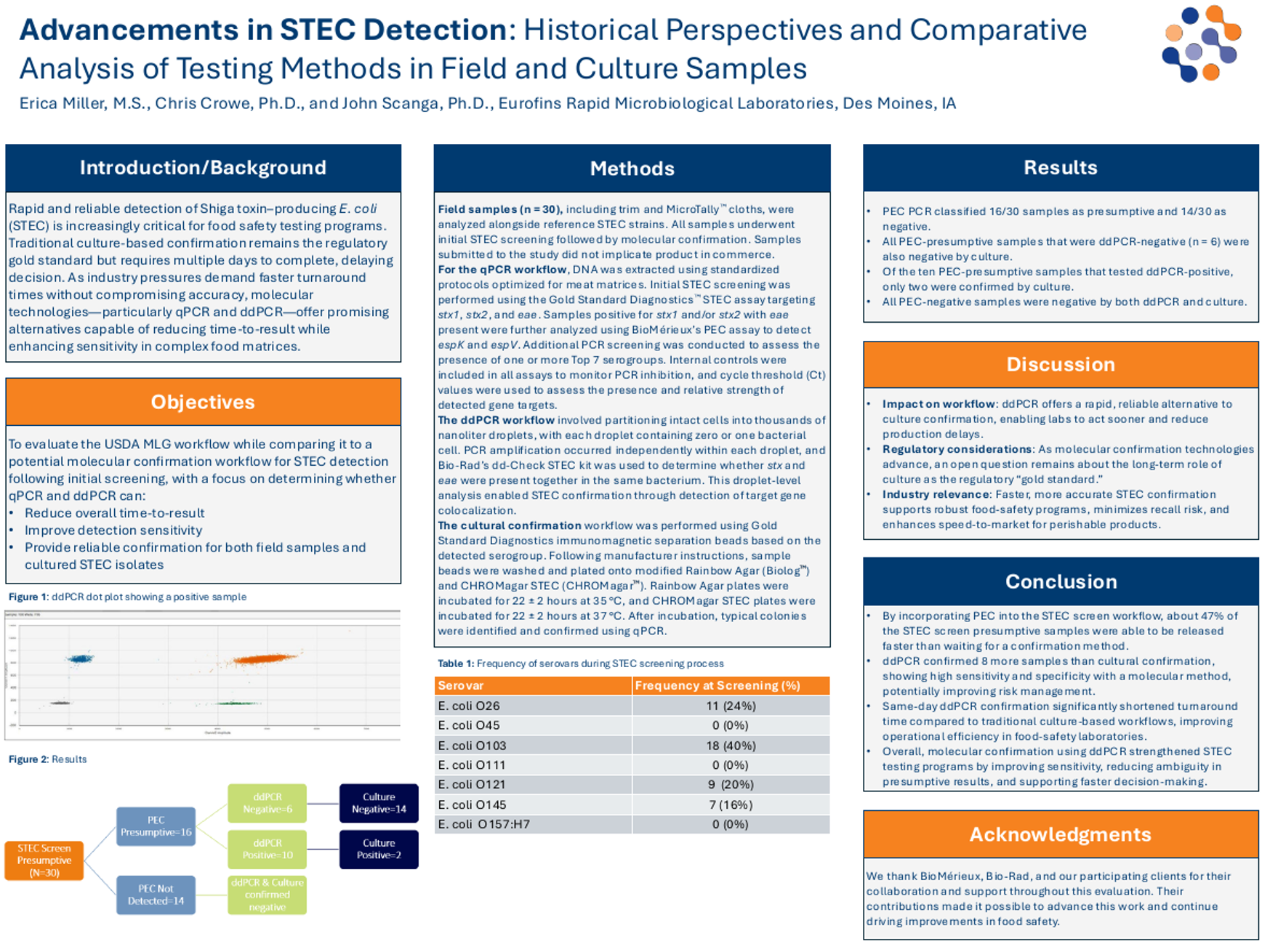
Researchers tested 30 real-world food and field samples that initially flagged as "presumptive positive" for STEC.
- Instant cleared samples: The PEC test instantly cleared 14 out of the 30 samples (nearly 47%) as completely negative, allowing those products to be released immediately rather than waiting days for a final answer.
- Catching hidden risks: Out of the remaining samples, traditional culture testing only managed to confirm 2 positives. However, the highly sensitive ddPCR technology successfully detected 10 positives.
The implications of this study are a win-win for both food producers and consumers showing that laboratories can provide definitive answers in a single day, eliminating production bottlenecks, catch hidden pathogens that old methods miss vastly reduces the risk of dangerous, costly product recalls and providing a competitive edge as faster testing means fresher products reach grocery store shelves quicker, maximizing shelf life and reducing waste.
As technology continues to advance, the food safety industry is moving closer to a future where we don't have to choose between absolute safety and maximum speed.
For an in-depth look at this research, see the abstract and poster presented at BIFSCo below.
BIFSCO abstract
Advancements in STEC Detection: Historical Perspectives and Comparative Analysis of Testing Methods in Field and Culture Samples
Authors: Erica Miller, Chris Crowe, and John Scanga* of Eurofins Rapid Microbiological Laboratories, Des Moines, IA
The demand for rapid, reliable pathogen detection in food safety testing continues to grow as markets prioritize speed without compromising accuracy. Traditional culture-based methods remain the gold standard but require extended timelines, creating a need for innovative molecular technologies that enable faster confirmation while maintaining regulatory compliance. The objective of this study is to evaluate molecular confirmation methods for Shiga toxin–producing Escherichia coli (STEC) following initial screening, focusing on approaches that reduce time-to-result and improve sensitivity compared to conventional workflows. Field samples (fresh produce and raw meat) and reference STEC strains were analyzed using two molecular platforms: real-time PCR (qPCR) and droplet digital PCR (ddPCR). For both qPCR methods, DNA was extracted following standardized protocols optimized for complex food matrices. qPCR analysis was conducted using STEC-specific primers targeting the stx1, stx2, and eae genes. Additionally, a second qPCR assay employed primers for espK and espV as markers for STEC detection. Strength of target DNA presence was based on cycle threshold (Ct) values, with internal controls included to monitor for potential inhibition. ddPCR analysis of linked virulence targets was conducted by partitioning intact cells into droplets in which cell lysis and PCR amplification occur. This method allows for absolute quantification of target genes without reliance on standard curves, resulting in enhanced tolerance to inhibitors. PEC PCR results showed strong correlation with ddPCR results, even though not all samples could be cleared by PEC PCR alone. ddPCR served as a reliable confirmatory tool, providing high confidence in the final outcome due to its enhanced resolution. Additionally, ddPCR enables same-day confirmation, significantly reducing turnaround time compared to the multiple days required for cultural confirmation. Molecular confirmation methods such as PEC and ddPCR significantly shorten time-to-result while improving sensitivity for STEC detection. These approaches enhance laboratory efficiency and support rapid decision-making in food safety programs. For food producers operating in fast-paced markets, this rapid confirmation capability minimizes production delays, supports quicker product release, and reduces the risk of costly recalls—helping maintain both compliance and competitive speed-to-market.
Download the scientific poster
Click below to download the Advancements in STEC Detection: Historical Perspectives and Comparative Analysis of Testing Methods in Field and Culture Samples poster.