Focus on animal feed: mycotoxins, plant toxins, and latest developments
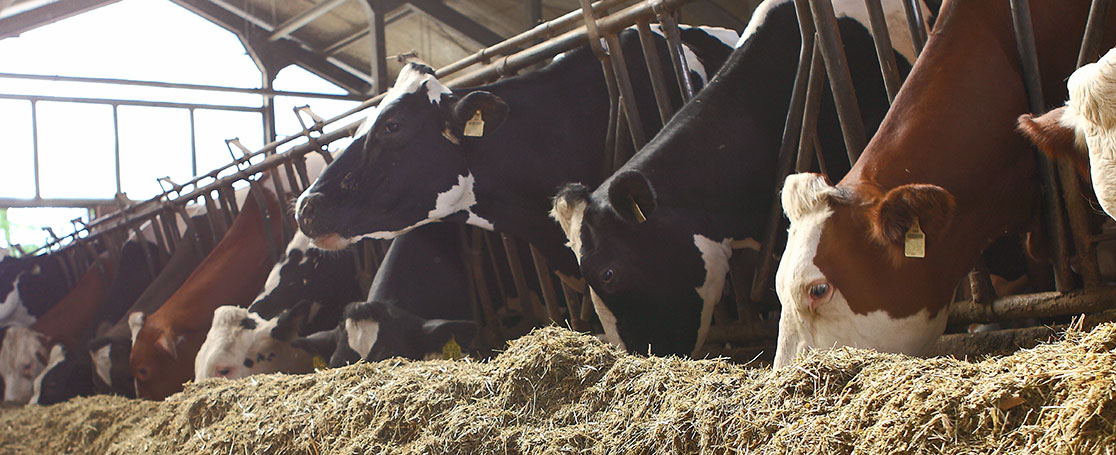
The EU recommends monitoring alkaloids and publishes new guideline values for mycotoxins
Aug 2026. Since June 2026, the EU has recommended monitoring ergot and pyrrolizidine alkaloids in selected animal feeds to expand the data basis for upcoming risk assessments. At the same time, partially stricter guideline values for Fusarium toxins and ochratoxin A in animal feed were published in July 2026.
This article provides an overview of which animal feed products require specific action in terms of current developments and what requirements must be fulfilled for reliable quantification.
June 2026: new recommendations for monitoring alkaloids
The recommendations for the monitoring of alkaloids are intended to collect data on analytical results to better assess the risks posed by these substances. This data must be submitted to EFSA by 30 June 2028, at the latest, so that appropriate measures can be taken to protect humans and animals.
Ergot alkaloids in feed (Commission Recommendation (EU) 2026/1243)
Ergot alkaloids are primarily found in mother grains. Mother grains are dark, grain-like structures consisting of a fungus (e.g., Claviceps purpurea, Claviceps africana, and Claviceps fusiformis) and grow in the ears of grain. The metabolic products of these fungi are alkaloids derived from tryptophan. Increased intake of ergot alkaloids can lead to mycotoxicosis, which can cause circulatory disorders and even result in the loss of limbs.
Maximum levels for ergot alkaloids in food are already regulated by Commission Regulation (EU) 2023/915. Additional data will now be collected, as concerns were raised in November 2023 regarding animal welfare, particularly that of pigs and cattle.
The following analytes should be considered:
- ergocristine/ergocristinine
- ergotamine/ergotaminine
- ergocryptine/ergocryptinine (α- and β-isomers)
- ergometrine/ergometrinine
- ergosine/ergosinine
- ergocornine/ergocorninine
It is also recommended to analyse ergovaline/ergovalinine, agroclavine, dihydro-ergosine and lolitrem B.
If feasible, the sclerotia content in the sample should also be determined to build a better understanding of the relationship between sclerotia and ergot content.
The matrices to be tested are listed as follows:
- cereals and products derived thereof
- grasses and products derived thereof, including forage
- compound feed
The Commission Recommendation (EU) 2026/1243 replaces Recommendation 2012/154/EU, which already addressed the relevance of animal feed.
Pyrrolizidine alkaloids in feed commission (Recommendation (EU) 2026/1210)
Pyrrolizidine alkaloids (PA) occur naturally in a wide variety of plants and serve, amongst other functions, as a defense mechanism against predators. If these plants are consumed, they can cause acute liver damage. Maximum levels for pyrrolizidine alkaloids in food are already regulated by Commission Regulation (EU) 2023/915.
The focus of Recommendation (EU) 2026/1210 is on collecting data on animal feed for the purpose of further protecting farm animals and pets. The main risk arises from the consumption of PA-producing Senecioneae and Boraginaceae spp., which might be co-harvested accidentally and thus contaminate the feed. Horses and rabbits are described as being particularly at risk, as they may consume relatively large amounts of alfalfa.
Not only alfalfa is in the focus, but also the following:
- grass silage
- hay
- (dried) forage and roughage, such as alfalfa (lucerne) and sainfoin
- herbs, herbal mixtures and plant extracts that consist of, are produced from, or can be contaminated with plants (or their parts) known to contain pyrrolizidine alkaloids
- compound feed containing herbs, herbal mixtures and plant extracts
The matrices should be analysed for the following 27 PAs:
- intermedine/lycopsamine, intermedine-N-oxide/lycopsamine-N-oxide
- senecionine/senecivernine, senecionine-N-oxide/senecivernine-N-oxide
- seneciphylline, seneciphylline-N-oxide
- retrorsine, retrorsine-N-oxide
- echimidine, echimidine-N-oxide
- lasiocarpine, lasiocarpine-N-oxide
- europine, europine-N-oxide
- senkirkine
- heliotrine and heliotrine-N-oxide
- jacobine, jacobine-N-oxide
- jaconine, jaconine-N-oxide
- erucifoline and erucifoline-N-oxide
Additionally, it is recommended to analyse 14 more substances. It is known that there are challenges with coelution of the named substances above.
- indicine, indicine-N-oxide
- echinatine, echinatine-N-oxide
- rinderine, rinderine-N-oxide
- integerrimine, integerrimine-N-oxide
- heliosupine, heliosupine-N-oxide
- spartioidine, spartioidine-N-oxide
- usaramine, usaramine N-oxide
Requirements for alkaloid analyses
The recommended analytical method for the analysis of alkaloids is liquid chromatography coupled with tandem mass spectrometry (LC-MS/MS). Other methods may also be used, if it can be proven that the results are reliable.
The following table summarises the required limits of quantification:
| Ergot alkaloids | each alkaloid 5 µg/kg |
| Pyrrolizidine alkaloids | each alkaloid 10 µg/kg |
New guidance values for deoxynivalenol, zearalenone, ochratoxin A, T-2 and HT-2 toxins and fumonisins in feed (Commission recommendation (EU) 2026/1801)
In July 2026, Recommendation (EU) 2026/1801 was published, containing guideline values for the monitoring of deoxynivalenol (DON), zearalenone (ZON), HT-2 and T-2 toxins, ochratoxin A, and fumonisin B1 and B2 in animal feed. The mycotoxins listed pose a risk to animal health and may also have an impact on human health if they are transferred into food. The new guideline values are to be considered from 1 July 2027. Exceptions to this apply to the feed materials maize, sorghum, soybeans and sunflower, and products derived from them. In these cases, the guideline values will apply from 1 October 2026. From 1 July 2027, commission recommendation 2006/576/EC and 2013/165/EU will be replaced. A particularly significant change to the guideline value is described for fumonisins in poultry feed. Here, the guideline value is reduced by a factor of 10 and will then correspond to the limit value for fumonisins in maize meal intended for final human consumption.
The following table summarises the most significant changes compared to 1: 2006/576 EC and 2: 2013/165 EU.
Further guidance can be found directly in the recommendation.
| Analyt | Feedstuff with a moisture content of 12% |
Exsiting guidance value |
Recommended guidance value |
| Deoxynivalenol | Feed materials: cereals and products derived thereof with the exception of maize and maize products |
8 mg/kg1 | 4 mg/kg |
| Deoxynivalenol | Feed materials: maize and maize products |
12 mg/kg1 | 8 mg/kg |
| Deoxynivalenol | Complete feed for porcine species |
0.9 mg/kg1 | 0.7 mg/kg |
| T-2 and HT-2 toxin | Feed materials: oat milling products (including husk), including oat pulp |
2 mg/kg2 | 3.0 mg/kg |
| T-2 and HT-2 toxin | Complete feed with the exception of special animal species |
0.25 mg/kg2 | 0.2 mg/kg |
| Zearalenon | Feed materials: cereals and products derived thereof (2) with the exception of maize and maize products |
2 mg/kg1 | 1 mg/kg |
| Zearalenon | Feed materials: maize and maize products |
3 mg/kg1 | 2 mg/kg |
| Fumonisin B1+ B2 | Feed materials: maize products |
60 mg/kg1 | 40 mg/kg |
| Fumonisin B1+ B2 | Complete feed for adult ruminants and fur animals |
50 mg/kg1 | 30 mg/kg |
| Fumonisin B1+ B2 | complete feed for calves (< 4 months), lambs and kids |
20 mg/kg1 | 10 mg/kg |
| Fumonisin B1+ B2 | complete feed for poultry except turkeys and ducks |
20 mg/kg1 | 2 mg/kg |
| Fumonisin B1+ B2 | complete feed for equines |
5 mg/kg1 | 1 mg/kg |
| Fumonisin B1+ B2 | complete feed for leporids |
5 mg/kg1 | 1 mg/kg |
| Fumonisin B1+ B2 | complete feed for porcine species |
5 mg/kg1 | 1 mg/kg |
| Ochratoxin A | Feed materials: Cereals and products derived thereof |
0.25 mg/kg1 | 0.05 mg/kg |
| Ochratoxin A | Complete feed for porcine species |
0.05 mg/kg1 | 0.01 mg/kg |
| Ochratoxin A | Complete feed for poultry | 0.1 mg/kg1 | 0.03 mg/kg |
As competence centre for mycotoxins and biotoxins, Eurofins WEJ Contaminants GmbH covers the analyses of ergot- and pyrrolizidine alklaoids, fusariumtoxins and ochratoxin A. We are happy to find the best solutions for your feed safety.
Get in touch
Would you like to find out more about our testing solutions, or do you need tailored analytical support? Contact us today to get in touch with our experts.
Written by:
Mareike Rathke
Eurofins WEJ Contaminants GmbH