










































Eurofins Softlines & Leather Monthly Bulletin (January 2026)


New update to Candidate List of substances of very high concern (SVHCs)
On 4 February 2026, the ECHA (European Chemicals Agency) released the new Candidate List of SVHCs with the addition of two new substances. The current list of SVHCs now contains 253 substances.
See below a table indicating the latest substance addition:
|
No. |
Substance name |
EC number |
CAS number |
Reason for inclusion |
Examples of use(s) |
|
1 |
n-hexane |
203-777-6 |
110-54-3 |
Specific target organ toxicity after repeated exposure |
Formulation, polymer processing, coatings and cleaning agent |
|
2 |
4,4'-[2,2,2-trifluoro-1-(trifluoromethyl)ethylidene]diphenol and its salts |
- |
- |
Toxic for reproduction (Article 57c) |
Process regulator and cross-linking agent |
Legal obligations for companies using SVHCs include:
- Suppliers must provide customers and consumers with enough information to allow for safe use of products that contain a substance of very high concern (SVHC) above a concentration of 0.1 % (weight by weight)
- Importers and producers of these products must notify the ECHA if their article contains SVHC substances above a concentration of 0.1% weight by weight (w/w) and the substance is present in those products in quantities totalling over 1 tonne per producer or per importer per year. The notifications must be submitted within six months from the date that the substance is included in the list.
- Suppliers of substances on the Candidate List, supplied either on their own or in mixtures, must provide their customers with a safety data sheet.
- Under the Waste Framework Directive, companies must also notify ECHA if the articles they produce contain substances of very high concern in a concentration above 0.1 % (weight by weight). This notification is published in ECHA’s database of substances of concern in products (SCIP).
Click here to access the official List from ECHA’s website
EU extends validity of ecolabel criteria for key consumer product groups
On the 6 January 2026, the European Commission officially adopted Commission Decision (EU) 2026/66,, extending and updating the validity periods of existing EU Ecolabel criteria for several major product groups, including:
- Textile products (Decision 2014/350/EU), which were scheduled to expire on 31 December 2025,
- Bed mattresses (Decision 2014/391/EU), furniture (Decision (EU) 2016/1332) and footwear (Decision (EU) 2016/1349), which were in December 2026,
- Wood-, cork- and bamboo-based flooring criteria under Decision (EU) 2017/176 were also affected.
The decision amends earlier Ecolabel decisions to ensure continuity while updated criteria are being developed by:
- Extending the validity period of criteria across all relevant product groups.
- Maintaining existing assessment and verification requirements until new or revised criteria are adopted.
- Providing legal certainty for manufacturers, retailers, certification bodies and EU Ecolabel applicants during the transition.
- The decision applies to the EU and is marked as EEA relevant, meaning it is also under review for incorporation into the legal frameworks of Iceland, Liechtenstein and Norway.
The new decision extends these validity periods to avoid regulatory gaps and maintain market stability.
EU launches multi‑stage preparatory study to develop new ecodesign and ecolabel criteria for textiles
On the 16 December 2025, the European Commission’s Joint Research Centre (JRC) published of details about the 3rd milestone of the study on textile products as part of the EU’s transition to more sustainable consumption and production. The study will support upcoming legislation and criteria under the Ecodesign for Sustainable Products Regulation (ESPR) and the EU Ecolabel.
The textile preparatory study follows the well‑established Methodology for Ecodesign of Energy‑related Products (MEErP), adapted for non‑energy products such as textiles.
The methodology covers seven core tasks, ranging from scope definition and market analysis to technology assessment, environmental and economic modelling, design options, and policy scenario development.
The study is also aligned with the ESPR (Regulation (EU) 2024/1781), ensuring that textile sustainability aspects—durability, reparability, recyclability, and chemical safety—are assessed in a manner consistent with the new EU‑wide product framework.
The project includes multiple consultation rounds; each tied to specific technical developments:
|
Milestone |
Focus Areas |
Dates |
|
Initial Questionnaire |
Definitions, scope, market analysis, user behaviour, ecodesign aspects, EU Ecolabel & GPP |
30 Mar – 8 May 2023 |
|
1st Milestone |
Scope, market, user behaviour, current Ecolabel & GPP criteria |
23 Feb – 22 Apr 2024 |
|
2nd Milestone |
Technologies, environmental/economic model data gaps, substances of concern |
14 Nov 2024 – 17 Mar 2025 |
|
3rd Milestone |
Base case analysis and design options |
16 Dec 2025 – 23 Mar 2026 |
|
4th Milestone |
Policy scenarios & Digital Product Passport elements |
Date to be communicated |
Each milestone includes document publication, online consultation meetings, and structured feedback rounds among all registered stakeholders. Stakeholders will be able to provide written contributions to the working document of the 3rd milestone until the 30 March 2026. For more information about 3rd milestone, consult the European Commission website here.
Update on import inspections for textiles
On 20 January 2026, the Turkish Ministry of trade published several communications which affect the import of consumer products. For textile, clothing and leather products, the notice Product safety and inspection: 2025/18 indicates that the Ministry inspects certain textile, clothing, and leather products during importation to ensure compliance with the limit values specified in the Registration, Evaluation, Authorisation and Restriction of Chemicals Regulation, to protect human health, life, and property, the environment, and consumers.
Click here to access the inspection guide.
2025 California Proposition 65 60-day notice enforcement analysis
Below is the 2025 California Proposition 65 (Prop 65) 60-day notice enforcement analysis based on our consolidated dataset.
You may share this with strategic clients. If you need specific details about a notice or a product/chemical category, please get in touch.
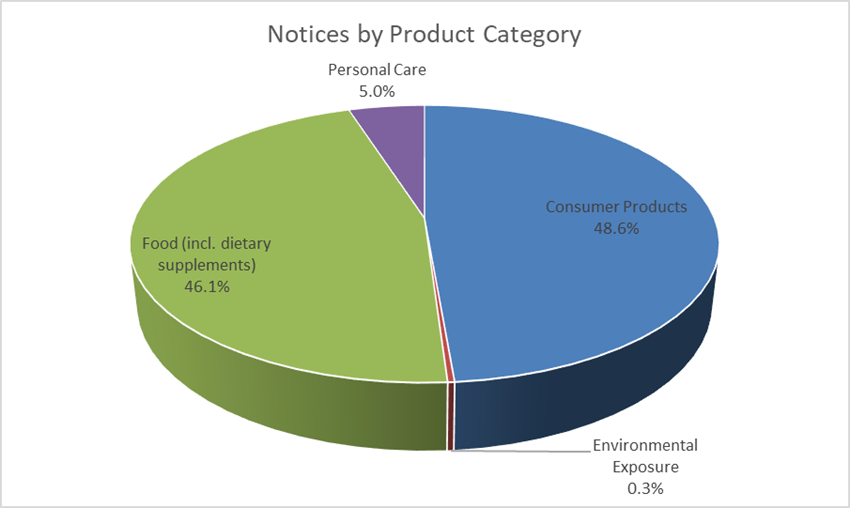
2025 at a glance (all categories)
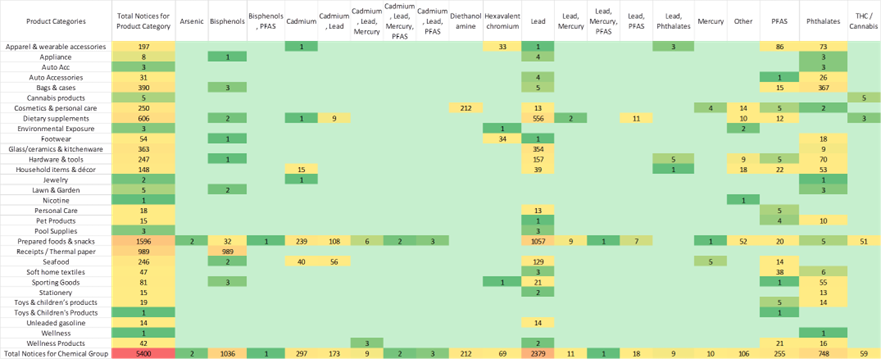
- Total unique notices: 5,233
- High-level category breakdown:
- Consumer Products: 49%
- Food (incl. dietary supplements): 46%
- Personal Care: 5%
Consumer Products focus (excluding Food + Personal Care)
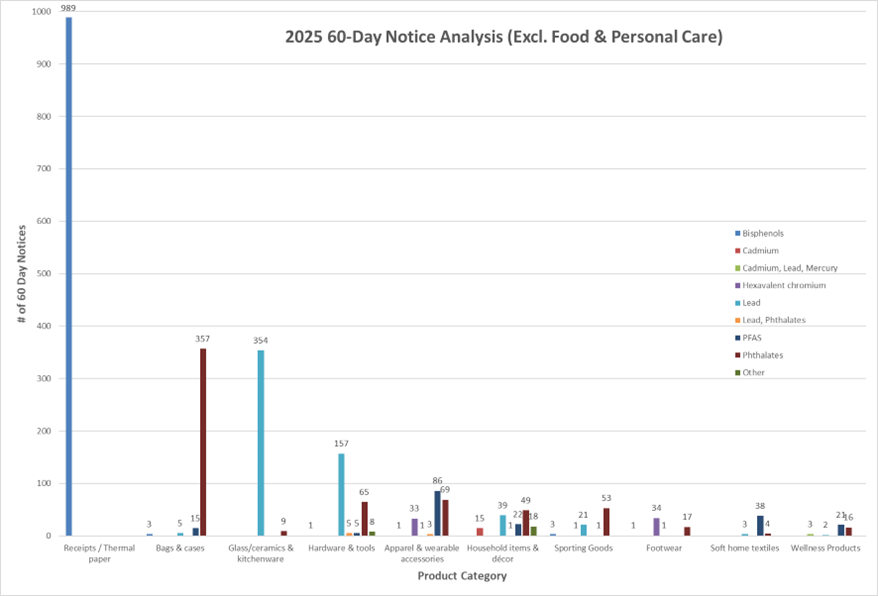
When we exclude Food and Personal Care, there are about 2,560 unique notices remaining. Following are key takeaways:
- Analysing from chemical group perspective:
- Bisphenols become the #1 driver (≈ 1,000 notices), primarily from receipts/thermal paper.
- Phthalates are the #2 driver (≈ 700 notices), concentrated in bags & cases.
- Lead remains a major enforcement driver (≈ 600 notices), especially in glass/ceramics and certain hardware/tool items.
- PFAS was targeted (≈ 200 notices) in apparel/wearable accessories and select soft home textiles.
- Analysing from product categories (consumer products excluding food and personal care) perspective:
- Receipts / Thermal paper: dominated by bisphenols (largest single product/chemical block).
- Bags & cases: primary target for phthalates.
- Glass/ceramics & kitchenware: primary targeted for lead.
- Hardware & tools: targeted for lead and phthalates.
- Apparel & wearable accessories: notable for PFAS (and some phthalates/other allegations depending on product type), there were also many notices for Hexavalent chromium in leather gloves (fashion, sporting goods and PPE) and leather footwear.
The following charts provide the visual summary supporting the findings above.
See below a table summarising some recent ASTM standards updates:
|
Reference |
Title |
|
Standard Test Method for Snagging Resistance of Fabrics (Mace) |
|
|
Standard Test Method for Resistance to Yarn Slippage at the Sewn Seam in Woven Upholstery Fabrics |
|
|
Standard Test Method for Extractable Matter in Textiles |
Standard update for textile products
In December 2025, the Chinese Ministry of Industry and Information Technology approved 748 industry standards, and the State Administration for Market Regulation (National Administration for Standardisation) approved 261 recommended national standards.
- Chinese Industrial Standard Announcement #41 of 2025
- Chinese National Standard Announcement #33 of 2025
The main standards related to textiles are:
|
No. |
Standard Code |
Standard name |
Applicable Scope |
Into force |
Replaced |
|
Labeling |
|||||
|
1 |
FZ/T 08009-2025 |
Recycling marking of textile products |
This document specifies the design principles, labelling, and marking requirements for the recycling marking of textile products. This document applies to all types of end-use textile products. |
2026-07-01 |
/ |
|
2 |
FZ/T 08010-2025 |
Textiles — Classification and content identification of recycled fibers |
This document specifies the terminology and definitions, classification, naming, content labelling requirements, identification and quantification, as well as marking for recycled fibres. This document applies to recycled fibers and their textile products. |
2026-07-01 |
/ |
|
Textile |
|||||
|
1 |
GB/T 46755-2025 |
General technical requirements for smart textile products |
This document specifies the terminology and definitions, requirements, test methods, inspection rules, product instructions, and packaging for smart textile products. This document applies to all types of smart textile products. |
2026-07-01 |
|
|
2 |
FZ/T 73012-2025 |
Brassiere |
This document specifies the sizes and specifications, requirements, testing, sampling rules, acceptance criteria, and instructions for use, packaging, transportation, and storage of bras. This document applies to bra products primarily made from knitted fabrics. |
2028-01-01 |
FZ/T 73012-2017 |
|
3 |
FZ/T 73013-2025 |
Knitted swimming wear |
This document specifies the product classification and sizing, requirements, testing, sampling rules, acceptance criteria, product usage instructions, packaging, transportation, and storage for knitted swimming wear. This document applies to knitted swimming wear primarily manufactured from knitted fabrics. Swimming wear made from other textile fabrics may be implemented by reference. |
2028-01-01 |
FZ/T 73013-2017 |
|
4 |
FZ/T 73083-2025 |
Knitted care underpants |
This document specifies the product classification, sizing, requirements, testing methods, sampling rules, acceptance criteria, instructions for use, packaging, transportation, and storage of knitted care underwear. This document applies to knitted care underwear primarily manufactured from knitted fabrics. |
2026-07-01 |
/ |
|
5 |
FZ/T 73084-2025 |
One size knitted bralette |
This document specifies the models and specifications, requirements, testing, sampling rules, acceptance criteria, as well as product instructions for use, packaging, transportation, and storage for free-size knit bras. This document applies to free-size bra products primarily made from elastic knit fabrics. |
2026-07-01 |
/ |
|
6 |
FZ/T 73026-2025 |
Knitted skirt and lady suit |
This document specifies the product sizes, requirements, testing methods, sampling rules, acceptance criteria, product usage instructions, packaging, transportation, and storage for knitted skirts and ladies suit. This document applies to knitted skirt and ladies suits primarily made from knitted fabrics. |
2028-01-01 |
FZ/T 73026-2014 |
|
7 |
FZ/T 73085-2025 |
Knitted garments with spun-dyed fibers |
This document specifies the sizing, requirements, testing, sampling rules, and acceptance criteria for knitted garments with spun-dyed fibers, as well as instructions for use, packaging, transportation, and storage of the products. This document applies to garments primarily made from knitted fabrics composed of spun-dyed polyamide (nylon) fibres, spun-dyed viscose fibres, spun-dyed polyester fibres, or spun-dyed fibre blends with a minimum content of 50%. Other spun-dyed fiber knitted garments may be produced by reference to this document. |
2026-07-01 |
/ |
|
8 |
FZ/T 73086-2025 |
Floor socks |
This document specifies the product classification, specifications, requirements, testing methods, sampling rules, acceptance criteria, product usage instructions, packaging, transportation, and storage for floor socks. This document applies to floor socks. |
2026-07-01 |
/ |
|
9 |
FZ/T 73087-2025 |
Knitted functional pillows for infants |
This document specifies the terminology and definitions, specifications, requirements, testing methods, sampling rules, acceptance criteria, and instructions for use, packaging, transportation, and storage of knitted functional pillows for infants. This document applies to pillow products for infants aged 36 months and under, manufactured with knitted fabric as the primary material and filled with materials such as textile fibers, natural plant fibers, polyurethane, or latex, designed to provide specific functional benefits. It also applies to walking head protection caps and walking head protection pads. |
2026-07-01 |
/ |
|
10 |
FZ/T 81001-2025 |
Sleepwear |
This document specifies the requirements, testing methods, and inspection rules for sleepwear, as well as their marking, packaging, transportation, and storage. This document applies to homewear garments such as sleepwear (including sets) primarily manufactured from textile woven fabrics. |
2028-01-01 |
FZ/T 81001-2016 |
|
11 |
FZ/T 81027-2025 |
Woven camel hair overcoat |
This document specifies the terminology and definitions, requirements, testing methods, inspection rules, as well as marking, packaging, transportation, and storage for woven camel hair overcoat. This document applies to woven woolen coats and similar garments containing 30% or more camel hair. This document does not apply to clothing for infants aged 36 months or younger. |
2026-07-01 |
/ |
|
12 |
FZ/T 81013-2025 |
Pet dog apparel |
This document specifies the terminology and definitions, requirements, test methods, inspection rules, as well as marking, packaging, transportation, and storage for pet dog apparel. This document applies to pet dog apparel primarily manufactured from textile fabrics. Other pet apparel or pet textile accessories may refer to this document for implementation. |
2028-01-01 |
FZ/T 81013-2016 |
|
13 |
FZ/T 74005-2025 |
Knitted yoga garment |
This document specifies the sizing, requirements, testing methods, sampling rules, acceptance criteria, product usage instructions, packaging, transportation, and storage for knitted yoga garment. This document applies to yoga apparel primarily made from knitted fabrics. |
2028-01-01 |
FZ/T 74005-2016 |
|
14 |
FZ/T 61007-2025 |
Home textiles—Super-fine rashel blanket |
This document specifies the technical requirements, test methods, inspection rules, marking, packaging, transportation, and storage of super-fine rashel blanket. This document applies to all types of warp-knitted super-fine rashel blanket primarily manufactured from polyester fibres. Other super-fine rashel blanket may be implemented by reference. |
2028-01-01 |
FZ/T 61007-2012 https://www.miit.gov.cn/jgsj/kjs/wjfb/art/2025/art_a061d8bdab7d4fceb6132f7cf05385ad.html |
|
15 |
FZ/T 64123-2025 |
Daily-used cotton swabs |
This document specifies the terminology and definitions, product classification, technical requirements, test methods, inspection rules, packaging, marking, transportation, and storage of daily-used cotton swabs. This document applies to daily-used cotton swabs, consisting of a swab stick and a cotton head formed by winding cotton fibres, intended for personal care, skin cleansing, and similar purposes. |
2026-07-01 |
/ |
|
16 |
FZ/T 64124-2025 |
Disposable compressed towel |
This document specifies the terminology and definitions, requirements, test methods, inspection rules, marking, packaging, transportation, and storage of disposable compressed towels. This document applies to compressed disposable wiping products made from materials such as woven, knitted, or nonwoven fabrics, including compressed bath towels, compressed facial wipes, and similar products. |
2026-07-01 |
/ |
Below you will find a monthly summary of product recalls and alerts in Europe (Source: “Safety Gate (RAPEX)”).
Safety Gate (RAPEX) (European Commission Rapid Alert System for dangerous non-food products – Alerts reported by EU national authorities).
The following 12 alerts regarding clothing, textile and fashion items were reported between week 52 of 2025 and week 3 of 2026.
|
Type of Risk |
Number of alerts |
Notes |
|
Chemical |
1 |
Shoes The rate of nickel release is too high. The product does not comply with the REACH Regulation nor with the General Product Safety Regulation. |
|
1 |
Handbag The product has an excessive concentration of lead. The product does not comply with the REACH Regulation nor with the General Product Safety Regulation. |
|
|
Chemical, Environment |
1 |
Waterproof bag The plastic material of the product has excessive concentrations of bis(2-ethylhexyl) phthalate (DEHP), cadmium and short-chain chlorinated paraffins (SCCPs). The product does not comply with the REACH Regulation nor with the Persistent Organic Pollutants (POP) Regulation. |
|
2 |
Jacket The product has an excessive quantity of C9-C14 PFCA-related substances. The product does not comply with the Persistent Organic Pollutants (POP) Regulation, the REACH Regulation nor the General Product Safety Regulation. |
|
|
1 |
Anorak The coat contains perfluorocarboxylic acid related compounds (PFCAs). The product does not meet the requirements of the REACH Regulation nor of the Persistent Organic Pollutants (POP) Regulation |
|
|
Environment |
1 |
Beanie hat The solders in the product have an excessive concentration of lead. The product does not comply with the requirements of the Directive on the restriction of the use of certain hazardous substances in electrical and electronic equipment (RoHS 2 Directive). |
|
Strangulation |
4 |
Children's hoodie The product has long drawstrings with free ends at the level of the neck. These drawstrings can become trapped during various activities of a child. The product does not comply with the General Product Safety Regulation nor with EN 14682 |
|
1 |
Children's coat The product has long drawstrings with free ends at the neck area. These drawstrings can become trapped during various activities of a child. The product does not comply with the General Product Safety Regulation nor with EN 14682 |
The Office for Product Safety and Standards (OPSS) issues Product Safety Alerts to the UK market. The following two alerts regarding clothing, textile and fashion items were issued between week 52 of 2025 and week 3 of 2026.
|
Type of Risk |
Number of alerts |
Notes |
|
Chemicals
|
1 |
Children’s beach shoes The plastic material used for the straps was found to contain excessive concentrations of phthalates. The product does not meet the requirements of the REACH Regulations 2008. |
From the 8th of January of 2026 to the 29th of January of 2026, the CPSC (Consumer Product Safety Commission) published the following recalls: 2 recalls of textile & leather products
|
Hazard |
Number of alerts |
Notes |
|
Burn |
2 |
Children’s pyjamas The pyjama pants and shorts violate the mandatory standards for flammability of children’s sleepwear, posing a risk of burn injuries to children. |