Challenge: Limited methods for mushroom species differentiation
As demand for functional mushroom ingredients continues to grow, so does the need for reliable methods to confirm species identity. There are many published methods but no standardized official methods of analysis or compendial methods other than the USP Ganoderma Fruiting Body HPTLC ID method.
Among existing approaches, a key concern persists:
"Do these methods provide sufficient selectivity to confidently differentiate between mushroom species?"
For manufacturers, ingredient suppliers and brand holders working with single-ingredient products or complex blends, this uncertainty creates risk particularly in ensuring accurate labeling and product authenticity.
Approach: Verifying and expanding a targeted HPTLC method
To address this gap, Eurofins Botanical Testing adopted the Nammex HPTLC identification method for multiple fungal species and conducted extensive internal verification.
This evaluation assessed method performance across:
- Multiple sample matrices
- Different extraction types (e.g., crude material vs. extracts)
- Materials sourced from various growers
The goal was to confirm robustness and expand applicability across real-world product formats.
Solution: Demonstrating selectivity across species and formats
Through method verification and optimization, Eurofins Botanical Testing demonstrated the ability to:
Differentiate at least seven mushroom fruiting body species
Adapt the method for use in multi-ingredient mushroom blends
Distinguish between water extracts and crude forms across multiple species
Tested species include:
- Cordyceps militaris (Cordyceps)
- Ganoderma sp. (Reishi)
- Grifola frondosa (maitake)
- Hericium erinaceus (lion’s mane)
- Inonotus obliquus (chaga)
- Ophiocordyceps sinensis (Chinese caterpillar)
- Trametes versicolor (turkey tail)
Each species exhibited a distinct mycochemical fingerprint, enabling clear identification and differentiation.
Business impact: Greater confidence in botanical identity
By improving HPTLC selectivity for mushroom species, this approach provides:
- Increased confidence in species-level identification
- Enhanced ability to validate product claims
- Reduced risk of misidentification or substitution
- Stronger support for quality and regulatory compliance
- Detect batch inconsistencies
- Protect brand reputation through batch verification
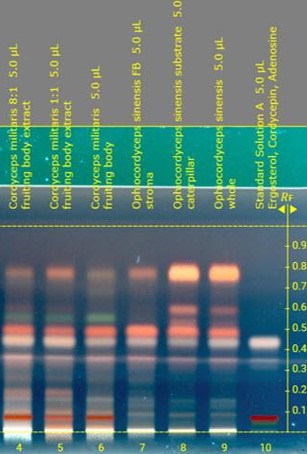
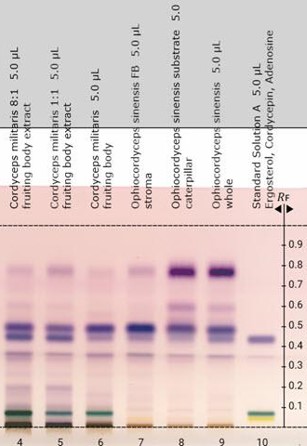
The following images demonstrate the selectivity of the Nammex HPTLC identification method for mushrooms as these seven species present unique mycochemical profiles that allow for easy identification and differentiation.
Key takeaway
For complex botanicals like mushrooms, method selectivity is critical. With targeted verification and optimization, HPTLC can reliably differentiate fungal species across diverse matrices and formulations. Beyond identity testing, a single selective method creates valuable chemical benchmarks that enable direct lot-to-lot comparisons, helping manufacturers detect inconsistencies early, reduce recall risk, and strengthen product quality and consumer trust.
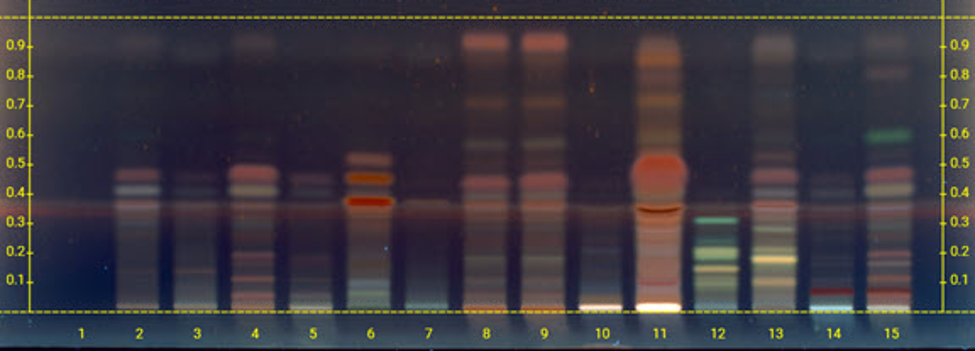
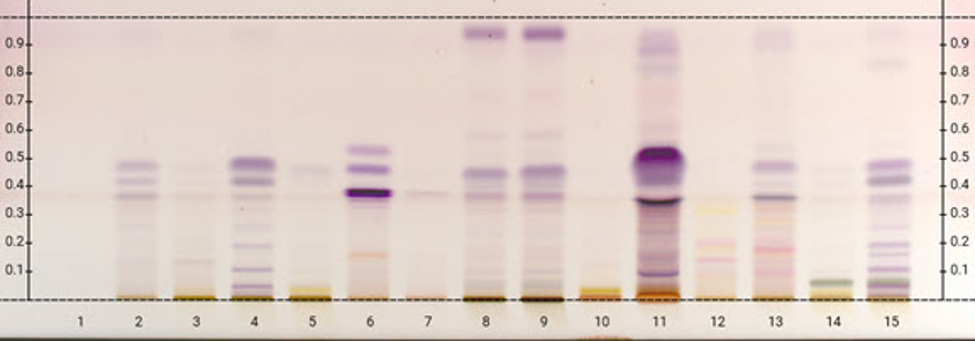
Lane assignments:
- Lane 1: Methanol blank (2.0 µL)
- Lane 2: Trametes versicolor fruiting body BRM (methanol extract) (10 µL)
- Lane 3: Trametes versicolor fruiting body BRM (water extract) (10 µL)
- Lane 4: Grifola frondosa fruiting body BRM (methanol extract) (10 µL)
- Lane 5: Grifola frondosa fruiting body BRM (water extract) (10 µL)
- Lane 6: Inonotus obliquus sclerotium BRM (methanol extract) (10 µL)
- Lane 7: Inonotus obiquus sclerotium BRM (water extract) (10 µL)
- Lanes 8-9: Test Sample
- Lane 10: Hericium erinaceus fruiting body BRM (water extract) (10 µL)
- Lane 11: Hericium erinaceus fruiting body BRM (methanol extract) (10 µL)
- Lane 12: Ganoderma sp. fruiting body BRM (water extract) (10 µL)
- Lane 13: Ganoderma sp. fruiting body BRM (methanol extract) (10 µL)
- Lane 14: Cordyceps militaris fruiting body BRM (water extract) (10 µL)
- Lane 15: Cordyceps militaris fruiting body BRM (methanol extract) (10 µL)
Nammex HPTLC method use case #1: Confirming Species-Level Identification in Multi-Ingredient Mushroom Blends
This analysis demonstrates the ability of the HPTLC method to differentiate individual mushroom species including reishi (Ganoderma sp.), cordyceps (Cordyceps militaris), and lion’s mane (Hericium erinaceus) based on distinct mycochemical profiles.
Each species exhibits a unique chemical fingerprint, enabling clear differentiation. Importantly, these profiles remain identifiable even when multiple species are combined in a single formulation, supporting confident detection and verification of individual components within complex blend products.
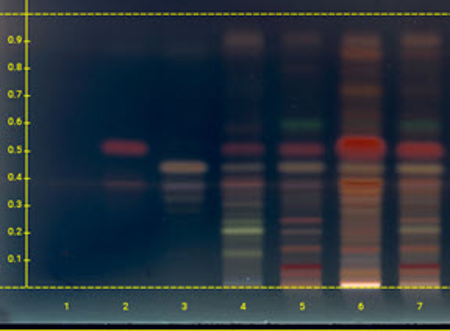
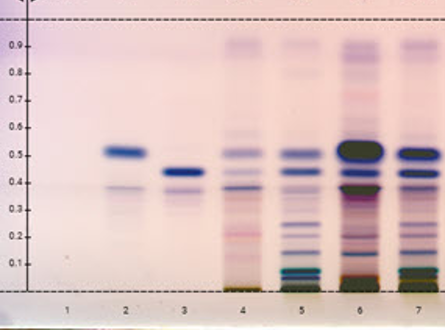
Lane assignments:
- Lane 1: Methanol Blank (2 µL)
- Lane 2: Lineolic Acid reference standard (4 µL)
- Lane 3: Ergosterol reference standard (4 µL)
- Lane 4: Ganoderma sp. fruiting body BRM (5 µL)
- Lane 5: Cordyceps militaris fruiting body BRM (5 µL)
- Lane 6: Hericium erinaceus fruiting body (5 µL)
- Lane 7: Mushroom Blend (Ganoderma sp. + Cordyceps militaris + Hericium erinaceus fruiting bodies 1:1:1) (5 µL)
Nammex HPTLC method use case #2: Distinguishing crude materials from extracts ssing HPTLC
This analysis highlights the method’s ability to differentiate between crude (methanol-extracted) materials and water-extracted forms across multiple mushroom species.
As mushrooms, by nature, contain many water-soluble compounds, water extracts show reduced or simplified mycochemical profiles, with many compounds either diminished or absent compared to their crude counterparts. In contrast, crude extracts present richer, more complex banding patterns, reflecting a broader mycochemical composition.
These differences demonstrate the method’s selectivity not only for species identification, but also for distinguishing between extraction processes, providing valuable insight into material composition and processing.
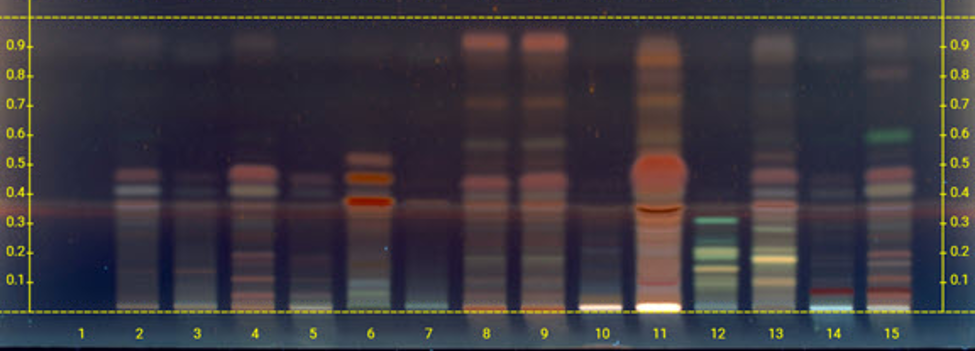
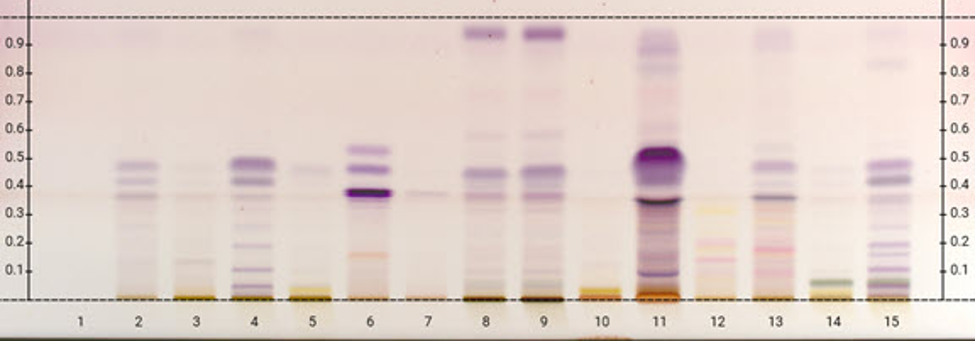
Lane assignments:
- Lane 1: Methanol blank (2.0 µL)
- Lane 2: Trametes versicolor fruiting body BRM (methanol extract) (10 µL)
- Lane 3: Trametes versicolor fruiting body BRM (water extract) (10 µL)
- Lane 4: Grifola frondosa fruiting body BRM (methanol extract) (10 µL)
- Lane 5: Grifola frondosa fruiting body BRM (water extract) (10 µL)
- Lane 6: Inonotus obliquus sclerotium BRM (methanol extract) (10 µL)
- Lane 7: Inonotus obiquus sclerotium BRM (water extract) (10 µL)
- Lanes 8-9: Test Sample
- Lane 10: Hericium erinaceus fruiting body BRM (water extract) (10 µL)
- Lane 11: Hericium erinaceus fruiting body BRM (methanol extract) (10 µL)
- Lane 12: Ganoderma sp. fruiting body BRM (water extract) (10 µL)
- Lane 13: Ganoderma sp. fruiting body BRM (methanol extract) (10 µL)
- Lane 14: Cordyceps militaris fruiting body BRM (water extract) (10 µL)
- Lane 15: Cordyceps militaris fruiting body BRM (methanol extract) (10 µL)
Start the conversation
Bring confidence to every mushroom and botanical product. Connect with our testing experts to discuss your quality, authenticity, and compliance needs today.