WHO reassessment of toxicity ratios of toxic PCDD/F and DL-PCB congeners
EFSA updates its previous risk assessment on dioxins and dioxin-like PCBs emphasising the importance of effective monitoring throughout the entire food and feed chain
Aug 2026 (update). Following the World Health Organisation’s (WHO) reassessment of the Toxic Equivalency Factors (TEF) for dioxins and dioxin-like PCBs (DL-PCBs) in 2022, the European Food Safety Authority (EFSA) has updated its risk assessment for dioxins and DL-PCBs based on the WHO (2022) TEFs. As part of this reassessment, the EFSA has significantly reduced the tolerable weekly intake (TWI): from the previous level of 2 pg WHO(2005)-TEQ/kg body weight per week to 0.6 pg WHO(2022)-TEQ/kg body weight per week.
The authority also concludes that, whilst the application of the new TEFs reduces the estimated overall exposure of the European population by around 27 to 35 per cent, this exposure remains a health concern. Data from Eurofins GfA Lab Service GmbH indicates that dioxins and DL-PCBs should remain a primary focus of contaminant management in the future, not only for food of animal origin (the main focus of EFSA's work), but also for all other foods and products used in food production.
Toxicity equivalent factors for dioxins and PCBs
Polychlorinated dibenzodioxins and -furans (PCDD/Fs) and polychlorinated biphenyls (PCBs) are two classes of persistent organic pollutants (POPs) consisting of 210 and 209 different chemical compounds respectively. However, only 17 PCDD/Fs, 12 DL-PCBs and 6 NDL-PCBs are relevant for food and feed legislation in the European Union.
 The colloquially used term “dioxins” generally refers to these 17 PCDD/Fs and 12 DL-PCBs. These are characterised by a common mode of action of the toxic properties, which vary in their strength.
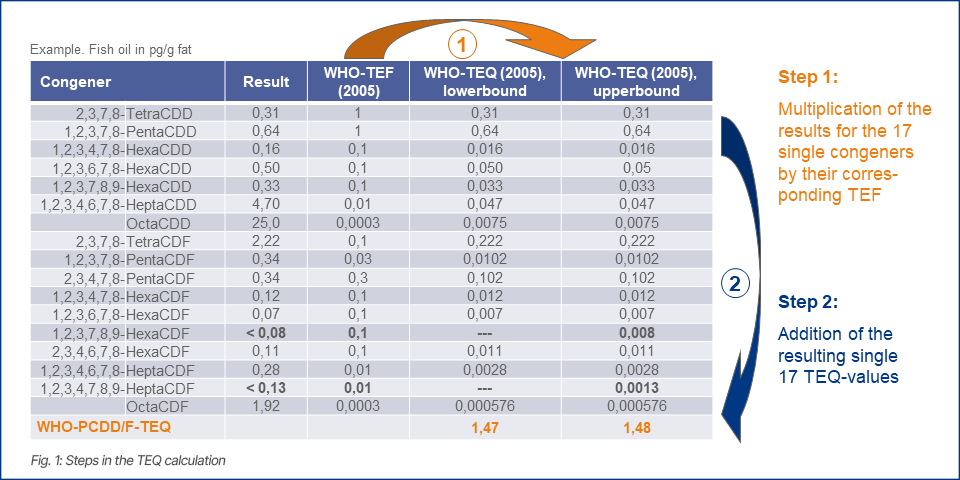
The system of toxic equivalents (TEQ) was developed and introduced to estimate the overall toxic potential of this mixture of substances. Toxicity equivalent factors (TEF) are part of this system. A TEF represents the ratio between the toxicity of a congener of this group and the toxicity of the most toxic congener and is a numerical factor for calculating the TEQ, as shown in figure 1. The TEFs are determined on the basis of scientific studies on the toxic potential of the various dioxins and dioxin-like PCBs and are updated at regular intervals to take account of new findings.
New WHO(2022)-TEFs for dioxins and DL-PCBs
The World Health Organization (WHO) first compiled a list of such toxicity equivalent factors, the WHO-TEFs, in 1998, on the basis of which the EU maximum levels for dioxins and dioxin-like PCBs in food were set in 2001 for the first time. The health assessments in combination with tolerable intake levels, which are carried out by the European Food Safety Authority (EFSA) or corresponding national organisations, are also based on the WHO-TEF. At the beginning of 2024, the WHO published modified factors for some dioxins and dioxin-like PCBs in a review of the WHO-TEFs. An overview of all previously published TEFs including the new WHO(2022)-TEFs is shown in the table below.
Overview of TEF systems for PCDD/Fs and DL-PCBs
| Group | Congener | I-TEF (NATO/CCMS) (1988)[1] | WHO-TEF (1998)[2] | WHO-TEF (2005)[3] | WHO-TEF (2022)[4] |
| Polychlorinated dibenzodioxins and ‑furans (PCDD/Fs) |
2,3,7,8-TetraCDD | 1 | 1 | 1 | 1 |
| 1,2,3,7,8-PentaCDD | 0.5 | 1 | 1 | 0.4 | |
| 1,2,3,4,7,8-HexaCDD | 0.1 | 0.1 | 0.1 | 0.09 | |
| 1,2,3,6,7,8-HexaCDD | 0.1 | 0.1 | 0.1 | 0.07 | |
| 1,2,3,7,8,9-HexaCDD | 0.1 | 0.1 | 0.1 | 0.05 | |
| 1,2,3,4,6,7,8-HeptaCDD | 0.01 | 0.01 | 0.01 | 0.05 | |
| OctaCDD | 0.001 | 0.0001 | 0.0003 | 0.001 | |
| 2,3,7,8-TetraCDF | 0.1 | 0.1 | 0.1 | 0.07 | |
| 1,2,3,7,8-PentaCDF | 0.05 | 0.05 | 0.03 | 0.01 | |
| 2,3,4,7,8-PentaCDF | 0.5 | 0.5 | 0.3 | 0.1 | |
| 1,2,3,4,7,8-HexaCDF | 0.1 | 0.1 | 0.1 | 0.3 | |
| 1,2,3,6,7,8-HexaCDF | 0.1 | 0.1 | 0.1 | 0.09 | |
| 1,2,3,7,8,9-HexaCDF | 0.1 | 0.1 | 0.1 | 0.2 | |
| 2,3,4,6,7,8-HexaCDF | 0.1 | 0.1 | 0.1 | 0.1 | |
| 1,2,3,4,6,7,8-HeptaCDF | 0.01 | 0.01 | 0.01 | 0.02 | |
| 1,2,3,4,7,8,9-HeptaCDF | 0.01 | 0.01 | 0.01 | 0.1 | |
| OctaCDF | 0.001 | 0.0001 | 0.0003 | 0.002 | |
| Dioxinlike PCBs (DL-PCBs) |
PCB 77 | — | 0.0001 | 0.0001 | 0.0003 |
| PCB 81 | — | 0.0001 | 0.0003 | 0.006 | |
| PCB 105 | — | 0.0001 | 0.00003 | 0.00003 | |
| PCB 114 | — | 0.0005 | 0.00003 | 0.00003 | |
| PCB 118 | — | 0.0001 | 0.00003 | 0.00003 | |
| PCB 123 | — | 0.0001 | 0.00003 | 0.00003 | |
| PCB 126 | — | 0.1 | 0.1 | 0.05 | |
| PCB 156 | — | 0.0005 | 0.00003 | 0.00003 | |
| PCB 157 | — | 0.0005 | 0.00003 | 0.00003 | |
| PCB 167 | — | 0.00001 | 0.00003 | 0.00003 | |
| PCB 169 | — | 0.01 | 0.03 | 0.005 | |
| PCB 189 | — | 0.0001 | 0.00003 | 0.00003 |
Significantly lowered tolerable weekly intake (TWI)
The new TEF values result in altered TEQ results for many food and feed samples. Thus, following the World Health Organisation’s (WHO) reassessment of the Toxic Equivalency Factors (TEF) for dioxins and dioxin-like PCBs (DL-PCBs), the European Food Safety Authority (EFSA) has now updated its risk assessment for dioxins and DL-PCBs in food and feed [9].
As part of the reassessment, EFSA has significantly lowered the tolerable weekly intake (TWI) from the previous level of 2 pg WHO(2005)-TEQ/kg body weight per week to 0.6 pg WHO(2022)-TEQ/kg body weight per week. Impairment of male reproductive development resulting from exposure during early life stages continued to be regarded as a critical endpoint.
Occurrence data of PCDD/Fs and DL-PCBs in food were extracted from the EFSA Occurrence database. A total of 54,177 food samples included in the final dataset (submitted by 24 Member States plus Norway and Iceland, and sampled between the years 2013 and 2023) was used for estimation of the total exposure of the European population. 92% of the samples covered foods of animal origin such as meat and meat products, fish and seafood, milk and dairy products and eggs and egg products while only a limited number of samples was available for other food categories. Food consumption data from the EFSA Comprehensive European Food Consumption Database were used for the dietary exposure assessments. EFSA concludes that the application of the new TEFs reduces the estimated total exposure
Impact on food and feed business operators
For food and feed business operators, this means that dioxins and PCBs should continue to be a key focus of contaminant management. According to the EFSA Occurrence database, one could conclude that particular attention must be paid to raw materials and products with an increased risk of bioaccumulation, such as fish and fish products, fish oils, animal fats, and milk and dairy products. An evaluation study using data from the database of occurrence data of dioxins and PCBs in more than 40.000 food samples received in 2020 to 2024 from clients worldwide by Eurofins GfA Lab Service GmbH shows a more detailed situation. In contrast to the EFSA Occurrence database, only 65% of the samples covered foods of animal origin such as meat and meat products, fish and seafood, milk and dairy products and eggs and egg products in this Eurofins’ database. This means that both databases are not comparable and the Eurofins’ database includes a higher proportion of samples being of plant, mineral or other origin.
While the Eurofins database confirms that there is a decrease in TEQ when applying the new WHO(2022)-TEFs for food products of animal origin, the data also reveal trends for other products. For products of plant origin, a less pronounced increase can generally be expected. An even smaller decrease is estimated for products of mineral origin (including trace element salts). Exceptions, which may even involve an increase in TEQ, are to be considered in both cases. Several products in the Eurofins database could not be clearly classified regarding their origin – either because these products are not manufactured from raw materials of animal, plant or mineral origin, or because they may originate from more than one of the sources mentioned. For these products even a significant increase in TEQ is possible.
In this context, it is important to note that, in addition to the cause of the contamination, the processing of products may also influence whether the TEQ increases or decreases when applying the new WHO(2022)-TEFs instead of the current WHO(2005)-TEFs.
As shown by the evaluation study of Eurofins GfA Lab Service GmbH, particular attention should be paid not only to raw materials and products with an increased risk of bioaccumulation as stated by EFSA, but to all products used for production of food products.
Outlook on future developments
Although the current EU maximum levels and action limits for dioxins and DL-PCBs in food and feed are still linked to WHO(2005)-TEF[5,6,7], the new EFSA assessment and especially occurrence data of dioxins and PCBs in food and feed in the Eurofins database highlights the ongoing importance of effective monitoring throughout the entire food and feed chain.
Following EFSA’s updated risk assessment, the European Commission is then expected to adopt new EU maximum levels for food and feed with reference to the WHO(2022)-TEF system. As EFSA already concluded in 2018 that consumption and exposure data from European countries for all age groups indicate that the tolerable intake level derived by EFSA in 2018 is exceeded, a significant reduction of the maximum levels based on current frequency distributions in food and feed is likely to come in the coming years.
Eurofins supports companies with the analysis of PCDD/Fs, DL-PCBs and NDL-PCBs, as well as with the technical interpretation of test results, taking into account the latest WHO and EFSA assessments.
Setting up of a data collection based on the new TEFs
The calculation of toxic equivalents based on the WHO(2022)-TEFs is already being carried out additionally within our analytical methods. With the publication of EFSA’s updated risk assessment Eurofins started to report these new WHO(2022)-TEQs on a supplementary basis to reflect the current state of scientific knowledge in accordance with the toxicity equivalent factors (TEFs) most recently published by the WHO and to anticipate the possible future regulatory consideration of these factors.
Although EU maximum levels and action limits for dioxins and DL-PCBs in food and feed are still linked to currently WHO(2005)-TEF[5,6,7], food and feed business operators or other interested parties can already build up their own data collection based on the new TEF for their specific products. If the EU maximum levels or action values, which are important for the international trade of goods, change in the future, a comparison with the upcoming limit values can be made for these products without any additional analytical effort and without delay. Food and feed companies can therefore prepare themselves already now for future changes in EU legislation without any additional effort.
Analyses of dioxins and PCBs at Eurofins
The Competence Center for Dioxins and Persistent Organic Compounds (POPs) within the global Eurofins laboratory network – Eurofins GfA Lab Service GmbH – analyses dioxins and PCBs in both food and feed according to EU requirements. In addition to food and feed, biota, water, soil and sediments, materials, chemicals and even human samples (breast milk and blood) can be analysed, too. All analytical methods are accredited according to DIN EN ISO/IEC 17025:2018.
Get in touch
Would you like to find out more about our testing solutions, or do you need tailored analytical support? Contact us today to get in touch with our experts.
Relevant sources:
[1] North Atlantic Treaty Organization, Committee on Challenges of Modern Society: Pilot Study On International Information Exchange On Dioxins And Related Compounds: International Toxicity Equivalency Factor (I-TEF) Method of Risk Assessment for Complex Mixtures of Dioxins and Related Compounds. Report Number 176, August 1988.
[2] Van den Berg et al. (1998): Toxic Equivalency Factors (TEFs) for PCBs, PCDDs, PCDFs for Humans and for Wildlife. Environmental Health Perspectives, 106(12), 775
[3] Van den Berg et al. (2006): The 2005 World Health Organization Reevaluation of Human and Mammalian Toxic Equivalency Factors for Dioxins and Dioxin-Like Compounds. Toxicological Sciences, 93 (2), 223–241
[4] DeVito et al. (2024): The 2022 world health organization reevaluation of human and mammalian toxic equivalency factors for polychlorinated dioxins, dibenzofurans and biphenyls. Regulatory Toxicology and Pharmacology, 146 (January 2024), 105525
[5] Commission Regulation (EU) 2023/915 of 25 April 2023 on maximum levels for certain contaminants in food and repealing Regulation (EC) No 1881/2006. OJ L 119, 5.5.2023, p. 103–157. (in the version of 22 July 2024)
[6] 2013/711/EU: Commission Recommendation of 3 December 2013 on the reduction of the presence of dioxins, furans and PCBs in feed and food. OJ L 323, 4.12.2013, p. 37–39. (in the version of 3 October 2014)
[7] Directive 2002/32/EC of the European Parliament and of the Council of 7 May 2002 on undesirable substances in animal feed. OJ L 140, 30.5.2002, p. 10–22. (in the version of 28 Nov 2019)
[8] EFSA (2018): Risk for animal and human health related to the presence of dioxins and dioxin‐like PCBs in feed and food. Scientific Opinion. EFSA Journal 2018;16(11):5333
[9] EFSA (2026): Update of the risk assessment on dioxins and dioxin‐like PCBs in feed and food. EFSA Journal. 2026;24:e10103
Written by:
Simone Staiger, Nina Lohmann
Eurofins GfA Lab Service GmbH