Novel food: insects – food of the future?!
Current status of risk assessment and approval as a novel food
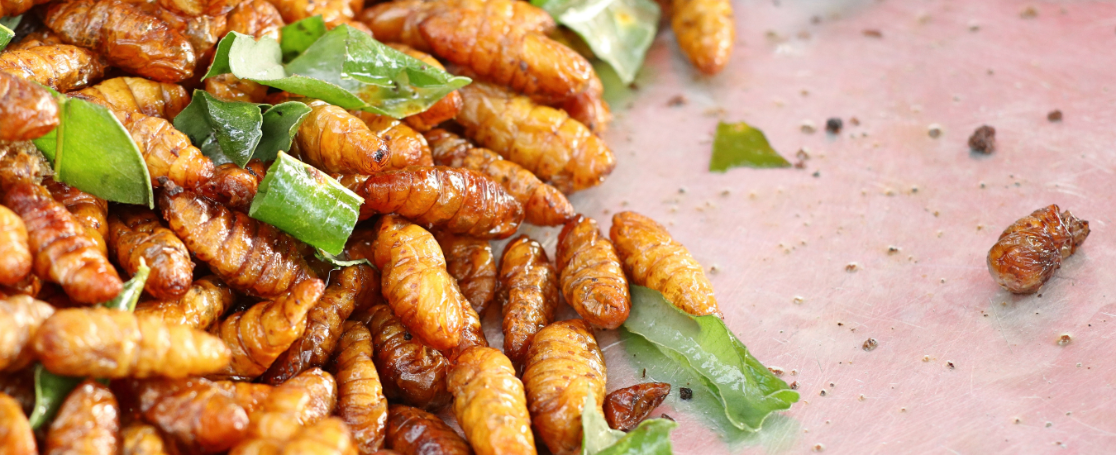
March 2025 (update). Insects as food and especially as an alternative source of protein are on the rise in Europe. Find out in this article what makes them interesting and what insects have been approved to date. Which laws and risk factors currently have to be taken into account when marketing insects as food for human consumption?
Potential of insects as food
Reasons for the increasing attractiveness of insects as so-called novel food are their high nutritional value (high protein content, rich in vitamins and nutrients) and their cost- and resource-efficient breeding, which is characterized, among other things, by their short development cycle, rapid population growth, high weight gain per day, and a high conversion rate from feed to body weight (van Huis et al., 2013). Already 50% of the 14 to 29-year-old population can envision the consumption of insects as a measure to feed the growing population in the future (forsa Ernährungsreport 2019/2020).
Legal status quo
Across Europe, edible insects and insect-containing foods are considered novel foods and require prior health assessment and approval under the Novel Food Regulation (EU) 2015/2283. With the help of the transitional provision of Article 35 (2) of the Regulation (EU) 2015/2283, it was previously possible for companies to market the respective insect or products thereof as food even without authorisation, as long as an application for authorisation was submitted.
The importing countries of insects intended for human consumption are also regulated by Article 20 of Regulation (EU) 2019/626. This was amended on 15. February 2021 with the implementing regulation (EU) 2021/17 by another third country, so that in addition to Canada, South Korea, Thailand and Switzerland, Vietnam is now also included.
Larvae of the yellow mealworm made the start
On 3 May 2021, it was announced via the EU Commission that the draft implementing regulation was approved by the Standing Committee on Plants, Animals, Food and Feed (SCOPAFF), and thus the larvae of the yellow mealworm (lat. Tenebrio molitor) from the black beetle family was authorised as a novel food.
EFSA's risk assessment
The decision is based on a risk assessment carried out by the European Food Safety Authority (EFSA). On 13 January 2021, EFSA published a risk assessment for an insect to be placed on the market as food by considering the yellow mealworm. According to EFSA, the safety of eating mealworms is generally considered to be positive, with mealworm larvae being safe for human consumption "both as a whole, dried insect and in powder form."
Furthermore, the larvae contain primarily protein, fat, and fibre; therefore, their consumption is "not nutritionally disadvantageous." However, allergic reactions may occur in individuals who are already allergic to crustaceans or mites due to cross-reactions. In addition, contamination from the larvae's diet may contribute to other allergenic ingredients in the novel foods. According to EFSA, it therefore is advisable to conduct further studies on the allergenic potential of the larvae. So far, labelling of existing products for possible allergens has been done on a voluntary basis.
Other insects approved
Since the mealworm was approved, other insects have been added for human consumption. For example, on 12 November 2021, the migratory locust Locusta migratoria was approved as novel food by the European Commission.
On 5 January 2023, the larva of Alphitobius diaperinus, also known as the grain mould beetle, was added to that list. This allows the applicant (the company Ynsect NL B.V. ) to use larvae of Alphitobius diaperinus in frozen, paste, dried and powdered (ground) form as a food ingredient in a range of food products for the general population and in powdered form in food supplements for adults. (Commission Implementing Regulation (EU) 2023/58 of 5 January 2023).
Another applicant was also granted authorisation in January 2023 for the use of partially defatted powder of Acheta domesticus (Commission Implementing Regulation (EU) 2023/5 of 3 January 2023). The domestic cricket was already authorised in frozen, dried and powdered form in February 2022.
The use of insect components must be indicated in the list of ingredients.
The placing on the market of the insects is limited to the applicants for a period of five years within the Union or is only allowed with their authorisation (except in the case of new applications from other applicants).
UV-treated mealworm powder
With the publication of Implementing Regulation (EU) 2025/89 on 20 January 2025, the applicant company NutriÉarth was granted exclusive authorisation to market UV-treated powder made from whole larvae of Tenebrio molitor (mealworm) for a period of five years. The powder has been approved for use in bread and rolls, cakes, pasta, processed potato products, cheese, cheese products and fruit and vegetable compotes. Due to the UV treatment, the powder has a higher content of vitamin D3 than originally and the Commission considers it appropriate to add the statement "contains vitamin D produced by UV treatment" and to indicate the vitamin D content in the nutrition declaration.
Get in touch
Would you like to find out more about our testing solutions, or do you need tailored analytical support? Contact us today to get in touch with our experts.
Written by:
Kathleen Enke
Eurofins NDSC Food Testing Germany GmbH