Food colouring E150d in vinegar
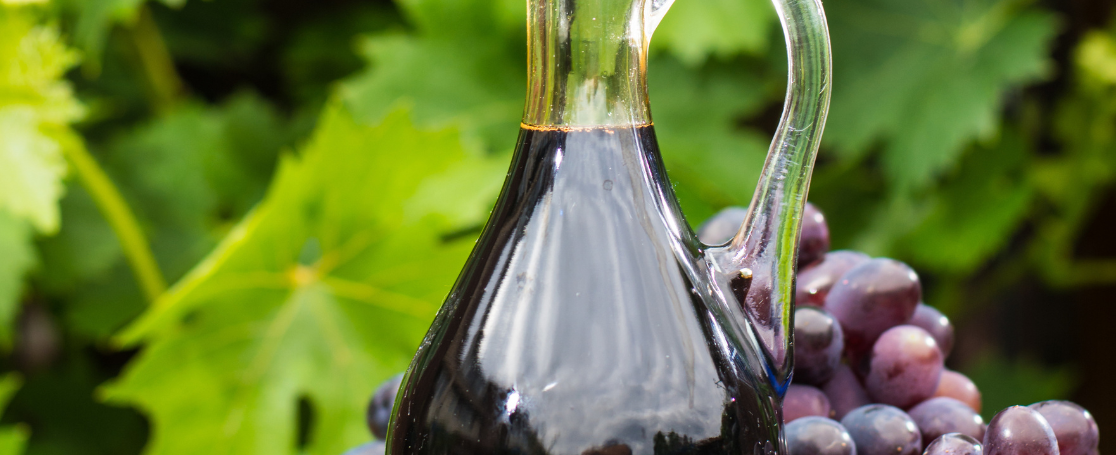
Detection of caramel colour in vinegar
A deep black colour in vinegar products is often interpreted as a sign of maturity – yet in many cases, the dark appearance is simply the result of added caramel colour (E150d). High‑quality balsamic vinegar, however, obtains its characteristic dark hue exclusively through years of oxidation and concentration in wooden barrels. The use of E150d in vinegar is permitted quantum satis, but it must always be declared. Using our LC‑MS/MS analysis, the colourant E150d can be detected in vinegar with high sensitivity and reliable semiquantitative accuracy, enabling a clear distinction between natural and added colouring.
Caramel Colour (E150d)
Caramel colour E150d is an artificially produced, deep‑brown food colourant obtained through controlled caramelisation of carbohydrates. It is commonly used in acidic foods and in non‑alcoholic beverages to achieve a uniform, dark appearance.
Legal Classification
Caramel colour E150d is authorised in the European Union as a food additive for a wide range of products under Regulation (EC) No. 1333/2008.
For table vinegar and diluted acetic acid, the use of E150d is permitted in quantum satis - that is, in a technically required but not excessive amount.
The addition must always be declared:
- either in the list of ingredients
- or, if no ingredient list is required, with the statement “contains colour”
Analytical Determination
Eurofins Food & Feed Testing in Germany has developed and accredited an analytical method for determining the semiquantitative presence of the colourant E150d in vinegar. The applied LC‑MS/MS technique (liquid chromatography coupled with mass spectrometry) provides very high sensitivity even at low concentration levels and ensures a reliable detection of the colourant in vinegar matrices.
Get in touch
Would you like to find out more about our testing solutions, or do you need tailored analytical support? Contact us today to get in touch with our experts.
Written by:
Larissa Schwarzpaul
Eurofins Food Integrity Control Services GmbH