Analysis of nitrosamines in food
Planned monitoring of nitrosamines in food
June 2025 (update). In February 2025, a working group of the EU Commission and member states drafted a Commission recommendation for the monitoring of nitrosamines in food. The aim is to determine meaningful and up-to-date data for a risk assessment of nitrosamines. The contents of this monitoring recommendation are currently being discussed. The Scientific Opinion on the risk assessment of N-nitrosamines in food published by the European Food Safety Authority (EFSA) in March 2023 concluded that nitrosamines could pose a health risk to the population in the European Union due to their carcinogenicity and genotoxicity. However, it was found that some of the underlying data were too old or too imprecise.
The draft for the currently planned Commission recommendation includes the collection of content data for nitrosamines in food, particularly in matured meat products, fish products, cocoa, beer and other alcoholic beverages, processed vegetables, cereals, dairy products and fermented and pickled foods. At least the ten nitrosamines classified as particularly relevant by the EFSA (see table) are to be investigated. Furthermore, research into the causes of high nitrosamine levels in foodstuffs is to be carried out and potential minimisation measures are to be compiled.
Legal background on nitrosamines
Nitrosamines belong to the most carcinogenic substances in animal experiments. For this reason, it is not yet possible to set limit values below which nitrosamines are considered harmless. The minimisation principle applies. Only for nitrosamines in malt and beer guidance values have been established (NDMA) (malt: 2.5 µg/kg; beer: 0.5 µg/kg; guideline values from Bavarian State Office for Health and Food Safety, LGL, in German). The general setting of maximum levels in foodstuffs is currently under discussion.
Formation of nitrosamines in food and intake
Nitrosamines have the general chemical formula R1R2N-NO. They are formed during the reaction of nitrite with secondary amines, which are found in many foods. One source of amines is their formation from the breakdown of amino acids during frying and stewing of foods. The addition of vitamin C and vitamin E can suppress the formation of nitrosamines, as these vitamins intercept the nitrite and thus it cannot react with the amines.
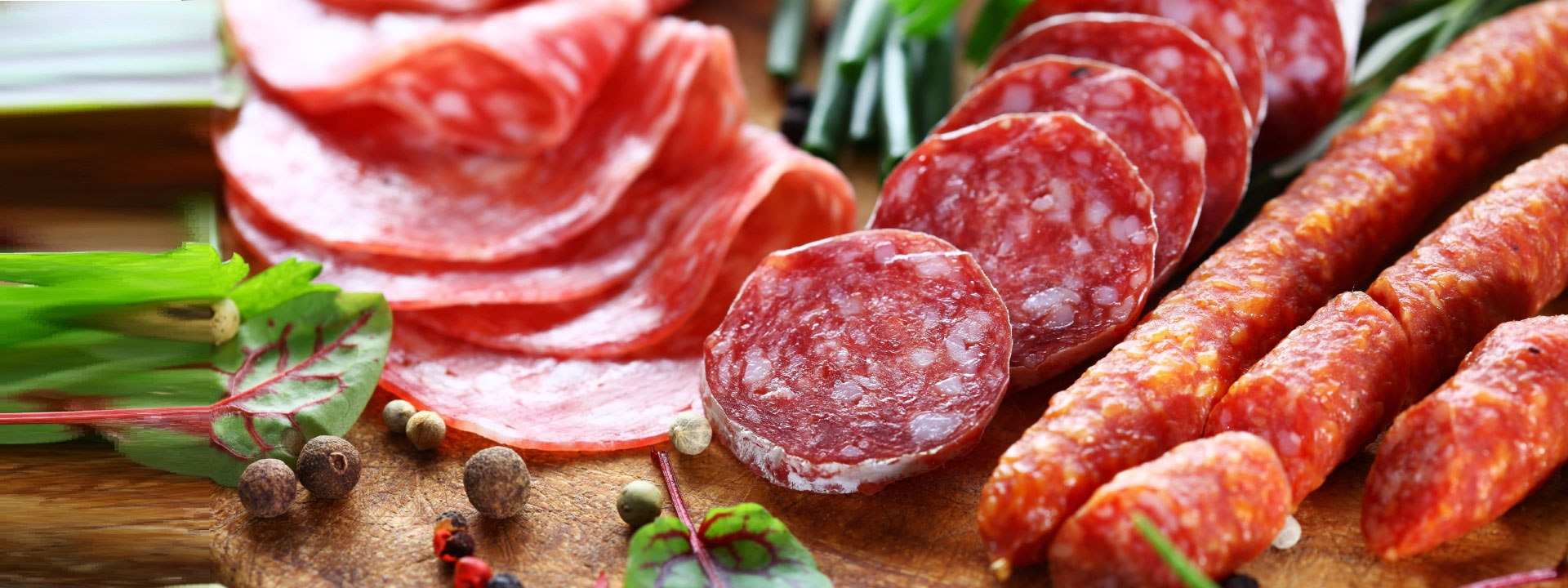
According to the EFSA Opinion, meat and meat products contribute most to the intake of nitrosamines in all age groups. In addition, nitrosamines may occur in fish, cocoa, beer and other alcoholic beverages, processed vegetables, cereals, milk and dairy products and fermented, pickled and spiced food.
Analysis of nitrosamines
The Competence Center for organic contaminants at Eurofins Food & Feed Testing laboratories in Germany has been offering the analysis of nitrosamines using LC-MS/MS for several years. This method is also mentioned as a recommended measurement technique in the draft monitoring recommendation. Various analysis scopes are available to order. The currently available nitrosamines and six others that are currently being implemented are listed in in the table.
Überblick über die Nitrosamine
| Nitrosamine | Akronym | CAS-Nr. | Flüchtig | Von der EFSA als besonders relevant eingestuft |
Bei Eurofins bereits implementiert |
| N-Nitrosodimethylamine | NDMA | 62-75-9 | yes | yes | yes |
| N- Nitrosomethylethylamine | NMEA | 10595-95- 6 | yes | yes | yes |
| N-Nitrosodiethylamine | NDEA | 55-18-5 | yes | yes | yes |
| N-Nitrosomorpholine | NMOR | 59-89-2 | yes | yes | yes |
| N-Nitrosodipropylamine | NDPA | 621-64-7 | yes | yes | yes |
| N-Nitrosodibutylamine | NDBA | 924-16-3 | no | yes | yes |
| N-Nitrosomethylaniline | NMA | 614-00-6 | no | yes | no - under validation |
| N-Nitrososarcosine | NSAR | 13256-22-9 | no | yes | no - method development in progress |
| N-Nitrosopyrrolidine | NPYR | 930-55-2 | yes | yes | yes |
| N-Nitrosopiperidine | NPIP | 100-75-4 | yes | yes | yes |
| N-Nitrosodiisobutylamine | NDIBA | 997-95-5 | no | no | yes |
| N-Nitrosodiphenylamine | NDPhA | 930-55-2 | no | no | yes |
| N-Nitrosoethylisopropylamine | NEIPA | 16339-04-1 | yes | no | no - under validation |
| N-Nitrosodiisopropylamine | DIPNA | 601-77-4 | yes | no | no - under validation |
| N-Nitroso-N-methyl-4- aminobutyric acid |
NMBA | 61445-55-4 | yes | no | no - under validation |
| 1-Methyl-4-nitroso-piperazine | MeNP | 16339-07-4 | unknown | no | no - under validation |
Currently, the analysis is available for fish, meat, beverages (non-alcoholic and up to 5% alcohol) and malting barley/roasted malt. The validation of further matrices is already in progress.
The samples are processed according to a QuEChERS protocol by extracting the analytes using an acetonitrile-water mixture and subsequent salting. The resulting acetonitrile phase is then purified using dispersive SPE. The purified extract is measured by a very selective LC-APCI-MS /MS using a special stationary reverse phase. Each of the nine analytes has its own stable-isotope-labelled internal standard for error correction.
Get in touch
Would you like to find out more about our testing solutions, or do you need tailored analytical support? Contact us today to get in touch with our experts.
Written by:
Sindy Böhme
Eurofins WEJ Contaminants GmbH