Expert insights in your inbox

A fertile soil is the foundation of optimal crop production and quality. To achieve this, soil chemistry, soil structure and soil biology must be properly balanced. BemestingsWijzer provides a complete picture of your soil, helping you optimise both fertilisation and soil cultivation.
What is Fertilisation Guide?
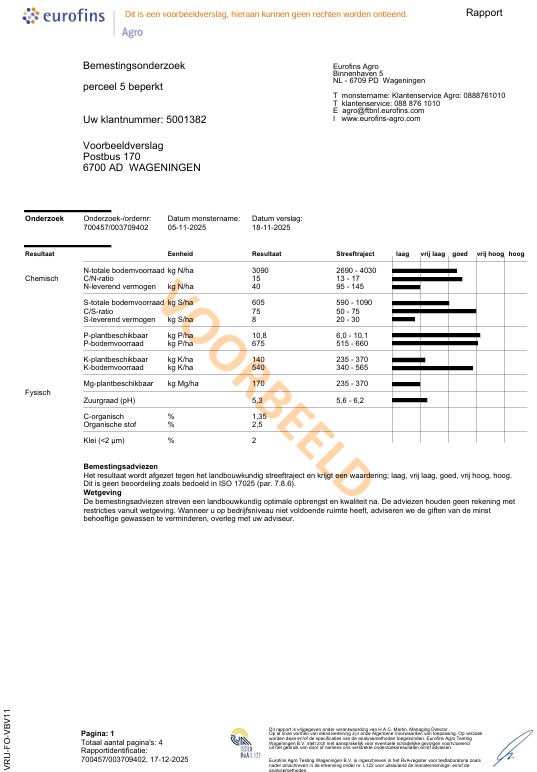
BemestingsWijzer is a comprehensive soil analysis that assesses the chemical, physical and biological properties of the soil. The analysis provides a complete picture of soil fertility and translates the results into a practical fertilisation recommendation tailored to the needs of the crop.
The analysis measures both plant-available nutrients and the nutrient reserves in the soil, giving you insight into what is immediately available and what can become available later through natural nutrient release. Results are presented in a clear and accessible format and compared with agronomic target values, allowing you to identify opportunities for optimisation and improve soil management with confidence.

Why Fertilisation Guide mathers?
Fertilisation Guide helps growers take a targeted approach to maintaining healthy soil and achieving optimum yields. The analysis combines information on nutrients, soil structure, organic matter and soil biology, providing a complete picture of soil quality.
The recommendations are divided into a soil-focused recommendation (for long-term soil fertility) and a crop-focused recommendation (for the current crop), enabling you to optimise both the underlying fertility of the soil and the crop’s immediate nutrient requirements.
The method can be applied across all open-field crops and also supports compliance with statutory requirements, as the parameters required for legislation are included in the analysis.
How do you use the Fertilisation Guide?
For the Fertilisation Guide, a representative soil sample is analysed using a comprehensive set of parameters. Chemical analyses include nitrogen, phosphate, potassium, calcium, magnesium, sulphur and trace elements. Physical soil properties such as pH, organic matter, cation exchange capacity (CEC), soil structure and texture are also assessed.
The biological component measures microbial activity, providing additional insight into overall soil health and functionality.
The results are presented in a range of practical visualisations, including the soil texture triangle, soil structure triangle, organic matter balance and pF curve. Based on these findings, a crop-specific fertilisation recommendation is produced. Where crop variety information is available, the advice can be further tailored to the specific variety and divided into multiple fertiliser applications throughout the growing season.
How do you use the Fertilisation Guide?
For the Fertilisation Guide, a representative soil sample is analysed using a comprehensive set of parameters. Chemical analyses include nitrogen, phosphate, potassium, calcium, magnesium, sulphur and trace elements. Physical soil properties such as pH, organic matter, cation exchange capacity (CEC), soil structure and texture are also assessed.
The biological component measures microbial activity, providing additional insight into overall soil health and functionality.
The results are presented in practical visualisations, including the soil texture triangle, soil structure triangle, organic matter balance and pF curve. Based on these findings, the Fertilisation Guide generates a crop-specific fertilisation recommendation. Where crop variety information is available, the advice can be further tailored to the specific variety and divided into multiple fertiliser applications throughout the growing season.

Methods & Standards (report context)
Samples are analysed using prescribed and documented methods. The analysis report includes a brief description of each method and indicates which methods are accredited by the Dutch Accreditation Council (RvA); these are marked with a Q.
When assessing compliance against standards, and where results are compared directly with threshold values, measurement uncertainty is not taken into account.