Screened Soil Analysis
For healthier soils, stronger crops and improved yields.
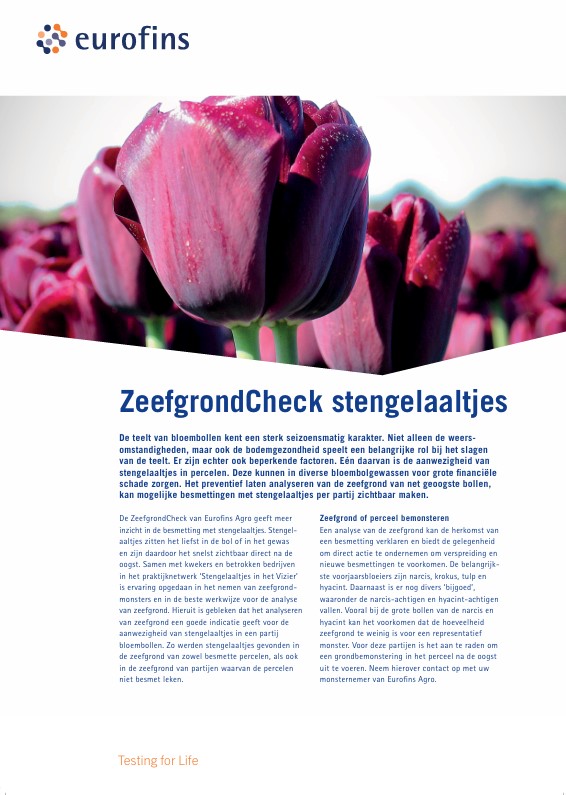
Screened Soil Analysis
Stem nematodes can cause significant financial losses in bulb crops. Preventive analysis of screened soil from newly harvested bulbs helps identify potential infestations on a batch-by-batch basis.
What is Screened Soil Analysis
Screened Soil Analysis is a specialised analysis of the sieving soil from freshly harvested flower bulbs to determine whether stem nematodes are present. These nematodes can cause significant damage to bulb crops, making early detection of infestations essential. By analysing the soil released during the sieving process, you gain rapid insight into potential infestations within individual bulb lots.
Why to use Screened Soil Analysis?
Stem nematodes are among the most significant risk factors in flower bulb cultivation. They prefer to live within the bulb or crop and are most easily detected immediately after harvest. With Sieving SoilCheck, you can:
-
identify infestations at an early stage and prevent further spread;
-
trace the source of an infestation;
-
assess individual bulb lots for potential risks;
-
take timely measures to minimise crop damage.
Practical experience has shown that sieving soil analysis provides a reliable indication of stem nematode infestations, even when fields appear visually free from symptoms.
How to use Screened Soil?
Screened soil from newly harvested bulbs is analysed to detect the presence of stem nematodes. The method, developed in collaboration with growers, helps identify potential infestations at an early stage.
Wanneer de hoeveelheid zeefgrond te klein is, wordt geadviseerd om een grondmonster uit het perceel te nemen om toch een representatief beeld te krijgen.
When to use Screened Soil Analysis?
Screened Soil Analysis is particularly suitable in the following situations:
-
immediately after harvest, when stem nematodes are most readily detectable;
-
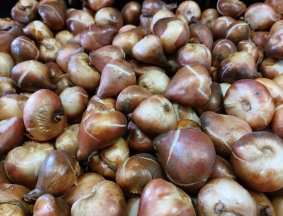
for high-risk bulb lots, such as daffodils, crocuses, tulips and hyacinths;
-
when you want to identify the source of an infestation;
-
as a preventive screening measure to avoid processing or moving infected material;
-
when fields appear healthy, but you want assurance of the health status of a bulb lot.
For large bulbs or lots that produce only small amounts of sieving soil, post-harvest field sampling can be a suitable alternative.
Parameters Screened Soil Analysis
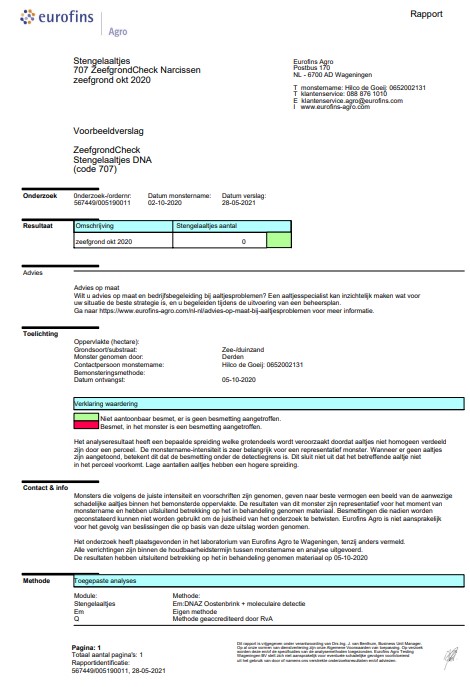
Screened Soil analyses soil for the presence of stem nematodes. The results provide insight into potential infestations within individual flower bulb lots and support informed decision-making on preventive measures and the reduction of infestation spread risks.
Download and read more!