
















































Beyond the bench: the true operational cost of running a QC lab

Matthew Rodak, Scientific Director, BioPharma Chemistry Raw Materials; Andrew Schaefer, Scientific Director, Analytical Method Development & Validation
 You sit down to start a seemingly normal day managing your QC lab. A day full of juggling manufacturing timelines, ongoing investigations, problematic method troubleshooting, etc. Then you open the dreaded email from a vendor. The message states the software the lab is using will no longer be supported by your operating system; the hardware will be discontinued by the end of the year; and they are releasing a brand-new software platform. This one message introduced potential IT vulnerability and compliance risk.
You immediately become flush with stress putting together a mental checklist of the impact to your operation. Do I have the IT infrastructure to support the changes? What is the impact to my validated methods? How many SOPs need updating or creating? How do I train the staff on the updates, etc? The cherry on top: I didn’t budget for any of this!!
While this seems extreme, this is happening more and more often and not just with software and instrumentation, but with every aspect of the supply chain to manage a QC laboratory operation. And it’s not the only recurring cost of running your QC.
 QC laboratory operations are a significant, ongoing cost whether run internally or outsourced. How do I even start to determine if I should start up my own QC operations, outsource to a contract testing organization (CTO), or a combination of both? Then exactly what services do I need to support? How many global markets am I operating in? How often do materials need testing, and are my vendors qualified?
The task is daunting and often leads to overlooking recurring costs. The fundamental question any lab manager needs to ask for return on investment of building a lab operation: what is my break-even point? Can a break-even be achieved in a high cost, high investment QC operation?
Let’s look at an example of ongoing cost structures of a raw materials QC laboratory. Why look at raw materials as a case study? Every phase of every operation needs the testing, and raw materials testing is historically a large overhead operation, although, not significantly different than many other QC operations.
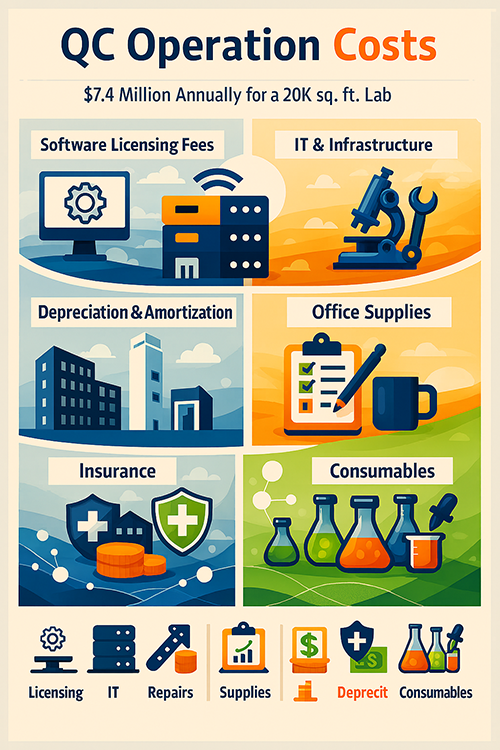
Graphic at left depicts the main categories of ongoing costs a fully compliant QC lab will incur. These are ongoing costs NOT including labor costs. Labor cost is not just a line item—it is a sustained management effort that includes hiring, scheduling, training, and turnover coverage. These hidden demands can materially shift breakeven assumptions and delay realization of internal-lab ROI. An accurate cost model must also include time and costs such as quality engineering (metrology), system administrators, staff for monitoring compendia changes for compliance, QA, and overall time required to gain expertise in compliance. The cost of removing resources from core competencies such as product R&D and commercial manufacturing must also be considered. Beyond labor, to start up a lab, cost of building and/or retrofitting facility space must be included.
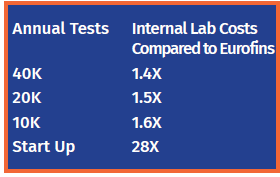
Taking all these factors, potential breakeven points were calculated between outsourcing vs internal resourcing at different volume levels, highlighted above. This exercise demonstrates that breakeven is not achieved at the highest test volume levels in support of commercial manufacturing.
How does Eurofins BioPharma Product Testing achieve a structurally lower-cost model? The biggest factor is economies of scale. Eurofins BPT performs hundreds of identification and quality tests and numerous other compendial and platform methods each month for dozens of customers, maximizing instrument utilization and distributing maintenance, calibration, and method update costs across a broad testing base. This stands in stark contrast to internal laboratories, which often experience instrument idling, under-utilized staff, and high-fixed operating costs.
Eurofins’ instrumentation breadth is another core advantage: maintaining the full suite of equipment required to support large scale QC testing is prohibitively expensive for most organizations. Beyond cost, Eurofins demonstrates regulatory maturity through proactive compendial surveillance, participation in standard setting organizations, and mature lifecycle management practices. These capabilities ensure continuity, method compliance, regulatory readiness, and rapid adaptation to evolving standards. Finally, Eurofins’ position as an industry leader allows for future investment in laboratory operations, such as automation and robotics (p. 2). For more information visit: www.Eurofins.com/BPT or: Contact-Us to submit an inquiry.