
Top-down approach
Eurofins Clinical Diagnostics Ireland conducts specific immunoglobulin E (IgE) tests on behalf of the clinician.

In addition, around 450,000 people in Ireland are living with asthma. Many children with food allergies also experience one or more associated allergic conditions, including asthma, atopic dermatitis, allergic rhinitis, and eczema. The diagnosis of allergic disease is a complex, multi‑step process, often requiring a combination of clinical assessments and specialised diagnostic testing. A range of tools may be used to support accurate diagnosis, including:
Skin testing
- Skin prick tests
- Intradermal tests
- Patch testing
Laboratory testing
- Total IgE
- Specific IgE
- Basophil Activation Test (BAT)
These diagnostic approaches enable clinicians to identify allergic triggers accurately and guide appropriate patient management.
The ultimate value of allergy testing depends on thorough pre‑test history‑taking and physical examination. The clinical judgement of the healthcare provider greatly influences the predictive value of allergy testing and appropriate interpretation of test results. A clinician can choose a 'Top-Down' or 'Bottom Up' approach.
Eurofins Clinical Diagnostics Ireland conducts specific immunoglobulin E (IgE) tests on behalf of the clinician.

Below are examples of the allergens we test for. For test codes and samples requirements, please consult our test guide for test codes, sample requirements etc. Visit Thermofisher website for allergen codes e.g. E1 is cat dander. Eurofins can build customised test panels for your clinic. Contact your local Laboratory.
| Single Allergen |
Whatever molecule the clinician suspects |
| Food Allergens |
Peanut, hazelnut, brazil nut, almond, coconut, pork, beef, egg yolk, chicken, turkey, cod, shrimp, blue mussel, tuna, salmon, oat, corn, sesame seed, buckwheat, egg white, milk, wheat, soya, tomato, yeast, garlic, onion, celery, caraway, mace, cardamon, clove, basil, fennel, ginger, anise, orange, apple, cocoa, kiwi, melon, banana, grape, crab, strawberry, rice |
| Occupational Allergens |
Latex, metals (nickel, cobalt), chemicals like isocyanates, wood dust |
| Inhalant Allergens |
Cat dander, dog dander, horse dander, cow dander, bermuda grass, rye grass, timothy grass, meadow grass, johnson grass, bahia grass, Hollister-Stier labs, house dust mite (D pteronyssinus & farinae), cockroach, penicillium notatum, cladosporium herbarum, aspergillus fumigatus, alternaria alternata, box-elder Tree, common silver birch tree, hazel tree, oak tree, sycamore tree |
| Children & Young Infants Panel |
Cow's milk, peanuts, hen's eggs, soya, wheat |
| IGg & IgG4 monitoring |
Specialised testing to support the monitoring of desensitisation and immunotherapy progress. |

Eurofins Clinical Diagnostics Ireland offers ALEX®, a next generation test covering 295 molecules (117 allergen extracts and 178 recombinant or high purified molecules) that assesses a patient’s allergen sensitisation.
ALEX® provides information on allergy risks, cross reactivities, and the presence of allergens not initially suspected, as well as indicating the suitability of a specific immunotherapy.
A positive serum specific IgE test does not necessarily indicate an allergy, but is a useful indicator when interpreted (with caution) in conjunction with other clinical assessments to confirm allergy.

A high level of specific IgE may indicate sensitisation to an allergen, but it does not mean that a clinically significant allergic reaction is occurring. Some people may be sensitised without showing symptoms.
Results should be interpreted in the context of the patient's clinical symptoms and medical history.

Certain IgE antibodies may react with similar allergens (structural homology between the allergens' molecular components), giving positive results that do not correspond to a real allergy to the allergen tested.
Additional tests, such as skin tests or symptom evaluation, are often necessary to establish a precise diagnosis.

Factors such as age, other pathologies and genetics can influence IgE assay results and allergic reaction.
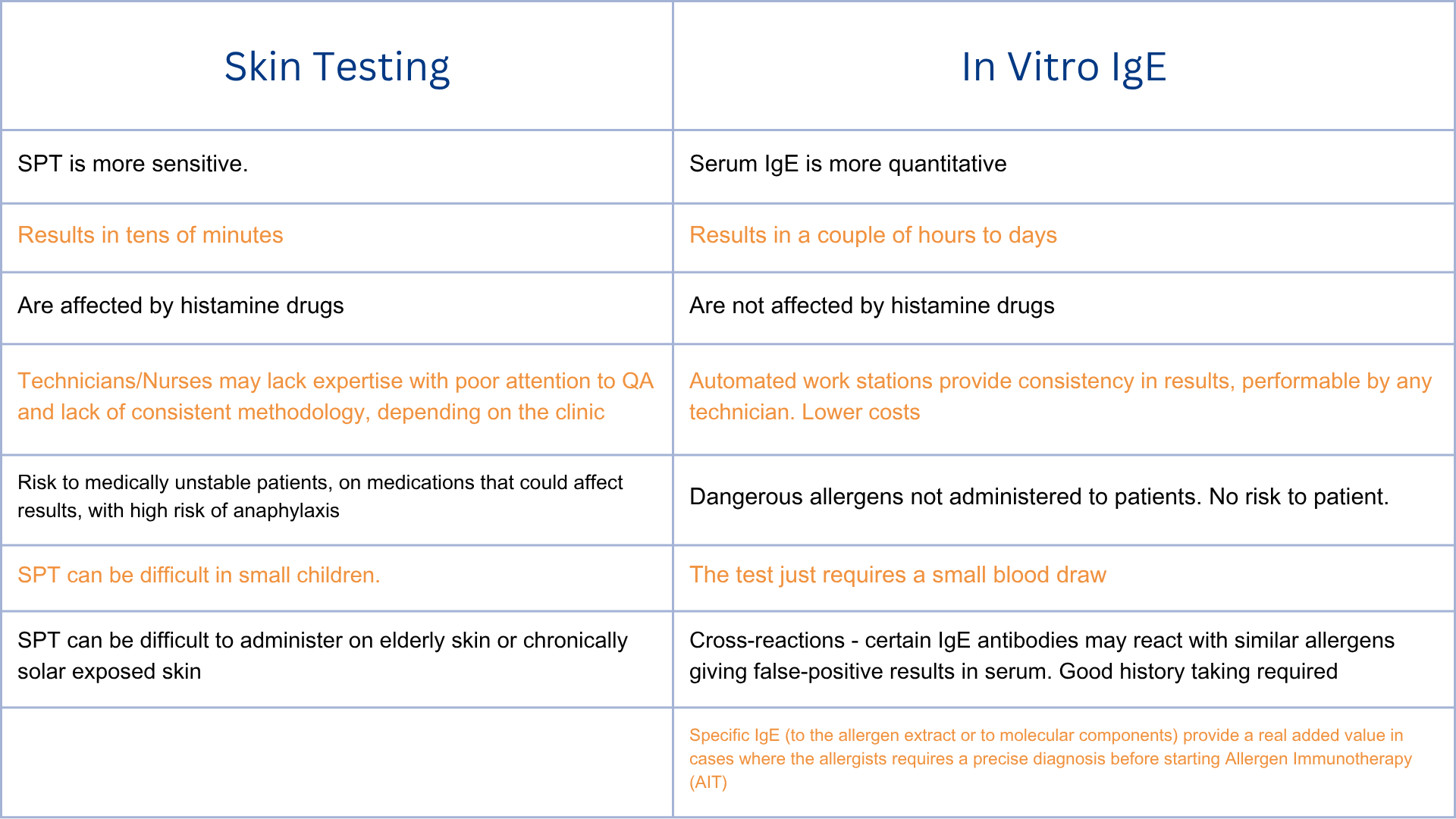
Below are the advantages and disadvantages associated with skin prick tests versus in vitro IgE blood tests:
In cases where IgE results are inconclusive, Eurofins Clinical Diagnostics Ireland provides advanced cellular diagnostics, including:
Three Rock Road, Sandyford Industrial Estate, Dublin,D18 A4C0, Ireland
