














































Eurofins Toys & Hardlines Monthly Bulletin (January 2026)


New update to Candidate List of substances of very high concern (SVHCs)
On 4 February 2026, the ECHA (European Chemicals Agency) released the new Candidate List of SVHCs with the addition of two new substances. The current list of SVHCs now contains 253 substances.
See below a table indicating the latest substance addition:
|
No. |
Substance name |
EC number |
CAS number |
Reason for inclusion |
Examples of use(s) |
|
1 |
n-hexane |
203-777-6 |
110-54-3 |
Specific target organ toxicity after repeated exposure |
Formulation, polymer processing, coatings and cleaning agent |
|
2 |
4,4'-[2,2,2-trifluoro-1-(trifluoromethyl)ethylidene]diphenol and its salts |
- |
- |
Toxic for reproduction (Article 57c) |
Process regulator and cross-linking agent |
Legal obligations for companies using SVHCs include:
- Suppliers must provide customers and consumers with enough information to allow for safe use of products that contain a substance of very high concern (SVHC) above a concentration of 0.1 % (weight by weight)
- Importers and producers of these products must notify the ECHA if their article contains SVHC substances above a concentration of 0.1% weight by weight (w/w) and the substance is present in those products in quantities totalling over 1 tonne per producer or per importer per year. The notifications must be submitted within six months from the date that the substance is included in the list.
- Suppliers of substances on the Candidate List, supplied either on their own or in mixtures, must provide their customers with a safety data sheet.
- Under the Waste Framework Directive, companies must also notify ECHA if the articles they produce contain substances of very high concern in a concentration above 0.1 % (weight by weight). This notification is published in ECHA’s database of substances of concern in products (SCIP).
Click here to access the official List from ECHA’s website.
EU Adopts new directive allowing limited use of cobalt in certain toys
On 29 January 2026, the European Commission adopted Commission Directive (EU) 2026/192, introducing a targeted amendment to the EU’s Toy Safety Directive that permits the controlled use of cobalt in specific toy applications under strict conditions. The measure updates Appendix A of Annex II to Directive 2009/48/EC and is aimed to maintain a high level of child safety across the European Union.
Directive (EU) 2026/192 introduces an exemption, authorising the use of cobalt in three narrowly defined toy-related applications:
- Toys and toy components made of stainless steel containing nickel, where cobalt is present only as an impurity
- Toy components intended to conduct electric current
- Neodymium-based magnets (NdFeB magnets), provided that they cannot be swallowed or inhaled by children.
The amendment makes cobalt the second CMR substance to be permitted for limited use under the Toy Safety Directive, and aligns it with the new Regulation (EU) 2025/2509.
The directive entered into force following its publication in the Official Journal of the European Union on the 29 January 2026. EU Member States are required to transpose the directive into national law by the 29 July 2026, after which the new rules will apply across the internal market.
Manufacturers placing toys on the EU market after that date will need to ensure compliance with the updated provisions, including technical documentation demonstrating that cobalt use falls strictly within the permitted categories.
For full details, visit the official EUR-Lex page: Commission Directive (EU) 2026/192
EU extends validity of ecolabel criteria for key consumer product groups
On the 6 January 2026, the European Commission officially adopted Commission Decision (EU) 2026/66, extending and updating the validity periods of existing EU Ecolabel criteria for several major product groups, including:
- Textile products (Decision 2014/350/EU), which were scheduled to expire on 31 December 2025
- Bed mattresses (Decision 2014/391/EU), furniture (Decision (EU) 2016/1332) and footwear (Decision (EU) 2016/1349), which were scheduled to expire in December 2026
- Wood-, cork- and bamboo-based flooring criteria under Decision (EU) 2017/176 were also affected
The decision amends earlier Ecolabel decisions to ensure continuity while updated criteria are being developed by:
- Extending the validity period of criteria across all relevant product groups.
- Maintaining existing assessment and verification requirements until new or revised criteria are adopted.
- Providing legal certainty for manufacturers, retailers, certification bodies and EU Ecolabel applicants during the transition.
- The decision applies to the EU and is marked as EEA relevant, meaning it is also under review for incorporation into the legal frameworks of Iceland, Liechtenstein and Norway.
The new decision extends these validity periods to avoid regulatory gaps and maintain market stability.
Publications on European Commission initiatives
The table below summarises recent publications on European Commission initiatives related to consumer products:
|
Date |
Title |
|
23/12/2025 |
Plastic waste – EU-wide end-of-waste criteria This initiative aims to establish EU-wide end-of-waste criteria for plastic waste. A single, harmonised set of end-of-waste criteria and its uniform application in the EU will help achieve a well-functioning single market for secondary raw materials. By clarifying when obligations from the current waste legislation cease to apply to plastic waste, the new criteria will reduce the administrative burden for economic operators. Its status is in preparation. |
|
23/12/2025 |
Rules on single-use plastics and fishing gear (evaluation) The 2019 Single-Use Plastics Directive aims to prevent this waste and reduce its impact on the marine environment. This initiative will evaluate the impact of the directive’s measures, informing of any possible future updates or amendments. Its status is in public consultation until the 17 March 2026. |
New plan to boost circularity of plastics
On the 23 December 2025, the European Commission published a major new communication titled “Accelerating Europe’s transition to a circular economy: a pilot for boosting the circularity of plastics” (COM/2025/805). The initiative forms part of the EU’s wider strategy to strengthen economic resilience, reduce environmental impacts, and advance the bloc’s climate objectives through a more efficient and circular use of materials.
The communication highlights plastics—especially those used in energy‑intensive sectors—as a priority area where coordinated EU action can have a transformative impact. Key ambitions include:
- Accelerating the recirculation of plastics through better design, reuse, and recycling.
- Reducing lifecycle greenhouse‑gas emissions, especially from production and incineration.
- Strengthening the EU supply base by cutting demand for virgin fossil‑fuel feedstocks.
- Creating new market opportunities in recycling, secondary materials, and circular product design.
France publishes new decrees clarifying rules for household and professional packaging
On 18 December 2025, the French government published new decrees in the Journal Officiel that reshape the regulatory framework for packaging used by households and professionals.
The Order of 2 December 2025, appearing in JORF n°0296 ( Text nº 51), introduces updated definitions, exclusions, and classification rules for packaging types governed under the environmental code.
The decree clarifies that packaging falling under Article R.543‑43 I is divided into two categories:
- Household packaging
- Professional packaging
These are defined respectively under points 4° and 5° of Article R.543‑43 III.
The decree outlines rules for how these types are allocated across categories I, II, and III. However, it specifies that several types of packaging are not covered by these new rules, including:
- Packaging for mineral or synthetic oils
- Packaging for chemicals posing significant health or environmental risks
- Packaging and waste from construction materials
- Rechargeable gas bottles for non‑professional use
The provisions of this decree entered into force on 1 January 2026.
The Order of 2 December 2025, appearing in JORF n°0296 (Text nº 50), lays out mandatory requirements for eco‑organisms, individual systems, and coordinating bodies operating within the professional packaging sector. The decree applies to a wide range of stakeholders, including:
- Producers of packaging and packaged products used by professionals
- Collective applicant organisations seeking official accreditation as eco‑organisms
- Coordinating bodies overseeing REP operations
- Local authorities responsible for waste management
- Operators engaged in waste treatment or reuse activities
- Producers of packaged goods intended for households
Most provisions take effect on 1 January 2026 and Articles 1 and 2 will apply starting 1 July 2026.
Extends Deadline for Eliminating Plastic in Single-Use Cups to 2030
On 30 December 2025, the French government announced a significant adjustment to its plastic reduction policy through the publication of the Order of December 28, 2025, which amends the previous regulation dated 24 September 2021.
This new measure revises the timeline for eliminating plastic from single-use cups, extending the deadline from 1 January 2026 to 1 January 2030.
This order is issued under Article L. 541-15-10 of the French Environmental Code and aligns with EU notification procedures under Directive (EU) 2015/1535.
The Ministry for Ecological Transition and the Ministry of Economy emphasised that this extension aims to ensure a realistic and effective transition toward sustainable alternatives while maintaining progress toward France’s environmental objectives.
New Mercosur regulation tightens controls on silicone materials used in food applications
On 13 January 2026, Mercosur introduced significant updates to its regulatory framework governing silicone materials intended to come into contact with food. The changes were published through the Mercosur/GMC/Res. No 34/2025, which revises and modifies the following Mercosur regulations:
- GMC Resolution 27/99 on adhesives
- GMC Resolution 28/99 on positive lists for elastomers
- GMC Resolution 02/12 on positive lists for plastics
Key highlights of the regulation:
- An annex summarising new criteria and requirements (Scope Expansion and Updated Positive List Requirements)
- Migration limits and safety metrics
The strict specific migration limits (SMLs) for metals are as follows:
- ≤ 1 mg/kg for aluminium and barium
- ≤ 0.05 mg/kg for cobalt
- ≤ 5 mg/kg for copper and zinc
- ≤ 48 mg/kg for iron
- ≤ 0.6 mg/kg for lithium and manganese
- ≤ 0.02 mg/kg for nickel
Additional chemical safety parameters include:
- ≤ 0.5% volatile organic matter (VOM)
- ≤ 0.5% extractable compounds
- Mandatory “negative” peroxide testing
- ≤ 0.01 mg/kg sum of primary aromatic amines (PAA)
- Non-intentionally added substances (NIAS) are not included in the positive list, but the regulation mandates the implementation of appropriate compliance mechanisms to assess them.
- Guidelines for the use of dye meeting the requirements of the Mercosur Technical Regulation on dyes for food‑contact plastics.
The new regulation establishes a unified and updated technical framework governing the use of silicones in materials, packaging, coatings, and equipment that may contact food. These updates align Mercosur with evolving global standards on food‑contact materials, particularly those emphasising transparency, stricter migration limits and comprehensive substance listings.
Member countries (Argentina, Brazil, Paraguay and Uruguay) must integrate this resolution into national law.
Update on import inspections for consumer products
On 20 January 2026, the Turkish Ministry of trade published several communications which affect the import of consumer products. The most relevant for consumer products are:
- Certain products requiring CE marking - Notice on the Control of Imports of Certain Products Requiring CE Marking (Product Safety and Control: 2026/9)
Regulations on electrical equipment designed for use within specific voltage limits, electromagnetic compatibility, elevators, pressure equipment, simple pressure vessels, gas appliances, and efficiency requirements for new hot water boilers using liquid and gaseous fuels apply to products such as elevators, electrical and electronic devices, cameras, electric blankets, and small household appliances during the import process to ensure compliance. The procedures and principles for these inspections are determined by the Ministry, and the inspections are carried out by the Turkish Standards Institute. Click below to access the inspection guide.
- Toys - Regulation on the Control of Toy Imports (Product Safety and Inspection: 2026/10)
The Ministry inspects toys during the import process to ensure compliance with the Toy Safety Regulation. Click below to access the inspection guide.
- Consumer products - Notice on the Control of Imports of Consumer Products (Product Safety and Inspection: 2026/12)
The Ministry inspects stationery, mouse pads, costume jewelry, watches, pool seats, disinfectants, etc., during importation to protect human health and the environment, and to ensure compliance with the limit values, applicable standards, and licensing requirements specified in the Regulation on the Registration, Evaluation, Authorisation and Restriction of Chemicals. Click below to access the inspection guide.
- Batteries and accumulators - Notice on the Control of Imports of Batteries and Accumulators (Product Safety and Inspection: 2026/15)
The Ministry inspects various batteries and accumulators during importation to ensure their compliance with the Regulation on the Control of Waste Batteries and Accumulators. Click below to access the inspection guide.
- Mother and Baby Products - Notice on Import Controls for Mother and Baby Products (Product Safety and Inspection: 2025/17)
Products such as pacifiers, baby bottles, sippy cups, teethers, pacifier clips, baby swings, etc., are inspected in accordance with the Regulation on Registration, Evaluation, Authorisation and Restriction of Chemical Substances (KKDİK), the Toy Safety Regulation (OGY), the Turkish Food Codex Regulation on Materials in Contact with Food (KODEKS), the Regulation on Electrical Equipment Designed for Certain Voltage Limits (2014/35/EU) (LVD), the General Product Safety Regulation, and the Notice on Conformity Assessment of Certain Consumer Products. Numerous product groups are inspected to verify their compliance with the relevant technical legislation under these notices. Click here to access the inspection guide.
- Textile, clothing and leather products - Notice on the inspection of certain textile, clothing and leather products (Product safety and inspection: 2025/18)
The Ministry inspects certain textile, clothing, and leather products during importation o protect human health and the environment, and to ensure compliance with the limit values, applicable standards, and licensing requirements specified in the Regulation on the Registration, Evaluation, Authorisation and Restriction of Chemicals. Click here to access the inspection guide.
Oregon expands reporting requirements under Toxic-Free Kids Act
The Oregon Health Authority (OHA) Public Health Division has expanded reporting obligations for children’s products under the state’s Toxic-Free Kids Act (TFKA), introducing new compliance requirements for manufacturers selling into Oregon.
These changes arise from legislation enacted in 2023 (House Bill 3043, Section 4), which revises how manufacturers must disclose the presence of High Priority Chemicals of Concern for Children’s Health (HPCCCHs). Under the updated rules, chemical disclosures must now be submitted at the brand name and product model (BNPM) level, significantly increasing the level of detail compared with prior reporting cycles.
Manufacturers are required to report any HPCCCHs present at or above de minimis thresholds in any component of a children’s product sold or offered for sale in Oregon during calendar years 2024 or 2025. Reports must be submitted by 31 January 2026, using Oregon’s High Priority Chemicals Data System (HPCDS).
Previously, TFKA reporting was conducted using broader product category groupings. Oregon’s updated rules also specify additional data elements that must be included to meet TFKA compliance requirements.
California Proposition 65: OEHHA information letter – Guidance on warnings for receipts and shipping labels containing BPS
On 8 December 2025, the California OEHHA issued a letter to explain that Prop 65 safe harbour warnings apply to items that accompany the purchase of consumer goods, such as receipts, labels, tags, product stickers, shipping materials, packaging, and instructions/manuals, whether the purchase is made in person or online.
A business is free to inform consumers that a particular warning is being given for a receipt or label, rather than an exposure caused by the product itself. However, OEHHA encourages such information to notify consumers about the source of the exposure.
OEHHA also notes that if paper with BPS is used, the warning cannot be on the receipt itself as the warning must be given before an exposure occurs.
Businesses concerned about BPS exposures from product receipts and shipping labels must consider not only consumer product exposures, but also occupational exposures to any workers handling the receipts or labels.
California Proposition 65: OEHHA information letter – Guidance on evaluating vinyl acetate exposures from consumer products
On 23 December, 2025, the California OEHHA issued a guidance letter on evaluating vinyl acetate exposures from consumer products. The warning requirement for the chemical took effect on 3 January 2026.
Vinyl acetate is mainly used in the production of polymers and copolymers, such as polyvinyl acetate (PVA), polyvinyl alcohol, polyvinyl acetals, ethylene-vinyl acetate (EVA) copolymers, polyvinyl chloride-acetate copolymers, and vinyl acetate-vinyl laurate copolymers. These various polymers and copolymers described above were not added to the Proposition 65 list.
The mere presence of a vinyl acetate–based polymer or copolymer in a consumer product does not, on its own, demonstrate potential exposure to vinyl acetate. Exposure assessments should focus on the amount of vinyl acetate that may be released from the product during normal use or other reasonably foreseeable situations in which people could come into contact with it. Accordingly, testing methods should measure vinyl acetate that is actually present or emitted under real-world conditions, rather than relying on results obtained by dissolving vinyl acetate–containing polymers in ways that would not occur during the product’s normal purchase, use, storage, maintenance, or repair.
2025 California Proposition 65 60-day notice enforcement analysis
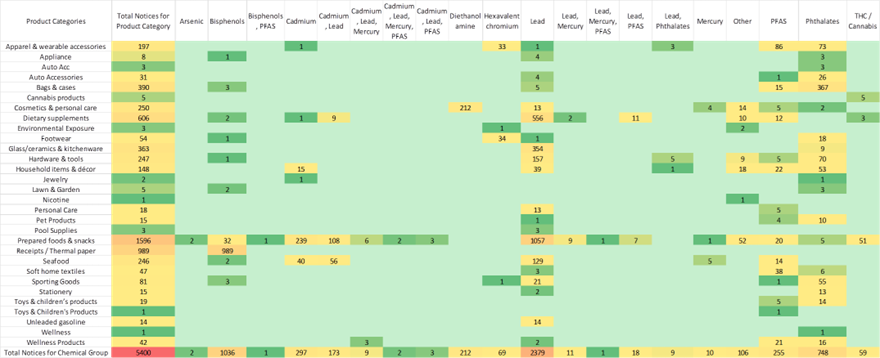
Below is the 2025 California Proposition 65 (Prop 65) 60-day notice enforcement analysis based on our consolidated dataset.
You may share this with strategic clients. If you need specific details about a notice or a product/chemical category, please get in touch.
2025 at a glance (all categories)
- Total unique notices: 5,233
- High-level category breakdown:
- Consumer Products: 49%
- Food (incl. dietary supplements): 46%
- Personal Care: 5%
Consumer Products focus (excluding Food + Personal Care)
When we exclude Food and Personal Care, there are about 2,560 unique notices remaining. Following are key takeaways:
- Analysing from chemical group perspective:
- Bisphenols become the #1 driver (≈ 1,000 notices), primarily from receipts/thermal paper.
- Phthalates are the #2 driver (≈ 700 notices), concentrated in bags & cases.
- Lead remains a major enforcement driver (≈ 600 notices), especially in glass/ceramics and certain hardware/tool items.
- PFAS was targeted (≈ 200 notices) in apparel/wearable accessories and select soft home textiles.
- Analysing from product categories (consumer products excluding food and personal care) perspective:
- Receipts / Thermal paper: dominated by bisphenols (largest single product/chemical block).
- Bags & cases: primary target for phthalates.
- Glass/ceramics & kitchenware: primary targeted for lead.
- Hardware & tools: targeted for lead and phthalates.
- Apparel & wearable accessories: notable for PFAS (and some phthalates/other allegations depending on product type), there were also many notices for hexavalent chromium in leather gloves (fashion, sporting goods and PPE) and leather footwear.
The following charts provide the visual summary supporting the findings above:


New Jersey enacts “Protecting Against Forever Chemicals Act” targeting PFAS in consumer products
Effective 12 January 2028, New Jersey has enacted comprehensive legislation (Senate Bill 1042, now law) that significantly restricts the use of intentionally added per- and polyfluoroalkyl substances (PFAS) in selected consumer product categories.
What the law does
- Prohibits sales of PFAS-containing products. The sale, offer for sale, or distribution of products with PFAS intentionally added is banned in several categories, including:
- Cosmetics containing intentionally added PFAS
- Carpet and fabric treatments treated with PFAS
- Food packaging made with added PFAS
These prohibitions take effect on 12 January 2028.
- Cookware labelling requirement:
- Instead of an outright ban, manufacturers of consumer-grade cookware containing intentionally added PFAS must include a clear label stating “This product contains PFAS” (in both English and Spanish). The labelling requirement also applies to online product listings; small cookware items without sufficient label space may be exempt.
- PFAS definition and scope:
- “PFAS” is broadly defined to include any fluorinated organic chemical with at least one fully fluorinated carbon atom, consistent with other U.S. state standards.
Canada updates the Prohibition of Certain Toxic Substances — PFAS and flame retardants targeted
Canada has published and finalised the Prohibition of Certain Toxic Substances Regulations, 2025 (SOR/2025-270), which will repeal and replace the earlier 2012 federal prohibition framework under the Canadian Environmental Protection Act, 1999 (CEPA). The updated regulation takes effect on June 30th, 2026 and introduces strengthened controls on a suite of persistent, bioaccumulative toxic substances and products containing them.
Expanded prohibitions & scope
- Stricter PFAS controls: the revised regulation tightens restrictions on perfluorooctane sulfonate (PFOS), perfluorooctanoic acid (PFOA), long-chain perfluorocarboxylic acids (LC-PFCAs), and related precursors. Previously permitted exemptions for certain products and uses have been removed or narrowed, including personal use items and earlier limited AFFF exemptions.
- New flame retardant bans: two additional high-concern flame retardants — Dechlorane Plus (DP) and decabromodiphenyl ethane (DBDPE) — and products containing them are now subject to prohibition.
- Products covered: the regulations apply not only to the listed substances themselves but also to products that contain them, broadening the compliance scope beyond chemical inventories to finished and semi-finished goods.
Time-limited exemptions & permits
Recognising ongoing industrial needs and transition challenges, the 2025 Regulations include time-limited “authorised activities” (exemptions) for certain sectors such as aerospace, automotive, electronics, and others, allowing continued manufacture, use, or import for specified durations. Where no specific exemption is provided, regulated parties may apply for temporary permits (valid up to 1 year and renewable up to two times) to continue activities while alternatives are adopted.
Removal of old exemptions
A number of long-standing exemptions from the 2012 Regulations (e.g. photoresists, certain firefighting foams, and personal use products containing PFAS and legacy flame retardants) have been repealed or substantially modified. This means manufacturers, importers, and users must reassess whether previously permitted products are now restricted.
See below a table summarising some recent ASTM standards updates:
|
Reference |
Title |
|
ASTM F1169-25 |
Standard Consumer Safety Specification for Full-Size Baby Cribs |
Issues new quality control order for aluminium cookware & beverage cans
On the 15 January 2026, the Government of India (Ministry of Commerce & Industry, Department for Promotion of Industry and Internal Trade) notified the Cookware, Utensils and Cans for Foods and Beverages (Quality Control) Order, 2026 — Gazette Notification S.O. 219(E). This order replaces the earlier 2025 version but only in relation to wrought aluminium utensils and aluminium beverage cans. It was published under the Bureau of Indian Standards Act, 2016 and took effect on the date of publication in the Official Gazette.
Products & mandatory standards
The new quality control order establishes compulsory conformity with specified Indian Standards (IS) for the following product categories sold in the Indian market:
- Wrought aluminium utensils → IS 1660:2024
- Aluminium cans for beverages → IS 14407:2023
Covered goods must bear the BIS Standard Mark and be manufactured or imported only with a valid licence under Scheme-1 of the Bureau of Indian Standards (Conformity Assessment) Regulations, 2018.
Phased dates for compliance
Implementation is staggered based on business size to allow time for certification and conformity assessment:
- General (non-MSME) enterprises: frome 1 October 2026
- Small enterprises: from 1 January 2027
- Micro enterprises: from 1 April 2027
These dates apply to both domestic producers and importers of the specified aluminium products destined for the Indian market.
Key exemptions & transitional provisions
The order includes several important exemptions:
- Exports: goods manufactured domestically exclusively for export are not subject to the order.
- Pre-implementation stock: manufacturers or importers with stock already manufactured or imported before the relevant compliance date may continue to sell or display such goods for up to six months, provided they submit a certified declaration to BIS.
- Filled goods: imported products already filled with solid, liquid, or gaseous content are exempt from the order.
- R&D import allowance: up to 200 units per year can be imported for research and development if not sold commercially and disposed of as scrap, with records maintained and reported.
Mandatory FCM on specific paper implementation date released
On January 15th, 2026, the Thailand Ministry of Industry notified (G/TBT/N/THA/604/Add.1, G/TBT/N/THA/709/Add.1) the WTO of two kinds of food contact paper materials for which the mandatory regulation measure will enter into force on the 22nd June 2026.
- Paper for food contact:
- Thai Industrial Standard: TIS 2948-2562(2019)
- Enter into force date: 22 June 2026
Standard update for consumer products
In December 2025, the Chinese Ministry of Industry and Information Technology approved 748 industry standards, and the State Administration for Market Regulation (National Administration for Standardisation) approved 261 recommended national standards.
- Chinese Industrial Standard Announcement #41 of 2025
- Chinese National Standard Announcement #33 of 2025
The main standards related to textiles are:
|
No. |
Standard Code |
Standard name |
Applicable Scope |
Into force |
Replaced |
|
Bag & Luggage |
|||||
|
1 |
GB/T 38082-2025 |
Biodegradable plastic shopping bags |
This standard specifies the terms and definitions, requirements, test methods, inspection rules, as well as packaging, transportation, and storage of biodegradable plastic shopping bags. This standard applies to plastic shopping bags made primarily from biodegradable plastic resins, processed into bags through film production and bag-making processes such as heat sealing or bonding. It also applies to shopping bags made from a composite of biodegradable plastics and other materials. This standard does not apply to biodegradable plastic bags intended solely for packaging use and not for carrying purposes, such as biodegradable roll bags (also known as tear-off bags or perforated bags). |
2027-01-01 |
GB/T 38082-2019 |
|
Hard goods |
|||||
|
1 |
GB 12142-2025 |
Safety requirements for portable metal ladders |
This document specifies requirements for the structural dimensions, performance, test methods, and usage information of portable metal ladders. This document applies to portable metal leaning ladders, extension ladders, self-supporting ladders, telescopic ladders, hinged ladders, and combination ladders. |
2027-01-01 |
GB 12142-2007 |
|
2 |
QB/T 2506-2025 |
Uncut finished spectacle lenses-Optical hard resin lenses |
This document specifies the technical requirements for optical resin lenses, describes the corresponding test methods, and provides a product classification system for technical specifications.
This document applies to the production, inspection, and sale of eyeglass lenses made from polymeric materials with optical properties. |
2026-07-01 |
QB/T 2506-2017 |
|
3 |
QB/T 8192-2025 |
Technical requirements and test methods for goggles for alpine snowy environment |
This document specifies the requirements, sample selection, marking, and packaging for high-altitude snow goggles, and describes the corresponding test methods. |
2026-07-01 |
QB/T 8192-2025 |
|
Hard goods Electrical |
|||||
|
1 |
GB 46859-2025 |
Technical requirements for safety of children's watches |
This document specifies the technical safety requirements for children's watches and outlines the corresponding test methods. This document applies to children's watches. |
2027-01-01 |
/ |
|
2 |
GB 46865-2025 |
Safety requirements for optical radiation of consumer laser pointers |
This document specifies the safety requirements for optical radiation of consumer laser pointers, mainly including safety requirements, measurement and evaluation, labeling, and instructions. This document applies to consumer laser pointers with a nominal wavelength in the visible light range of 400 nm to 700 nm (including but not limited to laser pointers, laser shooting simulators, laser aiming devices, and other laser products with indication, entertainment, or office functions) for production, testing, sale, and use. |
2026-07-01 |
/ |
|
Labeling |
|||||
|
1 |
FZ/T 08009-2025 |
Recycling marking of textile products |
This document specifies the design principles, labelling, and marking requirements for the recycling marking of textile products. This document applies to all types of end-use textile products. |
2026-07-01 |
/ |
|
2 |
FZ/T 08010-2025 |
Textiles — Classification and content identification of recycled fibers |
This document specifies the terminology and definitions, classification, naming, content labelling requirements, identification and quantification, as well as marking for recycled fibres. This document applies to recycled fibres and their textile products. |
2026-07-01 |
/ |
|
Textile |
|||||
|
1 |
GB/T 46755-2025 |
General technical requirements for smart textile products |
This document specifies the terminology and definitions, requirements, test methods, inspection rules, product instructions, and packaging for smart textile products. This document applies to all types of smart textile products. |
2026-07-01 |
|
|
2 |
FZ/T 73012-2025 |
Brassiere |
This document specifies the sizes and specifications, requirements, testing, sampling rules, acceptance criteria, and instructions for use, packaging, transportation, and storage of bras. This document applies to bra products primarily made from knitted fabrics. |
2028-01-01 |
FZ/T 73012-2017 |
|
3 |
FZ/T 73013-2025 |
Knitted swimming wear |
This document specifies the product classification and sizing, requirements, testing, sampling rules, acceptance criteria, product usage instructions, packaging, transportation, and storage for knitted swimming wear. This document applies to knitted swimming wear primarily manufactured from knitted fabrics. Swimming wear made from other textile fabrics may be implemented by reference. |
2028-01-01 |
FZ/T 73013-2017 |
|
4 |
FZ/T 73083-2025 |
Knitted care underpants |
This document specifies the product classification, sizing, requirements, testing methods, sampling rules, acceptance criteria, instructions for use, packaging, transportation, and storage of knitted care underwear. This document applies to knitted care underwear primarily manufactured from knitted fabrics. |
2026-07-01 |
/ |
|
5 |
FZ/T 73084-2025 |
One size knitted bralette |
This document specifies the models and specifications, requirements, testing, sampling rules, acceptance criteria, as well as product instructions for use, packaging, transportation, and storage for free-size knit bras. This document applies to free-size bra products primarily made from elastic knit fabrics. |
2026-07-01 |
/ |
|
6 |
FZ/T 73026-2025 |
Knitted skirt and lady suit |
This document specifies the product sizes, requirements, testing methods, sampling rules, acceptance criteria, product usage instructions, packaging, transportation, and storage for knitted skirts and ladies suits. This document applies to knitted skirts and ladies suits primarily made from knitted fabrics. |
2028-01-01 |
FZ/T 73026-2014 |
|
7 |
FZ/T 73085-2025 |
Knitted garments with spun-dyed fibers |
This document specifies the sizing, requirements, testing, sampling rules, and acceptance criteria for knitted garments with spun-dyed fibers, as well as instructions for use, packaging, transportation, and storage of the products. This document applies to garments primarily made from knitted fabrics composed of spun-dyed polyamide (nylon) fibres, spun-dyed viscose fibres, spun-dyed polyester fibres, or spun-dyed fibre blends with a minimum content of 50%. Other spun-dyed fiber knitted garments may be produced by reference to this document. |
2026-07-01 |
/ |
|
8 |
FZ/T 73086-2025 |
Floor socks |
This document specifies the product classification, specifications, requirements, testing methods, sampling rules, acceptance criteria, product usage instructions, packaging, transportation, and storage for floor socks. This document applies to floor socks. |
2026-07-01 |
/ |
|
9 |
FZ/T 73087-2025 |
Knitted functional pillows for infants |
This document specifies the terminology and definitions, specifications, requirements, testing methods, sampling rules, acceptance criteria, and instructions for use, packaging, transportation, and storage of knitted functional pillows for infants. This document applies to pillow products for infants aged 36 months and under, manufactured with knitted fabric as the primary material and filled with materials such as textile fibres, natural plant fibers, polyurethane, or latex, designed to provide specific functional benefits. It also applies to walking head protection caps and walking head protection pads. |
2026-07-01 |
/ |
|
10 |
FZ/T 81001-2025 |
Sleepwear |
This document specifies the requirements, testing methods, and inspection rules for sleepwear, as well as their marking, packaging, transportation, and storage. This document applies to homewear garments such as sleepwear (including sets) primarily manufactured from textile woven fabrics. |
2028-01-01 |
FZ/T 81001-2016 |
|
11 |
FZ/T 81027-2025 |
Woven camel hair overcoat |
This document specifies the terminology and definitions, requirements, testing methods, inspection rules, as well as marking, packaging, transportation, and storage for woven camel hair overcoat. This document applies to woven woolen coats and similar garments containing 30% or more camel hair. This document does not apply to clothing for infants aged 36 months or younger. |
2026-07-01 |
/ |
|
12 |
FZ/T 81013-2025 |
Pet dog apparel |
This document specifies the terminology and definitions, requirements, test methods, inspection rules, as well as marking, packaging, transportation, and storage for pet dog apparel. This document applies to pet dog apparel primarily manufactured from textile fabrics. Other pet apparel or pet textile accessories may refer to this document for implementation. |
2028-01-01 |
FZ/T 81013-2016 |
|
13 |
FZ/T 74005-2025 |
Knitted yoga garment |
This document specifies the sizing, requirements, testing methods, sampling rules, acceptance criteria, product usage instructions, packaging, transportation, and storage for knitted yoga garment. This document applies to yoga apparel primarily made from knitted fabrics. |
2028-01-01 |
FZ/T 74005-2016 |
|
14 |
FZ/T 61007-2025 |
Home textiles—Super-fine rashel blanket |
This document specifies the technical requirements, test methods, inspection rules, marking, packaging, transportation, and storage of super-fine rashel blanket. This document applies to all types of warp-knitted super-fine rashel blanket primarily manufactured from polyester fibers. Other super-fine rashel blanket may be implemented by reference. |
2028-01-01 |
FZ/T 61007-2012 https://www.miit.gov.cn/jgsj/kjs/wjfb/art/2025/art_a061d8bdab7d4fceb6132f7cf05385ad.html |
|
15 |
FZ/T 64123-2025 |
Daily-used cotton swabs |
This document specifies the terminology and definitions, product classification, technical requirements, test methods, inspection rules, packaging, marking, transportation, and storage of daily-used cotton swabs. This document applies to daily-used cotton swabs, consisting of a swab stick and a cotton head formed by winding cotton fibres, intended for personal care, skin cleansing, and similar purposes. |
2026-07-01 |
/ |
|
16 |
FZ/T 64124-2025 |
Disposable compressed towel |
This document specifies the terminology and definitions, requirements, test methods, inspection rules, marking, packaging, transportation, and storage of disposable compressed towels. This document applies to compressed disposable wiping products made from materials such as woven, knitted, or non-woven fabrics, including compressed bath towels, compressed facial wipes, and similar products. |
2026-07-01 |
/ |
Below you will find a monthly summary of product recalls and alerts in Europe (Source: “Safety Gate (RAPEX)”) and the U.S. (Source “CPSC”).
Safety Gate (RAPEX) (European Commission Rapid Alert System for dangerous non-food products – Alerts reported by EU national authorities).
The following 43 alerts regarding toys, childcare articles and children's equipment products were reported between week 52 of 2025 and week 3 of 2026.
|
Type of Risk |
Number of alerts |
Notes |
|
Burns, fire |
1 |
Fancy dress costume The costume may catch fire if worn close to an ignition source. The product does not comply with the requirements of the Toy Safety Directive nor with EN 71-2. |
|
Chemical |
1 |
Soft toy The plastic material of the product has an excessive concentration of dibutyl phthalate (DBP). The product does not comply with the requirements of the Toy Safety Directive. |
|
1 |
Balloons The rubber of the balloons releases an excessive amount of nitrosamines and nitrosatable substances which generate nitrosamines. The product does not comply with the requirements of the Toy Safety Directive nor with EN 71-12. |
|
|
2 |
Toy slime The migration of boron from the toy slime is too high. Ingestion or contact with an excessive quantity of boron may harm the health of children. The product does not comply with the requirements of the Toy Safety Directive nor with EN 71-3. |
|
|
1 |
Plastic toy set The toy contains an excessive concentration of bis(2-ethylhexyl) phthalate (DEHP). The product does not comply with the REACH Regulation. |
|
|
1 |
Plastic doll The plastic material of the product contains an excessive concentration of bis(2-ethylhexyl) phthalate (DEHP). The product does not comply with the REACH Regulation. |
|
|
1 |
Soft toy The plastic material of the product has an excessive concentration of bis(2-ethylhexyl) phthalate (DEHP). The product does not comply with the requirements of the Toy Safety Directive. |
|
|
1 |
Balloons The rubber of the balloons releases an excessive amount of nitrosatable substances. The product does not comply with the requirements of the Toy Safety Directive nor with EN 71-12. |
|
|
Chemical, Choking
|
1 |
Toy wand The battery compartment can be easily opened, leaving the button batteries accessible. This product does not comply with the requirements of the Toy Safety Directive. |
|
1 |
Key ring with soft toy The product contains small parts (the red wheels) and the fibrous stuffing material of the toy is easily accessible due to the weakness of the seams. A small child may put the filling material and/or the small parts in the mouth. Moreover, the plastic material of the product has an excessive concentration of bis(2-ethylhexyl) phthalate (DEHP). The product does not comply with the REACH Regulation, the requirements set out in the Toy Safety Directive nor with EN 71-1. |
|
|
1 |
Soft toy The product contains small parts (metal rings, hands and feet, plastic stone in the hair slide, decorative plastic flower) that can easily detach. A small child may put them in their mouth. Additionally, the product has an excessive concentration of bis(2-ethylhexyl) phthalate (DEHP) and diisooctyl phthalate (DIOP). The product does not comply with the requirements of the Toy Safety Directive nor with the REACH Regulation and EN 71-1. |
|
|
Choking
|
1 |
Activity toy The product contains small parts (beads inside the wheel) that can easily detach. The product does not comply with the requirements of the Toy Safety Directive nor with EN 71-1. |
|
1 |
Bow toy set The product has small parts (the projectiles' suction cups) which may easily detach. The product does not comply with the requirements of the Toy Safety Directive nor with EN 71-1. |
|
|
1 |
Construction toy The product contains small parts (the red wheels). The product does not comply with the requirements of the Toy Safety Directive nor with EN 71-1.
|
|
|
1 |
Finger toothbrush and teether The product has small parts (small gum pins) that can easily detach. The product does not comply with the General Product Safety Regulation. |
|
|
2 |
Key ring with soft toy The fibrous stuffing material of the toy is easily accessible due to the weakness of the seams. The product does not comply with the requirements of the Toy Safety Directive nor with EN 71-1. |
|
|
1 |
Key ring The product has small parts which can easily detach (metal ring and turtle eyes). The product does not comply with the requirements of the Toy Safety Directive nor with EN 71-1. |
|
|
1 |
Playmat The product has small parts (poles) that can easily detach. The product does not comply with the requirements of the Toy Safety Directive. |
|
|
1 |
Set of toy rattles The rattles set has small parts. Small children may put them in their mouths. The product does not comply with the requirements of the Toy Safety Directive nor with EN 71-1. |
|
|
4 |
Soft toy The toy has small parts that can easily detach. A small child may put them in their mouths. The product does not comply with the requirements of the Toy Safety Directive nor with EN 71-1. |
|
|
1 |
Soft toy The product has small parts which can easily detach. Moreover, the fibrous stuffing material of the toy is easily accessible. The product does not comply with the requirements of the Toy Safety Directive nor with EN 71-1. |
|
|
2 |
Toy water gun The product contains small parts that can easily detach. A small child may put them in their mouths. Moreover, the product’s labelling lacks the required information, which can lead the user to lack the necessary information about the dangers of the product. The product does not comply with the requirements of the Toy Safety Directive nor with EN 71-1. |
|
|
1 |
Wooden toy set The product has small parts (yellow rattle cover) that can easily detach. A small child may put them in their mouth. The product does not comply with the requirements of the Toy Safety Directive nor with EN 71-1. |
|
|
Choking, Strangulation |
1 |
Wooden toy The toy contains small parts that can easily detach (wooden ball). Small children may put them in their mouths. Moreover, the red tope length exceeds the maximum permitted length. The product does not comply with the requirements of the Toy Safety Directive nor with EN 71-1. |
|
1 |
Toy musical instrument The toy has small parts that can easily detach or break (belt tensioners) releasing small parts. A small child may put them in their mouth. Furthermore, the strap attached to the drum has no quick release mechanism. If worn around the neck, it could form a loop and become trapped. The product does not comply with the requirements of the Toy Safety Directive nor with EN 71-1. |
|
|
1 |
Make-up toy set The product contains small parts (rings and bracelets) that can easily detach. A small child may put them in their mouth. Furthermore, if the necklace is worn around the neck, it could form a loop and become trapped. The product does not comply with the requirements of the Toy Safety Directive nor with EN 71-1. |
|
|
1 |
Soft toy The product has small parts which can easily detach (dog's nose). A small child could put them into their mouth. Moreover, there are no warnings to indicate that the product is supplied with a cord. The product does not comply with the requirements of the Toy Safety Directive. |
|
|
Choking, Suffocation |
1 |
Soft toy The product contains small parts (the eyes of the dragon). Furthermore, the plastic bag of the packaging is too thin. If a child plays with the packaging, the plastic can cover the mouth and nose. The product does not comply with the requirements of the Toy Safety Directive nor with EN 71-1. |
|
Environment
|
1 |
Police baton traffic control toy The solders have excessive concentrations of lead and cadmium. The product does not comply with the requirements of the Directive on the restriction of the use of certain hazardous substances in electrical and electronic equipment (RoHS 2 Directive). |
|
1 |
Game toy The solder joint in the product has excessive concentrations of lead and cadmium. The product does not comply with the requirements of the Directive on the restriction of the use of certain hazardous substances in electrical and electronic equipment (RoHS 2 Directive). |
|
|
1 |
Toy ball The solder joint in the product has an excessive concentration of lead. The product does not comply with the requirements of the Directive on the restriction of the use of certain hazardous substances in electrical and electronic equipment (RoHS 2 Directive). |
|
|
1 |
Fire fighting vehicle toy The solders in the product have an excessive concentration of lead. The product does not comply with the requirements of the Directive on the restriction of the use of certain hazardous substances in electrical and electronic equipment (RoHS 2 Directive). |
|
|
Injuries
|
1 |
Baby stroller The rear wheels of the stroller are not properly fixed. This product does not comply with the General Product Safety Regulation nor with EN 1888-1. |
|
1 |
Toy scooter The diameter of the front wheels of the scooter is too small which can lead the scooter's wheel to become stuck on an uneven surface and the child falling. The product does not comply with the requirements of the Toy Safety Directive nor with EN 71-1. |
|
|
Strangulation
|
1 |
Sticky hand toy The toy contains a long cord made from elastic material and can be considerably stretched during use. A child could swing the toy around the head and twist it around the neck. The product does not comply with the requirements of the Toy Safety Directive nor with EN 71-1. |
|
1 |
Children’s water bottle The buckle could easily open, and the loose strap could strangle the child. The product does not comply with the General Product Safety Regulation nor with EN 14350. |
|
|
Suffocation
|
1 |
Spinner toy The product has small parts which may easily detach. A small child may put them in their mouth. The product does not comply with the Toy Safety Directive nor with EN 71-1. |
The following 10 alerts regarding jewellery were reported between week 52 of 2025 and week 3 of 2026.
|
Type of Risk |
Number of alerts |
Notes |
|
Chemicals |
1 |
Bracelet |
|
1 |
Bracelet charm The product has an excessive concentration of cadmium. The product does not comply with the REACH Regulation. |
|
|
1 |
Extendable ring The rate of nickel release from the ring is too high. Moreover, the product has an excessive concentration of cadmium. The product does not comply with the REACH Regulation nor with the General Product Safety Regulation. |
|
|
1 |
Necklace set The product has an excessive concentration of lead and nickel. The product does not comply with the General Product Safety Regulation nor the REACH Regulation. |
|
|
1 |
Earrings The product has an excessive concentration of cadmium. The product does not comply with the REACH Regulation nor with the General Product Safety Regulation. |
|
|
1 |
Piercing jewellery The product has an excessive concentration of cadmium. The product does not comply with the REACH Regulation. |
|
|
4 |
Necklace The product has an excessive concentration of lead and Cadmium. The product does not comply with the REACH Regulation nor with the General Product Safety Regulation. |
The following three alerts regarding furniture were reported between week 52 of 2025 and week 3 of 2026.
|
Type of Risk |
Number of alerts |
Notes |
|
Fire |
2 |
Armchair The product can easily ignite. The product does not comply with the General Product Safety Regulation. |
|
Injuries |
1 |
Plastic chair The chair's construction does not ensure stability. The product does not comply with the General Product Safety Regulation. |
The following 25 alerts regarding miscellaneous consumer products were reported between week 52 of 2025 and week 3 of 2026.
|
Type of Risk |
Number of alerts |
Notes |
|
Burns, Cuts, Injuries |
1 |
Mug The base of the ceramic cup may crack or break unexpectedly during normal use, particularly when filled with hot liquids. This sudden failure can result in sharp ceramic fragments. Additionally, the breakage may cause hot liquid to spill. The product does not comply with the General Product Safety Regulation. |
|
Burns, Fire |
1 |
Deep fryer The oil may reach excessive temperatures. The product does not comply with the requirements of the Low Voltage Directive nor with EN 60335-1 and EN 60335-2-13. |
|
Chemicals |
1 |
Jump rope The plastic material of the product has an excessive concentration of bis(2-ethylhexyl) phthalate (DEHP), diisobutyl phthalate (DIBP) and dibutyl phthalate (DBP). The product does not comply with the General Product Safety Regulation nor with the REACH Regulation. |
|
1 |
Tablecloth The plastic material of the product has an excessive concentration of bis(2-ethylhexyl) phthalate (DEHP). The product does not comply with the REACH Regulation nor with the General Product Safety Regulation. |
|
|
2 |
Car floor mat The plastic of the product has an excessive concentration of polycyclic aromatic hydrocarbons (PAHs), notably Benzo (a)pyrene (BaP), Benzo (e)pyrene (BeP), Benz (a)anthracene (BaA), Chrysene (CHR), Benzo (b)fluoranthene (BbFA), Benzo (j)fluoranthene (BjFA, Benzo (k)fluoranthene (BkFA), and Dibenz(a,h)anthracene (DBAhA). The product does not comply with the REACH Regulation nor with the General Product Safety Regulation. |
|
|
1 |
Steering wheel cover The plastic of the product has an excessive concentration of polycyclic aromatic hydrocarbons (PAHs), ) notably Benzo (a)pyrene (BaP), Benzo (e)pyrene (BeP), Benz (a)anthracene (BaA), Chrysene (CHR), Benzo (b)fluoranthene (BbFA), Benzo (j)fluoranthene (BjFA, Benzo (k)fluoranthene (BkFA), and Dibenz(a,h)anthracene (DBAhA). The product does not comply with the REACH Regulation. |
|
|
1 |
Spring clip plier The plastic material of the product contains an excessive concentration of bis(2-ethylhexyl) phthalate (DEHP). The products do not comply with the REACH Regulation. |
|
|
1 |
Tool set The plastic material of the product contains an excessive concentration of bis(2-ethylhexyl) phthalate (DEHP). The product does not comply with the REACH Regulation. |
|
|
1 |
Emergency hammer |
|
|
Chemical, Environment
|
1 |
Flashlight The solders in the product have an excessive concentration of lead. In addition, the product contains excessive concentrations of bis(2-ethylhexyl) phthalate (DEHP). The plastic of the product also contains short chain chlorinated paraffins (SCCP). The product does not comply with the requirements of the Directive on the restriction of the use of certain hazardous substances in electrical and electronic equipment (RoHS Directive) nor with the Persistent Organic Pollutants (POP) Regulation. |
|
1 |
Emergency radio The solders in the product have an excessive concentration of lead. In addition, the plastic material in the cord has an excessive concentration of bis(2-ethylhexyl) phthalate (DEHP) and dibutyl phthalate (DBP). The product does not comply with the requirements of the Directive on the restriction of the use of certain hazardous substances in electrical and electronic equipment (RoHS 2 Directive). |
|
|
1 |
Spotlight Solders in the product have an excessive concentration of lead. In addition, the plastic material in the cord has excessive concentrations of bis(2-ethylhexyl) phthalate (DEHP), dibutyl phthalate (DBP) and short chain chlorinated paraffins (SCCP). The product does not comply with the requirements of the Directive on the restriction of the use of certain hazardous substances in electrical and electronic equipment (RoHS Directive) nor with the Persistent Organic Pollutants (POP) Regulation. |
|
|
2 |
Emergency kit The solders in the flashlight have an excessive concentration of lead. In addition, the plastic material in the survival tool case has an excessive concentration of bis(2-ethylhexyl) phthalate (DEHP). The product does not comply with the requirements of the Directive on the restriction of the use of certain hazardous substances in electrical and electronic equipment (RoHS 2 Directive). |
|
|
Cut |
1 |
Bicycle Handlebars were incorrectly fitted, therefore, the holes for the integrated cabling may work incorrectly, leading to the breakage of the handlebar. The product does not comply with the General Product Safety Regulation. |
|
Environment
|
1 |
Headlamp The solders in the product have an excessive concentration of lead. The product does not comply with the requirements of the Directive on the restriction of the use of certain hazardous substances in electrical and electronic equipment (RoHS 2 Directive). |
|
1 |
Emergency radio The solders in the product have an excessive concentration of lead. The product does not comply with the requirements of the Directive on the restriction of the use of certain hazardous substances in electrical and electronic equipment (RoHS 2 Directive). |
|
|
3 |
Waving cat The solders in the product have an excessive concentration of lead. The product does not comply with the requirements of the Directive on the restriction of the use of certain hazardous substances in electrical and electronic equipment (RoHS 2 Directive). |
|
|
1 |
Monocular The solders in the product have an excessive concentration of lead. The product does not comply with the requirements of the Directive on the restriction of the use of certain hazardous substances in electrical and electronic equipment (RoHS 2 Directive). |
|
|
Fire |
1 |
Candle set The wicks of the candle can re-ignite after the candles are extinguished. The product does not comply with the General Product Safety Regulation nor with EN 15493. |
|
Injuries
|
1 |
Anchor for climbing The anchor's resistance to load is insufficient. If a climber uses the anchor when climbing, there is a risk that the anchor won’t be able to stop a potential fall and the climber is therefore exposed to the risk of insufficient fall arrest when taking a fall. The product does not comply with the General Product Safety Regulation. |
|
1 |
Bicycle The fork of the bicycle could crack and break. The product does not comply with General Product Safety.Regulation. |
RASFF (European Commission Rapid Alert System for Food and Feed - Alerts reported by EU national authorities).
The following 5 alerts regarding Food Contact Materials related to children's tableware were reported from the 21st of December 2025 to the 20th of Janaury 2026.
|
Product |
Notes |
|
|
Melamine plate |
Insufficient stability of melamine plate with repeated use. Formaldehyde and melamine increasing migration. |
|
|
|
Excessive level of total migration from plastic |
|
|
Melamine spoon |
Formaldehyde migration from melamine is high level. |
|
|
Plate |
Migration of lithium from plates is high. |
|
|
Drinking bottle |
Loose particles |
|
The Office for Product Safety Standards (OPSS) issues Product Safety Alerts for the UK market.
The following 25 alerts regarding toys, childcare articles and children's equipment products were reported between week 52 of 2025 and week 3 of 2026.
|
Type of Risk |
Number of alerts |
Notes |
|
Asphyxiation
|
1 |
Water beads If these products are swallowed in their hydrated form, they can block a young child’s airway. The product does not meet the requirements of the Toys (Safety) Regulations 2011. |
|
1 |
Baby/infant stimulation toys (non-powered) If the product is swallowed in its hydrated form, it can block a young child’s airway. The product does not meet the requirements of the Toys (Safety) Regulations 2011. |
|
|
1 |
Fancy dress accessories (powered) The product contains water beads, which if swallowed in hydrated form, can block a young child’s airway. The water beads may also be swallowed and continue to expand inside the digestive tract, causing a blockage. |
|
|
Chemicals |
1 |
Bath/pool water toys The bath powder is sold in a clear plastic bottle without a child-resistant cap. If left unattended, a child may access and mouth the contents. The soap dinosaur also has a small parts. Improvements are required to product labelling and marking. The product does not meet the requirements of the Toys (Safety) Regulations 2011. |
|
2 |
Remote controlled vehicles The nickel-cadmium (Ni-Cd) battery compartment is not adequately secured, making the battery easily accessible to children. If a child accesses and removes the battery, there is a risk that, if the battery is damaged or has deteriorated with age, it may leak hazardous electrolytes. The product does not meet the requirements of the Toys (Safety) Regulations 2011. |
|
|
1 |
Dolls buildings/settings The plastic material used for the dolls and the battery cable were found to contain excessive concentrations of Dibutyl phthalate (DBP), di-isobutyl phthalate (DIBP), di-isononyl phthalate (DINP) and Bis(2-ethylhexyl) phthalate (DEHP). The battery compartment for the lights can also be easily removed, which could lead to a child accessing the button batteries during use. The product does not meet the requirements of the Toys (Safety) Regulations 2011. |
|
|
Choking Strangulation
|
1 |
Baby walkers The product may detach during reasonably foreseeable use, creating small parts and the cords exceed the maximum permissible length. The product does not meet the requirements of the Toys (Safety) Regulations 2011. |
|
1 |
Baby/infant stimulation toys (Non-Powered) The product has small parts from the rattle may detach during reasonably foreseeable use. Improvements are also required to product labelling and markings. |
|
|
Choking
|
1 |
Card games (non-powered) The elephant has a cardboard disc which should have been removed from the nose as part of the manufacturing process. The product does not meet the requirements of the Toys (Safety) Regulations 2011. |
|
1 |
Baby play pens/dens The printed laminate may detach over time, creating small parts. The product does not meet the requirements of the Toys (Safety) Regulations 2011. |
|
|
3 |
Pacifiers/teething rings The product is not compliant with the relevant safety standards specific to soother clips. The product does not meet the requirements of the General Product Safety Regulations 2005. |
|
|
5 |
Dolls/soft toys (non-powered) The key ring, plastic hands, and feet can detach creating small parts. If the hands or feet detach, it is also possible for children to access the fibrous stuffing, which may also present a choking risk. Improvements are also required to product labelling and marking. |
|
|
1 |
Toy model construction (non powered) The product can be torn into small parts which fit entirely within a small parts cylinder. As the product expands when hydrated, once swallowed it may expand in the digestive tract, causing a blockage. The product does not meet the requirements of the Toys (Safety) Regulations 2011. |
|
|
1 |
Role play (kitchen toys) The product presents a risk of choking as the hook and loop fastening (Velcro) can detach during reasonably foreseeable use, creating a small part. The product does not meet the requirements of the Toys (Safety) Regulations 2011. |
|
|
1 |
Role play (shopping/office/business Toys) The product includes a plastic strawberry which has small parts. The product is also supplied in a plastic bag which does not meet minimum thickness requirements. |
|
|
1 |
Musical toys (non-oowered) The drumstick ends can detach during use, creating small parts. The product does not meet the requirements of the Toys (Safety) Regulations 2011. |
|
|
Cuts and injuries |
1 |
Indoor/outdoor games The toys were found to include a retractable blade. The product does not meet the requirements of the Toy (Safety) Regulations 2011. |
|
Drowing
|
2 |
Baby baths/bath chairs/bath cradles The product failed to provide adequate and complete support surrounding the child and therefore could result in the child slipping down or out of the seat. The product was not marked, or accompanied, with relevant information, warnings, to enable consumers to assess and take precautions against the drowning risks posed by the product. The product does not meet the requirements of the General Product Safety Regulations 2005. |
|
Injuries |
1 |
Pacifiers/teething rings The dummy clip exceeds the maximum permitted length and does not meet the minimum required thickness for such products. The product does not meet the requirements of the General Product Safety Regulations 2005. |
|
1 |
Trampoline The product lacks essential safety warnings and does not provide adequate visibility for safe access. The zip closure access is black, matching the rest of the enclosure netting, making it difficult to distinguish and potentially unsafe in emergency situations. Additionally, the minimum specified height enclosure is not met, increasing the risk of falls from the product. The product does not meet the requirements of the Toys (Safety) Regulations 2011. |
|
|
Strangulation |
1 |
Baby/infant stimulation toys (non-powered) The attached cord creates a loop that is long enough to wrap around the infant’s neck. If a guardian has stepped away from the infant/ does not notice this and the cord becomes too tight around the infant’s neck. The product does not meet the requirements of the Toys (Safety) Regulations 2011. |
|
1 |
Outdoor games The instructions are incomplete, which could lead to a consumer installing the product incorrectly. If it is installed too high, the child’s head could become entangled in accessible openings. The product does not meet the requirements of the Toys (Safety) Regulations 2011. |
|
|
Suffocation |
2 |
Baby sleeping patter Pillows and soft toys are advised not to be placed in the sleep space for babies under the age of one year as their presence increases the risk of overheating and airway obstruction, which have been associated with sudden infant death syndrome (SIDS). The product does not meet the requirements of the General Product Safety Regulations 2005. |
|
1 |
Baby bassinet The product lacks a locking mechanism to securely attach the bassinet to the adult bed. As a result, there is a risk that a gap may form between the bassinet and the bed, allowing a child to fall into this space. This could force the child into a position where breathing is obstructed. The product does not meet the requirements of the General Product Safety Regulations 2005. |
|
|
2 |
Baby sleeping bag The hooded infant sleeping bag has a hood, which increases the likelihood that, during normal sleep movements, the hood may cover the baby’s nose and mouth, obstructing the airway. Additionally, the neck opening is secured with inappropriate fasteners and there are no arm holes, which may allow the baby to slip further into the sleeping bag, increasing the risk of the head becoming fully covered. Improvements are also required to safety information and warnings. |
The following six alerts regarding jewellery were reported between week 52 of 2025 and week 3 of 2026.
|
Type of Risk |
Number of alerts |
Notes |
|
Chemical |
1 |
Earrings/body-piercing jewellery The product contains excess concentrations of cadmium and nickel. The product does not meet the requirements of the REACH Regulations 2008. |
|
3 |
Bracelets The product contains excess concentrations of nickel, cadmium and lead. The product does not meet the requirements of the REACH Regulations 2008. |
|
|
2 |
Necklaces/necklets The product contains cadmium and lead. The product does not meet the requirements of the REACH Regulations 2008. |
The following nine alerts regarding miscellaneous consumer products were reported between week 52 of 2025 and week 3 of 2026.
|
Type of Risk |
Number of alerts |
Notes |
|
Asphyxiation
|
1 |
Flower/plant pots replacement parts/accessories If the product is swallowed in its hydrated form, it can block a young child’s airway. The product does not meet the requirements of the General Product Safety Regulations 2005. |
|
Choking |
1 |
Mugs/cups (non-disposable) The straw can disintegrate, creating small parts. The product does not meet the requirements of the General Product Safety Regulations 2005. |
|
Fire |
1 |
Candles The wick may ‘club’, resulting in higher-than-expected flaming. This could lead to increased smoking, wax dripping, and flaming. If left unattended, the flare could ignite nearby objects and potentially cause a fire to spread throughout the room. The product does not meet the requirements of the General Product Safety Regulation 2005. |
|
1 |
Candle holders/accessories The candle wick may fall onto the wooden part of the holder. The product does not meet the requirements of the General Product Safety Regulation 2005. |
|
|
Injuries |
1 |
Sports goals/nets accessories If the red height adjustment crank is removed whilst the product is in use or being handled, the main pole may fall vertically, possibly injuring the consumer. The product does not meet the requirements of the General Product Safety Regulations 2005. |
|
1 |
Ladders (non-powered) The ladder cannot hold the claimed weight without collapsing. The product does not meet the requirements of the General Product Safety Regulations 2005. |
|
|
1 |
Cycles (non-powered) The suspension forks can fail prematurely and crack, break or separate during use. The product does not meet the requirements of the General Product Safety Regulations 2005. |
|
|
2 |
Cycles parts The handlebar supplied with the bicycle may have a defect in the processing of the holes for the integrated cable routing. The product does not meet the requirements of the General Product Safety Regulations 2005. |
U.S.
From the 8 January of 2026 to the 29 January of 2026, the CPSC (Consumer Product Safety Commission) published the following recalls:
17 recalls regarding toys and childcare products
|
Hazard |
Number of alerts |
Notes |
|
Entrapment
|
2 |
Safety gates The recalled gates violate the mandatory standard for expansion gates and expandable enclosures because a child’s torso can fit through the opening between the gate and the floor, becoming entrapped, posing a risk of serious injury or death. |
|
1 |
Infant bath seats The recalled bath seats violate the mandatory standard for infant bath seats because they are unstable and can tip over while in use, and have leg openings that allow the child to slip down until the child's torso can become entrapped, posing a risk of serious injury or death due to drowning and entrapment. |
|
|
1 |
Crib mattresses The aftermarket mattresses violate the mandatory standard for crib mattresses, as the mattresses may not adequately fit certain play yards or non-full-sized cribs, which could create gaps posing a deadly entrapment hazard. Babies can face a risk of suffocation in gaps between an undersized mattress, or extra padding, and side walls of a product, especially when the infant’s face becomes trapped against the side and the mattress, preventing the infant from breathing. |
|
|
Ingestion |
1 |
Pounding Toys The recalled pounding toys violate the mandatory standard for toys because they contain high-powered magnets, which can detach, posing an ingestion hazard to children. When high-powered magnets are swallowed, the ingested magnets can attract each other, or other metal objects, and become lodged in the digestive system. This can result in perforations, twisting and/or blockage of the intestines, blood poisoning, and death. |
|
1 |
Water toy kits The recalled toy kits violate the mandatory standard for toys containing button cell batteries because the compartment that holds the batteries can be easily accessed and opened by children, posing a deadly ingestion hazard to children. When button cell and coin batteries are swallowed, the ingested batteries can cause serious injuries, internal chemical burns and death. |
|
|
2 |
Magnet ball toys The magnet ball toys violate the mandatory standard for toys because they are loose high-powered magnets, posing an ingestion hazard to children. When high-powered magnets are swallowed, they can attract each other, or other metal objects, and become lodged in the digestive system. This can result in perforations, twisting, and/or blockage of the intestines, blood poisoning and death. |
|
|
Fall and entrapment |
2 |
Baby loungers The recalled baby loungers violate the mandatory safety standard for Infant Sleep Products. The sides are too low to contain an infant, and the enclosed openings at the foot of the loungers are wider than allowed, posing serious risks of fall and entrapment hazards to infants. In addition, the baby loungers do not have a stand, posing a fall hazard if used on elevated surfaces. These violations create an unsafe sleeping environment and can cause death or serious injury to infants. |
|
Suffocation |
1 |
Crib bumpers The recalled padded crib bumpers violate the federal ban on crib bumpers because they can obstruct an infant’s breathing, posing a risk of serious injury or death, due to suffocation. This creates an unsafe sleeping environment for infants. Padded crib bumpers are banned by the federal Safe Sleep for Babies Act. |
|
1 |
Baby gyms The recalled baby gyms violate the mandatory safety standard for infant support cushions because the floor mats can obstruct an infant’s breathing, posing a serious risk of injury or deadly suffocation hazard. |
|
|
1 |
Self-feeding pillows The recalled self-feeding pillows hold the bottle at an unsafe angle while keeping it fixed in place, so the infant cannot pull away. This can lead to aspiration of milk or formula, posing a risk of suffocation. |
|
|
Poisoning |
1 |
Colouring sets The crayons in the colouring set have high levels of strontium and aluminum, and this may present a risk if ingested, posing a poisoning hazard if ingested by young children. |
|
Choking |
2 |
Teething toys The recalled teething toys violate the mandatory standard for toys because the silicone strings are smaller than permitted. The silicone strings can reach the back of the throat and become lodged, posing a risk of respiratory distress, serious choking hazard and death. |
|
1 |
Plush toys The legs of the plush toy can detach from the body allowing the release of small beads that are on the legs, posing a choking hazard to young children. |
11 recalls of consumer products
|
Type of Risk |
Number of alerts |
Notes |
|
Tip-over and entrapment |
2 |
Dressers The recalled dressers are unstable if they are not anchored to the wall, posing tip-over and entrapment hazards that can result in a risk of serious injuries or death to children. The dressers violate the mandatory standard as required by the STURDY Act. |
|
Impact |
1 |
Chandeliers If the chandelier is hung at an angle on a vaulted ceiling or a sloped beam, the chandelier canopy hardware can break, causing the chandelier to detach and fall from the ceiling, posing an impact hazard. |
|
Head injury |
1 |
Bicycle helmets The recalled helmets violate the mandatory safety standard for bicycle helmets because the helmets do not comply with the impact attenuation, positional stability, labeling and certification requirements. The helmets can fail to protect the user in the event of a crash, posing a serious risk of injury or death due to head injury. |
|
Fall |
1 |
Bicycle pedals The pedal axle can crack, causing the pedal to detach from the crank, posing a fall hazard to the rider. |
|
Entrapment and asphyxiation |
3 |
Adult portable bed rails The recalled bed rails violate the mandatory standard for adult portable bed rails because when the bed rails are attached to a bed, users can become entrapped within the bed rail or between the bed rail and the side of the mattress, posing a serious entrapment hazard and risk of death by asphyxiation. In addition, the bed rails do not bear the required hazard warning labels. |
|
Injury and fall |
2 |
Chairs The recalled chairs can crack and collapse, posing injury and fall hazards. |
|
Drowning |
1 |
Above-ground pool The compression strap that surrounds the outside of the pool legs may create a foothold, allowing a child access to the pool, posing a drowning risk. |