











































From auditor to management: Gregory’s journey in food safety industry


In a brightly lit office filled with the warmth of early Spring in France, Gregory found himself at ease while discussing his career journey through the world of food safety.
With a master’s degree in biology, Gregory attributed his scientific inclination to his upbringing. Being the son of a materials engineer, he was driven towards a scientific path from a young age. Over time, his curiosity in life and earth sciences solidified his decision to delve deeper into these fields.
The beginning at IFS Version 5
He stepped into the food safety industry with an end-of-study internship in a food processing plant during the transition IFS (International Featured Standards) Food certification Version 4 to Version 5. His internship company was among the few pioneers in Version 5 certification and his involvement in certification preparation gave Gregory some important first-hand experience and sowed the seeds for his food safety career.
Since then, Gregory has been tied to food quality, food development, food product development. Keywords like HACCP, quality KPIs and food audits are part of his day-to-day work.
Running field audits was an essential part of his job and over the past decade, Gregory has completed over 500 field audits in Europe, Morocco and Indonesia. He recounted several memorable experiences, both positive and challenging. One particularly vivid memory was when he found himself spending the night at an airport after missing a flight connection. Another anecdote was of him being in a maritime control tower in Indonesia, and then there was the time he faced the brutal November climate in Iceland. Each experience not only broadened his horizons but also enriched his professional insights.
Discussing the breadth of his auditing experiences, he described the stark contrasts between different site setups. The smallest site he audited had only one person who was both the worker and the manager. The manager of this small supplier, which delivered to a major Parisian restaurant, was initially reluctant to answer Gregory’s questions but became increasingly talkative as the audit went on. Juggling fish filleting with answering questions, the scene was so comical that Gregory still laughs about it today.
In contrast, he was in a massive palm oil production facility in Indonesia with 9,000 employees, where bus transfers were required to move between sections. The site was very well prepared for the audit and the auditor, with a completely different ambiance.
IFS Food Version 8 and beyond
As Gregory reflected on his early career, he recalled the significant changes he witnessed in the food manufacturing industry over the years.
When he started at IFS Food Version 5, critical aspects such as Food Defense, Food Fraud, and Food Safety Culture were not integrated into Global Food Safety Initiative (GFSI) standards. National and regional food safety regulations such as Regulation (EU) No 1169/2011 on food labelling emerged after that time, raising the bar for regulatory compliance for the food industry and the competency level of food safety auditors.
Gregory has witnessed a dramatic enhancement of food safety standards, largely fueled by increasing consumer awareness, the growth of consumer rights associations, and heightened media scrutiny, alongside regulatory pressure. Additionally, the alignment and benchmarking provided by the GFSI have significantly facilitated systematic improvements in these standards.
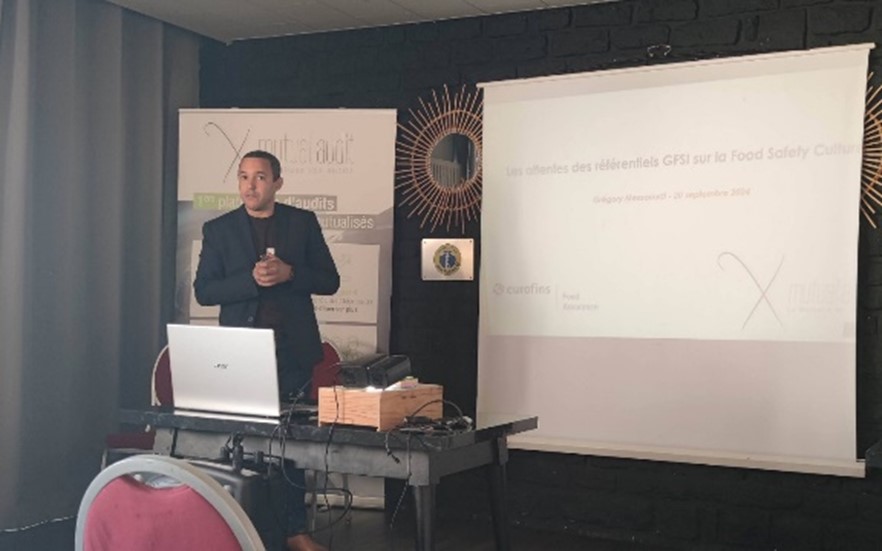
Gregory during one of his many training sessions explaining GFSI Food Safety Culture.
From auditor to management
In order to be an IFS auditor, Gregory spent a year and a half working hard to achieve his IFS auditor qualification, but he didn’t stop just there.
After joining Eurofins Consulting in France, Gregory took on bigger responsibilities, particularly in advisory services and training. Juggling audits, studying and other tasks, he challenged himself to be well-versed in topics related to GFSI standards, equipping him to be a sought-after trainer within the company.
Compared to auditing, which is highly regulated and protocol-driven, training and consultation (provided by a company that is different from and independent of certification audit) allow more flexibility, which in return brings more challenges to Gregory’s critical thinking and customer-oriented mindset. Gradually, he has become more exposed to the industry, the company and various tasks through building development processes and management systems that drive efficiency.
As he moved up the ranks, now as the Business Unit Manager, Gregory still engages in audits but on a reduced scale. He has replaced much of his audit travel with client meetings, industry events and internal training sessions. While he doesn’t miss the grueling travel schedule, he appreciates the enriching encounters he experienced as an auditor.
Leading a diverse team of about 15 employees alongside a pool of freelancers, Gregory emphasised the importance of teamwork and communication in maintaining consistency. Since he sees strong listening and communication skills as vital, in the past three years, he has invested time in implementing communication practice to align operations within the organisation and is now focused on extending these practices to the freelance network to foster loyalty and a stronger connection to organisational goals.
Gregory identified resource management as one of his greatest challenges in hhis current role, highlighting its significance for skill development and responsiveness to market trends. Like many other managers in the world, he is from time to time caught up in unforeseeable scenarios, adding extra excitement and inspiration to his hectic office life.
Reflecting on his career journey, Gregory's career path illustrates a blend of rigorous scientific training, hands-on experience in food safety and compliance, as well as a determined will to progress, leading him from an auditor to where he is now.
Taking a sip of his favorite black coffee, he encouraged aspiring auditors to step outside their comfort zones and consistently expand their skill sets. Acquiring new skills enables them to develop innovative processes that benefit the business, ultimately earning the trust and respect of their teams. This, in turn, paves the way for career advancement and opportunities to climb the professional ladder.



© Eurofins Assurance 2026 Personal data protection policy