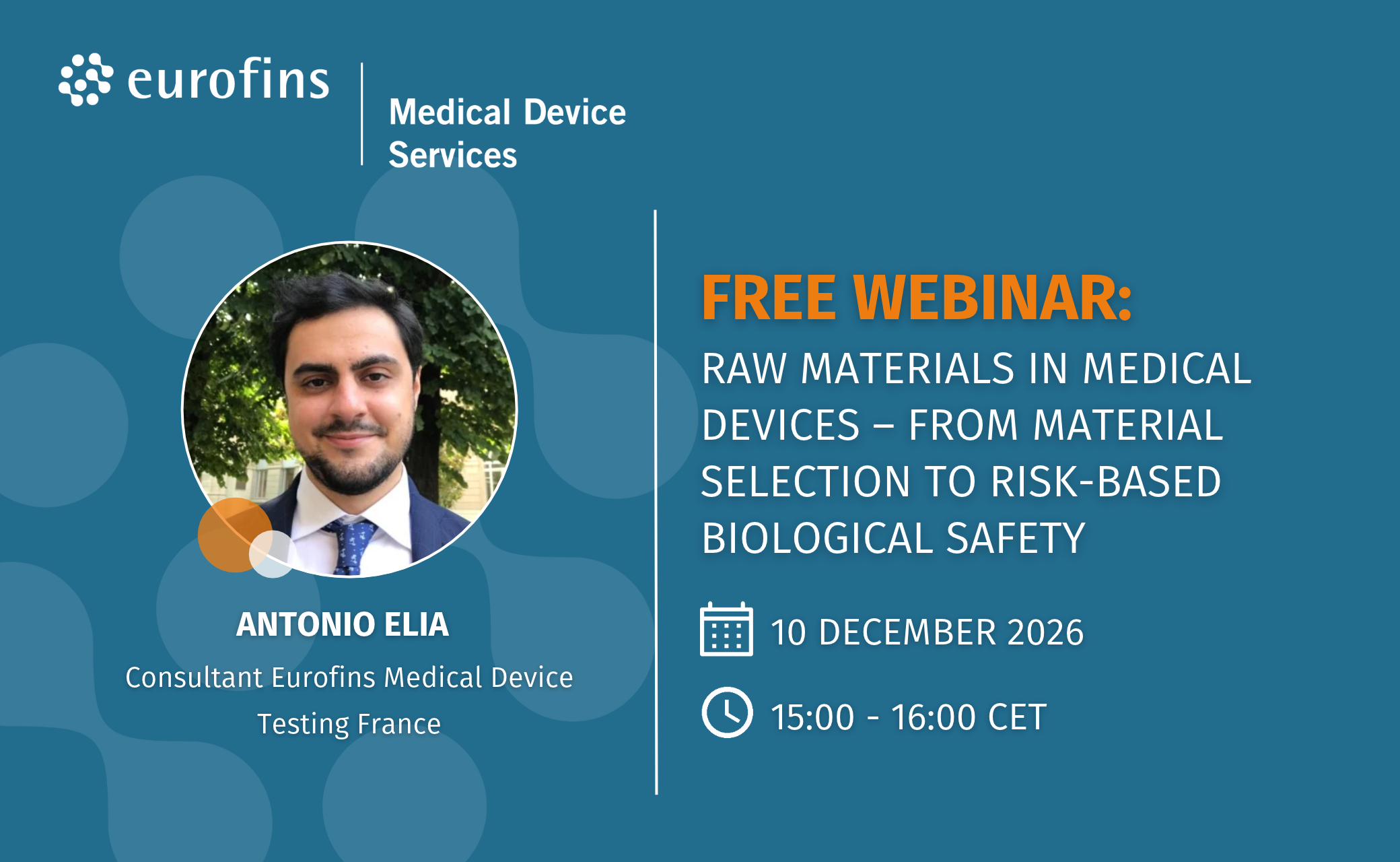
Raw Materials in Medical Devices – From Material Selection to Risk-Based Biological Safety
Raw Materials in Medical Devices: How to Select, Assess and Manage Materials in a Changing Regulatory Landscape. Antonio Elia, Consultant Eurofins Medical Device Testing France
Date: 10 December 2026
Time: 15:00 - 16:00
Raw Materials in Medical Devices – From Material Selection to Risk-Based Biological Safety addresses how decisions made at the raw material stage can influence the biological safety, regulatory readiness, and lifecycle management of a finished medical device. A material described as “medical grade” or supported by historical USP Class VI data may provide useful evidence, but neither designation alone demonstrates suitability for every intended use. Material composition, additives, processing, sterilisation, degradation, patient contact, and potential exposure must all be considered. The webinar will present a risk-based approach to selecting materials, assessing available documentation and toxicological information, evaluating material and supplier changes, and interpreting the changing role of USP Class VI. Participants will learn how to transform material information into a scientifically defensible biological safety rationale aligned with the ISO 10993 framework and the applicable requirements of the EU Medical Device Regulation.
Why Attend?
How to move beyond material labels and certificates and build an evidence-based raw material strategy that supports biological evaluation, change assessment, and regulatory submissions:
- Why biological safety begins during material selection, before final-medical device testing;
- How intended use, type and duration of body contact, processing, sterilisation, and degradation influence material suitability;
- Why “medical grade” is not, by itself, a complete biological safety conclusion;
- Which information can support raw material selection, including composition, specifications, SDS, CoA, existing biocompatibility data, literature, and toxicological information;
- How to identify documentation gaps and determine when chemical characterisation or targeted biological testing may be needed;
- How FDA expects a defensible assessment to represent the final finished device and integrate formulation, additives, impurities, manufacturing aids and residuals, cleaning, passivation, sterilisation, aging, clinical exposure, prior use, comparator relevance, and residual uncertainty.
Assessment of material changes and the evolving regulatory landscape:
- How to assess the biological impact of changes in material grade, supplier, formulation, additives, colorants, manufacturing, packaging, or sterilisation;
- Why nominally equivalent materials may not be chemically or biologically equivalent, according to ISO 10993 definitions;
- How to use a structured change assessment to determine whether additional testing can be waived or not;
- How to apply the FDA decision logic when assessing material changes;
- What the revisions to USP <87> and <88> mean for medical device manufacturers and the future use of USP Class VI data;
- How existing USP Class VI information can remain useful as supporting evidence without replacing final-device biological evaluation.
Who Should Join?
- Regulatory Affairs, Biological Safety & Toxicology Professionals
Strengthen your approach to material-related evidence, substances of concern, biological evaluation, and regulatory justification. Learn how to interpret existing data, recognize critical gaps, and build a risk-based rationale suitable for technical documentation and regulatory review. - Medical Device Manufacturers, R&D & Product Development Teams
Gain practical guidance for selecting materials early, understanding the limitations of “medical grade” and old USP Class VI claims, and considering processing, sterilisation, degradation, and patient exposure before design decisions become costly to reverse. - Quality, Risk, Change Management & Supplier-Facing Teams
Understand how changes in material grade, formulation, supplier, processing, colorants, sterilisation, or packaging can affect the biological safety profile of a medical device, and how to determine whether documentation, analytical comparison, toxicological assessment, or targeted testing is needed. - Start-ups and Emerging Medical Device Companies
Establish a proportionate raw material strategy from the beginning of development, reducing avoidable data gaps, late-stage redesign, unnecessary testing, and delays in regulatory submissions.
In Summary:
This webinar explores how raw material selection impacts the biological safety, regulatory compliance, and lifecycle management of medical devices. It explains why materials labeled as "medical grade" or supported by USP Class VI data may not be sufficient on their own, and highlights the need to consider factors such as material composition, processing, sterilisation, degradation, and patient exposure. Participants will learn a risk-based approach to material selection, supplier and material change assessment, and biological safety evaluation, with guidance on building a scientifically justified rationale aligned with ISO 10993 and EU MDR requirements.