Whitepaper
Selecting the right AUC partner for determination of empty/full ratio in AAV gene therapy
By Mirinda Tattan, PhD, Technical Consultant - Advanced Therapies, Eurofins BioPharma Product Testing, Ireland.
10/06/2026
Introduction
Adeno associated virus (AAV) vectors have become one of the most established delivery platforms in gene therapy, with multiple products approved in the European Union and a rapidly expanding clinical pipeline. As AAV based therapies progress from early clinical studies to pivotal trials and commercial manufacture, regulatory expectations for product characterisation and control continue to increase.
Within the European regulatory framework, the European Medicines Agency (EMA) places strong emphasis on comprehensive product understanding, robust control strategies, and clear linkage between critical quality attributes (CQAs) and clinical performance1,2. This expectation is particularly pronounced for advanced therapy medicinal products (ATMPs), where manufacturing complexity and inherent biological variability pose unique challenges.
One attribute that has attracted increasing regulatory attention is the ratio of empty to genome containing AAV capsids. Empty capsids do not contribute to therapeutic effect, yet they influence dosing accuracy, product potency, and immunogenic risk. As such, the empty/full capsid ratio is now widely recognised as a meaningful quality attribute rather than a purely descriptive parameter.
Among available analytical approaches, sedimentation velocity analytical ultracentrifugation (SV AUC) is broadly regarded as the most comprehensive technique for resolving AAV capsid heterogeneity. While its scientific value is well established, implementing SV AUC in a GMP aligned environment presents significant operational and data integrity challenges.
This white paper examines the role of SV AUC in AAV empty/full analysis, explores why it is considered the gold standard, and discusses the practical considerations involved in selecting an experienced AUC partner capable of delivering EMA ready data across the product lifecycle.
Background: AAV heterogeneity and why it matters
AAV drug substances are intrinsically heterogeneous. Even under well controlled manufacturing conditions, AAV preparations typically comprise a distribution of structurally similar but compositionally distinct species, including empty capsids, full capsids, partially filled particles, aggregates, and capsid fragments3,4.
This heterogeneity has direct implications for both efficacy and safety. From a potency perspective, empty and partially filled capsids dilute the effective dose of genome containing particles, complicating dose selection and comparability assessments. Inconsistent capsid composition between batches can undermine process validation efforts and challenge the demonstration of manufacturing consistency required under EU GMP and ICH guidelines5.
From a safety standpoint, non genome containing particles have been implicated in immune activation and complement responses, particularly at high vector doses6. While the clinical relevance of empty capsids may be product and indication specific, regulators increasingly expect developers to understand and justify their presence, supported by appropriate analytical data.
EMA guidance on quality, non clinical, and clinical aspects of gene therapy medicinal products emphasises the need for detailed characterisation of vector related impurities and heterogeneity, using complementary and, where appropriate, orthogonal methods1. Within this context, empty/full capsid ratio has become a focal point for both developers and assessors.
Methods for determining empty/full capsid ratio
A range of analytical techniques is employed across the gene therapy industry to assess AAV capsid composition. Each method interrogates different physical or biological properties of the vector, resulting in varying levels of resolution and interpretability.
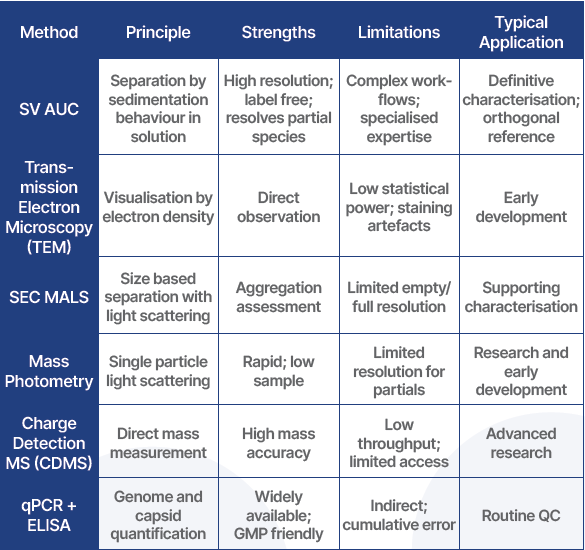
Comparative overview of common methods
Indirect approaches, such as qPCR combined with capsid ELISA, remain valuable for routine monitoring and release testing due to their relative simplicity and GMP compatibility. However, they rely on assumptions regarding particle uniformity and cannot resolve partially filled species.
SV AUC is distinguished by its ability to directly resolve capsid populations in their native state, providing a level of structural insight that is difficult to achieve with other techniques.
SV AUC as the gold standard
Sedimentation velocity AUC separates particles based on their sedimentation behaviour under high centrifugal force, which is determined by mass, density, and shape. For AAV vectors, differences in packaged nucleic acid content result in distinct sedimentation coefficients for empty, partially filled, and full capsids7,8.
A key advantage of SV AUC is that it analyses particles in free solution without the need for labels, stains, or immobilisation. This preserves native particle structure and avoids artefacts associated with surface interactions or matrix effects.
Unlike methods that require calibration against external standards, SV AUC is grounded in first principles hydrodynamic theory. Sedimentation coefficients are derived directly from experimental data, enhancing result robustness and comparability across laboratories when methods are appropriately controlled.
Importantly, SV AUC can resolve intermediate species, providing a more nuanced picture of capsid heterogeneity than binary empty/full classifications. This capability is particularly valuable for vectors with large or complex genomes, where partial packaging
may be more prevalent.
For these reasons, SV AUC is widely regarded as the reference method for AAV empty/full analysis and is frequently used to contextualise or validate data from higher throughput assays.
Principles and workflow of SV AUC
Sample preparation
Sample preparation for SV AUC is conceptually simple but requires careful control. Samples are typically analysed in formulation relevant buffers, with matrix matching between sample and reference sectors to minimise optical and hydrodynamic artefacts.
Consistency in buffer composition, excipient concentration, and sample handling is critical, particularly when data are intended to support comparability or regulatory submissions. In GMP aligned environments, standardised preparation procedures and documented acceptance criteria are essential.
Data collection
During analysis, samples are subjected to high centrifugal forces in an analytical ultracentrifuge. As particles sediment, their movement is monitored in real time, most commonly using UV/visible absorbance optics.
The resulting dataset comprises a series of radial concentration profiles collected over time, capturing the dynamic separation of particle populations.
Data analysis
Raw data are transformed into sedimentation coefficient distributions, often expressed as c(s) profiles, using numerical modelling. These distributions represent the relative abundance of species across a defined sedimentation range.
Open source software such as SEDFIT is widely used for this purpose, with visualisation tools such as GUSSI supporting interpretation and reporting9,10. While scientifically robust, these tools require expert oversight to ensure appropriate model selection and
parameterisation.
The Challenge: why AUC is difficult in a GMP environment
Despite its analytical power, SV AUC presents significant challenges in regulated environments.
One major limitation is the absence of fully GMP compliant, vendor supported software ecosystems. Instrument control software and data analysis tools were historically developed for research use and do not natively provide audit trails, electronic signatures, or role based access controls as expected under EU GMP Annex 11 and data integrity guidance11,12.
As a result, compliance with ALCOA+ principles relies heavily on procedural controls, manual documentation, and rigorous training. Data handling workflows are inherently multi step, spanning sample preparation, data acquisition, data transfer, analysis, and reporting. Each step introduces potential risk points if not carefully governed.
Method validation also presents challenges. SV AUC is sensitive to experimental conditions, and demonstrating robustness, precision, and system suitability requires a deep understanding of both the technique and the product. These complexities explain why AUC, despite its scientific acceptance, remains uncommon in routine QC laboratories.
Bridging the gap: from R&D AUC to GMP ready AUC
Transitioning SV AUC from a research tool to a GMP aligned capability requires more than technical expertise. It demands a structured analytical framework that integrates quality system principles with scientific best practice.
Key elements include controlled and standardised workflows, defined data handling procedures, risk based mitigation strategies, and clear governance over software use and result approval. In this context, AUC is treated not as a standalone experiment but as an end
to end analytical process aligned with EU GMP expectations.
Key criteria for selecting a GMP ready AUC partner
Selecting an AUC partner is a strategic decision with direct implications for regulatory success.
Demonstrated GMP Experience
Practical experience operating SV AUC within GMP aligned frameworks is essential, including familiarity with EMA inspections and ATMP specific expectations.
Validated and standardised workflows
Standardisation underpins reproducibility. Partners should demonstrate well defined, validated methods appropriate to their intended use.
Data integrity and traceability
Robust procedural controls must ensure data are attributable, traceable, and reviewable in line with EU data integrity guidance.
Breadth of AAV expertise
Experience across multiple serotypes and genome designs reduces interpretive risk and supports comparability assessments.
Integration into orthogonal strategies
SV AUC should be positioned within a broader analytical framework, supporting holistic product understanding.
Capacity and scalability
SV AUC should be positioned within a broader analytical framework, supporting holistic product understanding.
Regulatory track record
Experience supporting EMA submissions and scientific advice interactions provides confidence in data acceptability.
The value of an experienced AUC partner
An experienced AUC partner delivers more than data. They provide risk mitigation, efficient study design, and regulatory confidence. In an EMA context, where scientific justification and method appropriateness are closely scrutinised, this experience can materially influence development timelines and approval outcomes.
Conclusion
Empty and full capsid characterisation has become a central element of AAV product understanding. As EMA expectations for ATMP quality continue to evolve, developers must demonstrate not only that this attribute is measured, but that it is measured using
scientifically appropriate and operationally controlled methods.
SV AUC remains the most powerful and informative technique for resolving AAV capsid heterogeneity. However, its successful application in GMP aligned environments requires substantial expertise, infrastructure, and quality system integration.
As gene therapy programmes advance towards commercialisation, the ability to generate reliable, regulator ready AUC data will become increasingly important. Selecting the right AUC partner-one that combines scientific depth with EMA aligned quality maturity-can significantly reduce risk and support confident progression through development and
regulatory review.
References
- European Medicines Agency. Guideline on quality, non clinical and clinical aspects of gene therapy
medicinal products. EMA/CAT/80183/2014. - European Medicines Agency. Reflection paper on classification of advanced therapy medicinal products. EMA/CAT/600280/2010.
- Wright JF. Product related impurities in clinical grade recombinant AAV vectors: characterization and risk assessment. Biotechnol Bioeng. 2008;101(5):937–944.
- Lock M, et al. Rapid, simple, and versatile manufacturing of recombinant adeno associated viral vectors at scale. Hum Gene Ther. 2010;21(10):1259–1271.
- ICH Q8(R2). Pharmaceutical Development. International Council for Harmonisation; 2009.
- Mingozzi F, High KA. Immune responses to AAV vectors: overcoming barriers to successful gene therapy. Blood. 2013;122(1):23–36.
- Burnham B, et al. Analytical ultracentrifugation as an approach to characterize recombinant adeno
associated viral vectors. Hum Gene Ther Methods. 2015;26(6):228–242. - Cole JL, Hansen JC. Analytical ultracentrifugation as a contemporary biomolecular research tool. J Biomol Tech. 1999;10(4):163–176.
- Schuck P. Size distribution analysis of macromolecules by sedimentation velocity ultracentrifugation and Lamm equation modeling. Biophys J. 2000;78(3):1606–1619.
- Brautigam CA. Calculations and publication quality illustrations for analytical ultracentrifugation data. Methods Enzymol. 2015;562:109–133.
- EudraLex Volume 4. EU Guidelines for Good Manufacturing Practice – Annex 11: Computerised Systems. European Commission.
- MHRA. GxP Data Integrity Guidance and Definitions. Medicines and Healthcare products Regulatory Agency; 2018.