Whitepaper
Gene Therapy Release Testing: Navigating FDA vs EMA with an EU-Based Expert Partner
Practical strategies for harmonised Gene Therapy analytics, EU in country testing and release, delivered by Eurofins BioPharma Product Testing Ireland.
By Mirinda Tattan, PhD, Technical Consultant - Advanced Therapies, Eurofins BioPharma Product Testing Ireland.
10/06/2026
Gene therapies are rapidly transitioning from innovation to routine clinical practice. As programmes move from early clinical phases toward licensure, analytical methods for batch release and stability increasingly become the focus of regulatory scrutiny. The U.S. Food and Drug Administration (FDA) and the European Medicines Agency (EMA) broadly align on the need for risk-based, science-driven strategies; however, meaningful differences exist in the timing, extent and presentation of method validation and stability data for gene therapy products.
A critical nuance for global developers is that gene therapies and other advanced therapy medicinal products (ATMPs) generally do not fall under existing mutual recognition arrangements for batch release testing between the US and EU. As a result, gene therapy products destined for the European market typically require in country or in region testing under EU GMP, supporting Qualified Person (QP) release, even when extensive testing has already been performed in the US. These factors can translate into unforeseen
questions during scientific advice or review, delays in IND/IMPD approvals, and the need to redevelop or revalidate key assays-especially potency and genome titre methods-late in development.
This white paper, using AAV gene therapies as an example:
- Compares FDA and EMA expectations for analytical method development, validation and stability in the context of AAV gene therapy batch release
- Explores the implications of non harmonised mutual recognition for gene therapy release testing
- Highlights practical considerations for developers planning global submissions
- Illustrates how partnering with a specialised analytical testing provider such as Eurofins BPT, Ireland-with experience in method development, validation, transfer, global batch release and stability-can reduce regulatory risk and accelerate development timelines
- Outlines best practices for harmonised method strategies across both regions
Drawing on current regulatory guidance, contemporary analyses and our experience supporting gene therapy programmes, we propose a pragmatic framework for designing gene therapy release and stability methods that are technically robust, regulatory aligned and phase appropriate.
Introduction
Gene therapies offer the potential for long-term treatment of genetic diseases by delivering functional copies of genes to target tissues. AAV vector based gene therapies make up the majority of the current gene therapy global pipeline. Like other gene therapy vectors, their promise is matched by their complexity: gene therapy products are heterogeneous, with varied capsid serotypes and engineered variants, promoters, regulatory elements and transgenes, as well as diverse manufacturing platforms such as HEK293 transient transfection, Sf9/baculovirus systems and other producer cell lines [1,2]. Each of these variables can influence critical quality attributes (CQAs) such as vector genome titre, potency, empty/full capsid ratio, impurities and stability [1,2].
The analytical challenge in AAV gene therapy
Unlike many traditional biologics, AAV assays often lack compendial or harmonised methods; they rely heavily on biologically variable systems (for example, cell-based potency or transduction assays), draw on evolving technologies such as ddPCR, advanced capsid analytics and multidimensional chromatography, and usually require product-specific calibration and acceptance criteria [1,2,14].
Regulators therefore expect sponsors to demonstrate not only method validation in the classical sense (specificity, accuracy, precision, robustness), but also fit-for-purpose justification, orthogonal confirmation and a clear link between CQAs and clinical performance [4,8,11,14]. This is particularly true for methods that inform potency, dose and stability decisions.
Diverging but converging: FDA vs EMA
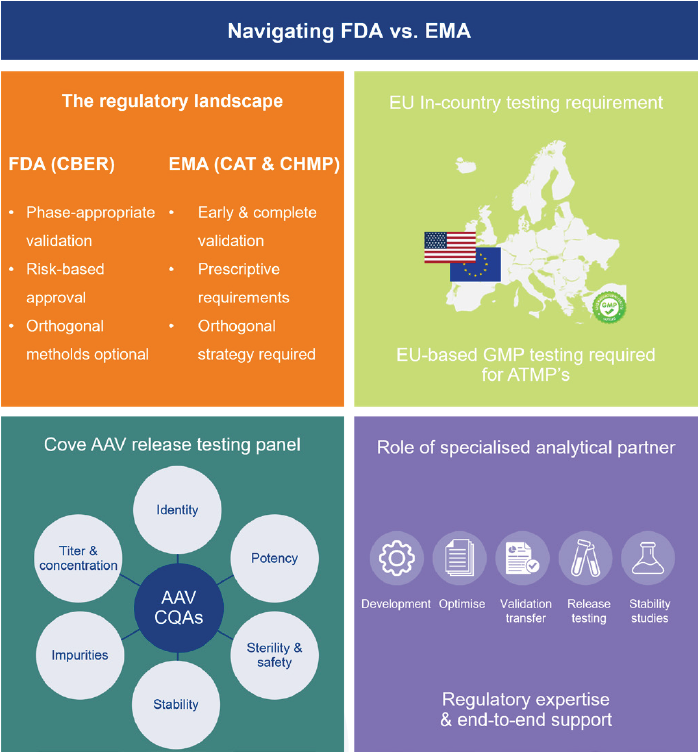
Both FDA and EMA support the principles of ICH Q2(R2) Validation of Analytical Methods and Q14 Analytical Procedure Development, emphasising riskbased, lifecycle-oriented approaches to analytical procedures [12,13]. In practice, however, their expectations for timing and depth of validation can diverge.
FDA often permits greater flexibility and phaseappropriate validation, particularly in early clinical stages, provided risks are well justified and residual uncertainty does not compromise patient safety [7,8,11,14]. EMA, by contrast, has tended to require more complete validation packages earlier, especially for assays underpinning potency, genome titre and identity [4,5,15]. These differences impact how developers plan and sequence method development activities.
For organisations planning global development, understanding these nuances is essential to avoid duplicated work, late redevelopment or inconsistent regional strategies. A well-designed analytical strategy-supported by a specialist testing partner with established platforms and global regulatory experience-can harmonise requirements and reduce friction across both regions [14,15].
Eurofins BioPharma Product Testing Ireland – an overview
Eurofins BPT Ireland has extensive experience supporting gene therapy programmes from early development through to commercialisation. The team has worked across GT modalities on:
- Method development, optimisation and validation for key CQAs
- Method transfers from sponsors or CDMOs into GMP laboratories
- Batch release testing, including full CQA panels, under EU and global regulatory frameworks
- Stability programmes with appropriate storage, monitoring and stability-indicating methods
The facility incorporates molecular and cell biology laboratories, cell-based assay capability and biopharmaceutical analytics, allowing all critical release and stability parameters to be tested within a single integrated environment. Because Eurofins BPT Ireland operates under both EU- and FDA-aligned quality systems, data packages are designed to support submissions to both agencies, and-critically-to enable EU QP release for gene therapy products that cannot rely on mutual recognition.
Regulatory Framework Overview
FDA perspective on gene therapy analytics
Within the FDA, the Centre for Biologics Evaluation and Research (CBER) has issued multiple guidance’s specifically addressing gene therapy and CMC expectations, including documents on CMC information for gene therapy INDs, and guidance for human gene therapy in rare diseases, haematologic disorders and retinal disorders [8–11]. Together, these guidance’s emphasise several key concepts:
- Risk-based, product-specific justification: Sponsors are encouraged to tailor analytical strategies to the mechanism of action, clinical context and manufacturing risks. For example, vector genome titre and potency may require more elaborate validation for high-dose systemic therapies than for local ocular administration [8–11,14].
- Phase-appropriate validation: FDA often accepts partial or limited validation in early-phase studies, with increasing rigour expected as programmes approach pivotal trials and licensure [7,11,14].
- Risk-based, product-specific justification: Sponsors are encouraged to tailor analytical strategies to the mechanism of action, clinical context and manufacturing risks. For example, vector genome titre and potency may require more elaborate validation for high-dose systemic therapies than for local ocular administration [8–11,14].
- Phase-appropriate validation: FDA often accepts partial or limited validation in early-phase studies, with increasing rigour expected as programmes approach pivotal trials and licensure [7,11,14].
The FDA’s implementation of ICH Q2(R2) and Q14 reinforces the expectation that analytical procedure development and validation are integrated lifecycle activities, not one-off exercises [12,13].
EMA perspective on gene therapy analytics
In the EU, gene therapies are regulated as ATMPs under Regulation (EC) No 1394/2007 and associated guideline documents [4–6]. EMA’s Committee for Advanced Therapies (CAT) and the Committee for Medicinal Products for Human Use (CHMP) provide guidance on the quality, non-clinical and clinical aspects of gene therapy medicinal products, as well as requirements for investigational ATMPs in clinical trials [4,5]. From an analytical perspective, the EMA tends to:
- Require more prescriptive and extensive validation earlier in development for key CQAs, particularly potency, genome titre and identity [4,5,15].
- Place strong emphasis on orthogonal and complementary testing for complex attributes such as genome titre, capsid content and product heterogeneity [4,5,15].
- Expect robust stability strategies, including long-term, accelerated and stress studies that clarify degradation pathways and confirm that monitored parameters are truly stabilityindicating[4,5].
- Scrutinise data consistency across clinical phases, including the impact of analytical method changes on comparability and the totality of evidence [4,5,14].
While EMA also supports the analytical lifecycle concepts in ICH Q2(R2) and Q14, it may adopt a more conservative stance in their application to gene therapy products, particularly where clinical experience with a specific modality or indication is limited [4,5,14,17].
Mutual recognition and in country testing for gene therapies
A practical challenge for sponsors is that gene therapies and other ATMPs generally fall outside the scope of most existing mutual recognition arrangements for batch release testing between major regions such as the US and EU. Mutual recognition agreements can streamline inspections and quality system assessments for certain conventional pharmaceuticals, but they do not typically remove the need for EU-based testing and QP certification for ATMPs [4–6,15]. In practice, this means that:
- Batches manufactured in the US and intended for the EU market still require testing under EU GMP, usually performed within the EU/EEA or at a site specifically recognised by the relevant authorities.
- A Qualified Person must review the complete data set and certify each batch for release, relying on testing that meets EU expectations in terms of methods, validation and documentation.
- Analytical packages must therefore be planned from the outset to support both US and EU use cases, not only from a scientific perspective but also from the standpoint of logistics, timelines and regulatory acceptance.
Independent contract laboratories such as Eurofins BPT Ireland are well positioned to support this model, providing EU-based release and stability testing that is scientifically aligned with FDA expectations while meeting the formal requirements in-region testing.
Comparative Analytical Expectations for AAV Release and Stability
Core AAV release tests and regulatory interpretation
Typical AAV release panels include:
- Identity assays (capsid and genome)
- Vector genome titre assays (qPCR or ddPCR)
- Infectious or functional titre and potency assays (often cell-based or transduction-based and linked to the mechanism of action)
- Empty/full capsid ratio or capsid content
- Residual DNA and host cell proteins
- Process-related impurities
- Sterility and mycoplasma, endotoxin and bioburden
- Suite of physicochemical characterisation methods (e.g. aggregation, particle size)
The broad categories of tests are similar between FDA and EMA; however, how each agency interprets the weight and readiness of these methods can differ [4,5,11,15].
- For vector genome titre, FDA generally accepts qPCR or ddPCR with appropriate validation and supports phase-appropriate robustness; orthogonal confirmation is desirable but not universally mandated [7,11]. EMA places stronger emphasis on assay reliability and often expects orthogonal support or additional confirmation [4,5,15].
- For potency and biological activity, FDA allows evolving strategies with partial validation in early phases, moving towards full validation for pivotal and post-marketing studies [8,11,14]. EMA frequently expects fully validated potency assays at the start of pivotal trials, with a clear and mechanistically meaningful link between assay readout and clinical effect [4,5].
- For empty/full capsid ratio, FDA’s expectations are more context-dependent, linked to product risk, serotype and any established relationship with clinical performance [11]. EMA more often treats capsid content as a central CQA, particularly in systemic, high-dose or long-term indications [4,5].
- For impurities and residuals, both agencies require characterisation of residual DNA, host cell proteins and process reagents; EMA’s expectations can be more detailed regarding demonstration of clearance and consistency [4,5,11,14].
- For stability-indicating methods, FDA is generally open to evolving panels and emerging technologies if they sufficiently support the proposed shelf-life and conditions [11,14]. EMA emphasises clearly established stability-indicating parameters and thorough justification of storage, shipping and in-use conditions [4,5].
These differences underscore the value of globally oriented analytical strategies that anticipate the stricter requirements where they exist and thereby simplify global submissions.
Analytical challenges and regulatory implications
Assays for gene therapy testing are subject to several inherent challenges that interact with regulatory expectations.
Biological and Technological Variability
Cell-based potency assays, replication-competent virus tests and transduction assays depend on cell health, transduction efficiency and time-dependent readouts. Nucleic acid amplification methods such as qPCR and ddPCR can be influenced by sample matrix, extraction efficiency and primer/probe design. Advanced capsid ratio methods (e.g. analytical ultracentrifugation, charge detection mass spectrometry, specialised
chromatography) require expert operation and careful method control [1,2].
Regulators recognise this complexity but still expect sponsors to demonstrate that methods are robust enough for their intended purpose.
That typically means:
- IDeveloping strong system suitability criteria and quality controls
- Demonstrating appropriate precision, linearity and range, even when variability is higher than in classic biologics
- Providing orthogonal confirmation where a single readout carries significant clinical weight [4,5,7,11,14]
Limited reference standards
There is often no universally accepted reference standard for a given indication. Sponsors must establish primary reference standards, design secondary working standards and manage the lifecycle of these standards over time. Regulatory authorities expect clear rationale and data for how changes in standards or assay platforms are bridged [4,5,11,14].
Method evolution across development
Assay changes are common as programmes progress: qPCR may be replaced by ddPCR for genome titre; potency formats may evolve; impurity methods may be refined as process understanding grows [2,14,17]. Both FDA and EMA expect sponsors to demonstrate comparability across such changes, typically through side-by-side testing, bridging studies and statistical analyses [4,5,11]. Poorly planned changes can delay development or complicate interpretation of safety and efficacy datasets.
These challenges reinforce the need for forwardlooking method design, coupled with rigorous documentation of analytical lifecycle decisions from early development onwards.
Harmonised Analytical Strategy and the Role of External Partners
Design Principles for a Global Gene Therapy Analytical strategy
To reduce rework and regulatory friction, gene therapy developers benefit from a harmonised analytical strategy that integrates the expectations of both FDA and EMA. Key design principles include:
- Start with a clear Analytical Target Profile (ATP). Define what each assay must measure, how it supports CQA control and how it links to clinical benefit–risk. This provides a stable anchor as methods evolve [12–14].
- Build for ICH Q2(R2)/Q14 alignment from the outset. Even before full adoption in all regions, applying lifecycle concepts helps future-proof analytical procedures and frames discussions with regulators [12,13].
- Prioritise potency, genome titre and capsid analytics. These assays carry high regulatory weight and should be targeted for early robustness, strong system suitability and, where appropriate, orthogonal support [4,5,8,11,15].
- Integrate orthogonal and complementary methods where risk is high. For key CQAs, combining technologies (for example, ddPCR with a capsid-based method) builds confidence in results and can address questions from different agencies [4,5,14,15].
- Plan for method and standard evolution. Anticipate upgrades in technology, shifts in manufacturing or refinement of impurity panels, and build explicit bridging and comparability strategies into the analytical lifecycle [4,5,11,17].
- Adopt a global mindset. Design validation and documentation packages that can be flexibly presented to meet the sometimes differing formats and emphases of FDA and EMA, rather than optimising for one region and retrofitting later [14,15].
Why partner with an Independent Testing Laboratory – and the Role of Eurofins BPT Ireland
While some sponsors consider performing release and stability testing entirely in house or relying solely on their CDMO, there are compelling reasons to involve an independent contract testing laboratory, particularly for gene therapies:
- Regulatory independence and credibility. Data generated by an independent, GMP-compliant laboratory can provide additional confidence to regulators, especially when method development and validation have been performed under a quality system that is separate from manufacturing.
- Specialised gene therapy expertise. Dedicated analytical laboratories are often at the forefront of
implementing and standardising advanced methods such as ddPCR, complex cell-based potency assays and capsid characterisation techniques, across multiple programmes and sponsors [14,15,17]. - EU-based batch release and stability capability. For gene therapies not covered by mutual recognition, EU-based testing and QP release are essential. An independent lab with EU presence simplifies logistics, avoids capacity constraints at CDMOs and reduces pressure on internal QC teams.
- Scalability and continuity. As programmes move from early clinical to commercial stages, analytical
workload grows. Contract labs can flex capacity and provide continuity even when manufacturing or CDMO arrangements change.
Eurofins BPT Ireland exemplifies this model. The organisation:
- Supports gene therapy programmes from method development and optimisation through to full GMP
validation and method transfer. - Provides a comprehensive suite of assays to cover all major CQAs, including molecular biology endpoints (vector genome titre, residual DNA), cellbased potency and infectivity assays, protein and
capsid analytics, and classic biopharmaceutical quality tests. - Operates molecular and cell biology, cell-based assay and biopharma analytics laboratories under
robust quality systems aligned with both EMA and FDA expectations. - Offers batch release and stability testing capabilities for gene therapy products, including storage, stability-indicating method development, routine stability studies and data packages tailored for EU QP release and global submissions.
- Has experience supporting gene therapy submissions across IND, IMPD, BLA and MAA pathways, bringing practical insight into how FDA and EMA may interpret similar data packages differently.
By engaging a partner such as Eurofins BPT Ireland early in development, sponsors can design analytical strategies that are not only scientifically sound but also operatio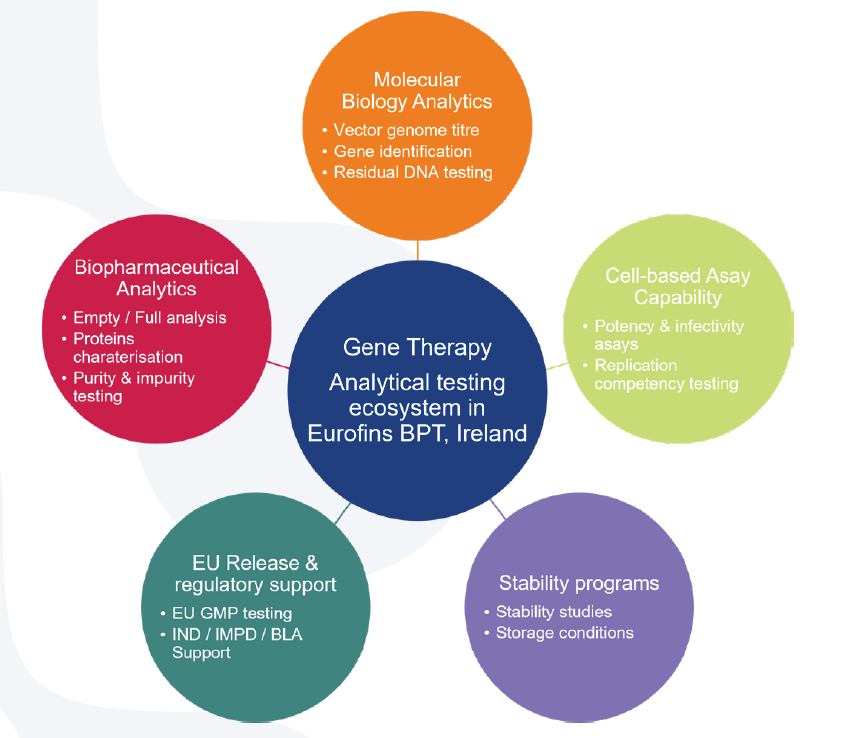 nally and regulatorily efficient, reducing the risk of late-stage surprises and enabling smoother transitions between phases and regions.
Conclusion
Gene therapy sits at the frontier of modern medicine, and their analytical characterisation is equally at the frontier of regulatory science. While FDA and EMA share core principles—risk-based assessment, scientific
justification and lifecycle thinking—their practical expectations for analytical method validation, orthogonal support, stability and in-country testing can differ in ways that materially impact development plans [4,5,8,11,14,15].
Sponsors that proactively:
- Understand these differences
- Design globally harmonised analytical strategies from the outset
- Anticipate the implications of non harmonised mutual recognition for gene therapy batch release
- Leverage independent partners with deep gene therapy expertise and EU testing capability
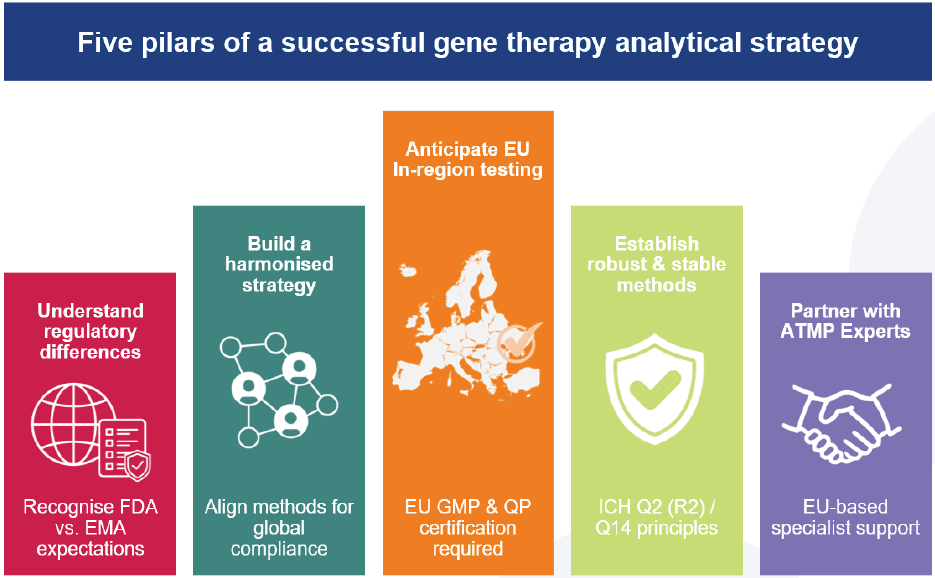
Are better positioned to navigate regulatory interactions smoothly, avoid late-stage redevelopment or validation gaps, and bring transformative therapies to patients more efficiently.
By embedding robust, stability-indicating and regulatory-aligned analytical methods at the heart of development—and by working with specialist partners such as Eurofins BPT Ireland-organisations can meet regulatory expectations, support EU and global batch release, and reinforce product quality, patient safety and long term programme success.
References
- Wright JF. Manufacturing and characterizing AAVbased vectors for use in clinical studies. Gene Ther.
2008;15(11):840–8. - Ayuso E. Comparative analysis of viral vectors for gene therapy. Expert Opin Biol Ther. 2019;19(4):335–48.
- Lock M, et al. Rapid, simple, and versatile manufacturing of recombinant adenoassociated viral vectors at scale. Hum Gene Ther. 2010;21(10):1259–71.
- European Medicines Agency. Guideline on quality, non-clinical and clinical aspects of gene therapy
medicinal products (EMA/CAT/80183/2014). London: EMA; 2018. - European Medicines Agency. Guideline on quality, non-clinical and clinical requirements for investigational advanced therapy medicinal products in clinical trials (EMA/CAT/852602/2018). London: EMA; 2019.
- European Parliament and Council of the European Union. Regulation (EC) No 1394/2007 on advanced therapy medicinal products and amending Directive 2001/83/EC and Regulation (EC) No 726/2004. Off J Eur Union. 2007.
- U.S. Food and Drug Administration. Analytical Procedures and Methods Validation for Drugs and
Biologics: Guidance for Industry. Silver Spring (MD): FDA; 2015. - U.S. Food and Drug Administration. Human Gene Therapy for Rare Diseases: Guidance for Industry.
Silver Spring (MD): FDA; 2018. - U.S. Food and Drug Administration. Human Gene Therapy for Hematologic Disorders: Guidance for
Industry. Silver Spring (MD): FDA; 2018. - U.S. Food and Drug Administration. Human Gene Therapy for Retinal Disorders: Guidance for Industry. Silver Spring (MD): FDA; 2018.
- U.S. Food and Drug Administration. Chemistry, Manufacturing, and Control (CMC) Information for
Human Gene Therapy Investigational New Drug Applications (INDs): Guidance for Industry. Silver Spring (MD): FDA; 2020. - International Council for Harmonisation. ICH Q2(R2): Validation of Analytical Procedures. ICH; 2022.
- International Council for Harmonisation. ICH Q14: Analytical Procedure Development. ICH; 2022.
- NCBI Bookshelf. Gene therapy CMC and regulatory considerations. NCBI Bookshelf. [cited 2026 Mar
24]. Available from: https://www.ncbi.nlm.nih.gov/books/NBK609382/ - BioProcess Online. How do cell & gene therapy requirements differ between FDA & EMA. BioProcess
Online; [cited 2026 Mar 24]. Available from: https://www.ncbi.nlm.nih.gov/books/NBK609382/ - U.S. Food and Drug Administration. Center for Biologics Evaluation and Research (CBER) 2023 Report from the Director. FDA [cited 2026 Mar24]. Available from: https://www.fda.gov/vaccines-blood-biologics/cy-2023-report-director
- Musazzi UM, Rocco P, Manellari S, Azari S, Pompilio G, Minghetti P. Back to gene therapy: bringing the
EU regulation into the future. Drug Discov Today.2025 Aug;30(8):104424.