Traditional gel-based isoelectric focusing (IEF) methods have long been used to assess the charge heterogeneity of protein-based therapeutics. However, these assays rely on labour-intensive workflows, staining for visualisation, and semi-quantitative evaluation of protein band patterns. Limited sensitivity, lengthy analysis times, and difficulties in quantifying individual variants can make routine Quality Control (QC) testing challenging.
At Eurofins BioPharma Product Testing Munich, we faced an additional challenge when a supplier announced the discontinuation of the commercially available precast polyacrylamide gels used for IEF analysis of release and stability samples. At the same time, this situation provided an opportunity to replace the legacy method with a modern, sensitive, and GMP-compliant approach suitable for testing both drug substances and drug products throughout the product lifecycle.
To address this challenge, we developed a new imaged capillary isoelectric focusing (icIEF) method using the Maurice™ iCE system. Like traditional gel-based IEF, icIEF separates protein variants according to their isoelectric point (pI), which is the pH at which a protein carries no net charge. However, instead of separating proteins in a gel and visually evaluating stained bands, the Maurice system performs the separation within a capillary followed by automated detection and software-based data analysis.
The workflow was integrated with Empower™ 3 Chromatography Data System (CDS), enabling standardised data acquisition, peak integration, and reporting. Adjustable UV and fluorescence detection settings support the reliable measurement of challenging proteins and low-abundance variants. In addition, standardised sample preparation and automated pI calibration reduce manual intervention and contribute to improved reproducibility.
The icIEF method was comprehensively developed and optimised, including, but not limited to, sample preparation, master mix composition, and focusing conditions, to achieve adequate separation of relevant charge variants, reliable quantification of acidic and basic species, and accurate determination of the protein pI. Following method development and establishment of system and sample suitability criteria, the icIEF method was validated under GMP in accordance with the ICH Q2(R1) guideline, which was applicable at the time. Validation included assessment of accuracy, repeatability, intermediate precision, specificity, linearity, range, limit of quantification (LOQ), robustness, as well as sample and diluent stability. The results demonstrated that the method was suitable for its intended use.
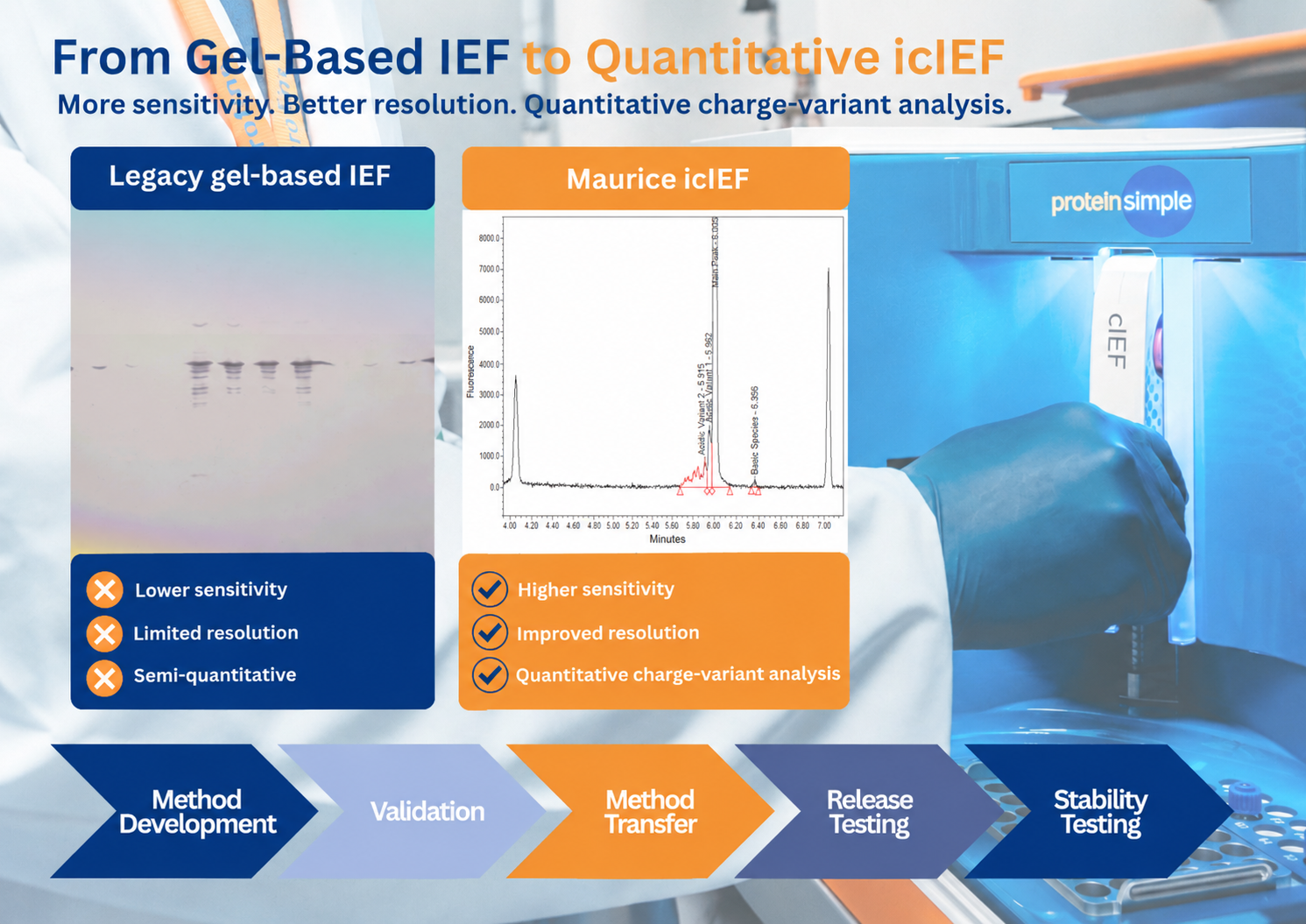
A comprehensive comparability assessment was subsequently performed between the legacy gel-based IEF method and the new Maurice icIEF method using release, stability, and stressed samples. The overall charged variant profiles were comparable, while the quantitative icIEF approach provided improved resolution and enabled individual acidic and basic species to be measured more consistently. As the legacy method relied on semi-quantitative visual evaluation against a reference standard, specification limits were reassessed and adapted to the quantitative data generated by the icIEF method.
The successful transition demonstrates how icIEF can modernise established protein analytical methods while maintaining the analytical performance required for GMP QC testing. Compared with conventional gel-based IEF, the Maurice icIEF workflow offers faster analysis, improved sensitivity and reproducibility, and robust quantitative assessment of charge variants. It therefore provides an efficient analytical solution for routine release and stability testing throughout the product lifecycle.
Contact us or visit our webpage to find out more.