Potency is a critical quality attribute for biopharmaceuticals, playing a key role in quality control to ensure product safety and efficacy. Bioassays used to assess potency combine biological complexity with numerous pipetting steps, handling small volumes, and repetitive operations. Due to their unique design and product-specific mode of action, bioassays can be particularly challenging to standardise and scale for sample testing. At Eurofins BioPharma Product Testing Munich, we have been using semi-automated solutions for almost a decade and have expanded our capabilities significantly since 2022. We have developed a comprehensive semi-automation strategy to address common bioassay challenges, from development and validation to transfer and into routine GMP testing.
From one platform to a broad automation portfolio:
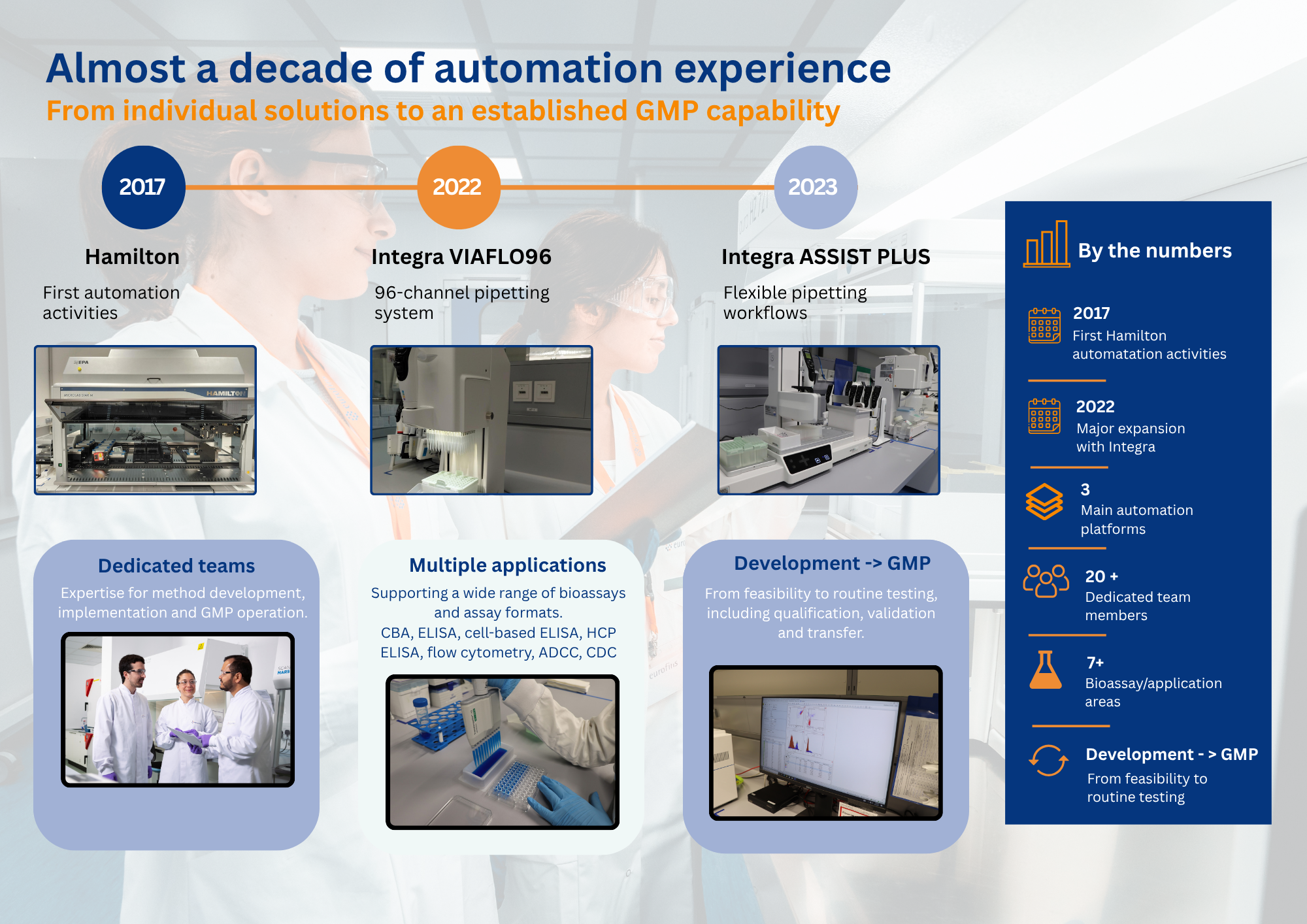
We began our automation activities in 2017 with the purchase of the Hamilton MICROLAB STAR. Since then, our expertise has grown into a broad, flexible automation platform supporting various bioassay formats and the analytical method lifecycle. A major milestone came in 2022 with the implementation of the Integra VIAFLO96. This 96 channel pipette enables rapid and consistent volume transfers across 96-well plates. In 2023, we added the Integra ASSIST PLUS to our portfolio to provide greater flexibility for more complex pipetting workflows, including pre-dilutions and serial dilutions. The fully GMP-validated Hamilton Liquid Handler is equipped with 12 independently operating pipetting channels, a HEPA hood, and plate shakers. The system also includes an integrated plate washer and multimode plate reader. Today, our automation portfolio enables us to select the most appropriate technology for the requirements of an individual assay, rather than applying a one-size-fits-all solution.
Automation requires people as much as technology:
Our experience has shown that successful automation requires more than just sophisticated instruments. Dedicated expertise is essential for method assessment, workflow development, programming, and implementation. We have therefore established core teams dedicated to the Integra and Hamilton systems. The Integra platforms are used for a wide variety of applications, like cell-based assays, ELISAs, cell-based ELISAs, flow cytometry, ADCC and CDC. The Hamilton system is primarily used for cell-based assays and ELISAs. This combination of technology and expertise has enabled us to develop automation solutions for multiple assay formats, while maintaining the flexibility to adapt workflows to specific requirements
From development to GMP routine testing:
Another significant advancement is the integration of automation throughout the entire method lifecycle, from non-GMP activities to GMP routine testing and housekeeping tasks. In our laboratory, we consider automation during non-GMP feasibility and method development. Here we assess which assay steps could benefit from increased standardisation, reduced hands-on time, or improved throughput. Suitable workflows can then progress through GMP qualification, validation, or method transfer before being used for routine testing. Additionally, we evaluate legacy methods and GMP routine assays to identify opportunities for semi-automation implementation. Our approach means that automation is not limited to established methods. In fact, our experience has shown that semi-automation can actively support method development by reducing variability associated with repetitive manual operations and improving process consistency from an early stage.
Selective automation - focus on what matters:
Automation does not necessarily mean automating an entire assay. Instead, we assess individual steps and ask: which operations consume the most time? Where is variability introduced? Which steps are highly repetitive? Where is the risk of human error highest? This assessment enables us to automate the steps that will be most beneficial. Examples include cell seeding, serial dilutions, and washing procedures. In some applications, automating just one or two critical steps can be highly valuable without introducing the complexity of automating the entire workflow. Beyond improving efficiency and consistency, automation can also enhance analyst well-being by reducing repetitive manual tasks and ergonomic strain associated with pipetting.
Sharing our experience:
Over the years, we have shared our experience through scientific conferences, industry events and technical presentations. These events provide an opportunity to exchange knowledge with the wider bioassay community and learn about emerging approaches in laboratory automation. Semi-automation has become an established part of our bioassay offering, supporting methods from early development through to long-term GMP routine testing. Our goal is not simply to automate more. Rather, we aim to identify where automation delivers the greatest analytical, operational and quality benefits, building robust, fit-for-purpose solutions around these needs.
Contact us or visit our bioassay webpage to find out more.
Register for our bioassay webinar
Robust Potency Assays: From MoA-Based Design to Lifecycle Management
10 Dec, 2026 | 15:00 CET