KeratinoSens™

In vitro assessment of skin sensitisation potential
Keap1-Nrf2-ARE pathway assessment according to OECD 442D
The in vitro KeratinoSensTM assay addresses the second molecular key event of the adverse outcome pathway (AOP) of skin sensitisation.1 The UN GHS (United Nations Globally Harmonized System of Classification and Labelling of Chemicals) defines a skin sensitiser as a substance that will cause an allergic response after skin contact.2
The KeratinoSensTM assay is validated by the EURL ECVAM (European Union Reference Laboratory for Alternatives to Animal Testing) and is performed in accordance with the OECD guidance OECD 442D at the Eurofins Human Safety Testing laboratory1, 3 with chemicals, cosmetics or personal care products and pharmaceuticals.
The KeratinoSensTM is one of three test methods (DPRA and h-CLAT) for the assessment of skin sensitisation potential.
Assessment of skin sensitisation potential with the KeratinoSensTM
- The second molecular key event of skin sensitisation addresses the induction of cyto-protective signaling pathways like the Keap1-Nrf2-ARE pathway in keratinocytes in responds to electrophiles and oxidative stress.
- The effect on the antioxidant response element (ARE) dependent pathway is assessed by measuring the induction of the luciferase gene, an ARE-dependent gene product, with luminescence detection.
- The luciferase signal reflects the activation of endogenous Nrf2-dependent genes which are triggered by sensitisers.1, 3, 4
- An MTT assay is performed, too, to see if the cells are stressed or if the elevation of the luminescence is due to sensitising properties of the test item.
"Skin sensitisers have been reported to induce genes that are regulated by the antioxidant response element (ARE). Small electrophilic substances such as skin sensitisers can act on the sensor protein Keap1, by e.g. covalent modification of its cysteine residue, resulting in its dissociation from the transcription factor Nrf2. The dissociated Nrf2 can then activate ARE-dependent genes such as those coding for phase II detoxifying enzymes."1 As a result, a higher luciferase activity is present and the cells are viable >70%.
Procedure: Principle of the KeratinoSens (TM)
Protocol |
|
Cell line |
|
|
Analysis |
|
| Concentrations |
|
| Exposure time |
48 h |
| Quality controls |
|
| Solvents of test chemical |
|
| Application |
|
| Data delivery |
|
| Positive prediction |
|
Eurofins data for demonstration technical proficiency of the KeratinoSens (TM) Assay
| Chemical | EC1.5* (OECD) |
IC50# (OECD) | Prediction (OECD) | EC1.5* (EF) | IC50# (EF) |
Prediction (EF) |
| Non-sensitising Chemicals | ||||||
| Isopropanol | >1000 | >1000 | Negative | >2000 | >2000 | Negative |
| Salicylic acid | >1000 | >1000 | Negative | >2000 | >2000 | Negative |
| Lactic acid | >1000 | >1000 | Negative | >2000 | >2000 | Negative |
| Glycerol | >1000 | >1000 | Negative | >2000 | >2000 | Negative |
| Sensitising Chemicals | ||||||
| Cinnamyl alcohol | 25-175 | >1000 | Positive | 139.01 | >2000 | Positive |
| Ethylene glycol dimethacrylate | 5-125 | >500 | Positive | 35.53 | 1811.39 | Positive |
| 2-Mercapthobenzothiazole | 25-250 | >500 | Positive | 91.92 | >2000 | Positive |
| Methyldibromo glutaronitrile | <20 | 20-100 | Positive | 9.74 | 28.46 | Positive |
| 4-Methylaminophenol sulfate | <12.5 | 20-200 | Positive | 8.07 | 25.12 | Positive |
| 2,4-Dinitro-chlorbenzene | <12.5 | 5-20 | Positive | 3.19 | 12.16 | Positive |
* = µg/mL; # = µM EF = Eurofins Human Safety Testing
Table 1: Eurofins Human Safety Testing data of the KeratinoSensTM – ten tested proficiency chemicals compared to the data of the OECD guideline.1
In Table 1 the obtained data from the KeratinoSensTM assay of four non-sensitising and six sensitising chemicals are shown. The prediction of all tested chemicals was correct in comparison to the classification of the OECD guideline.
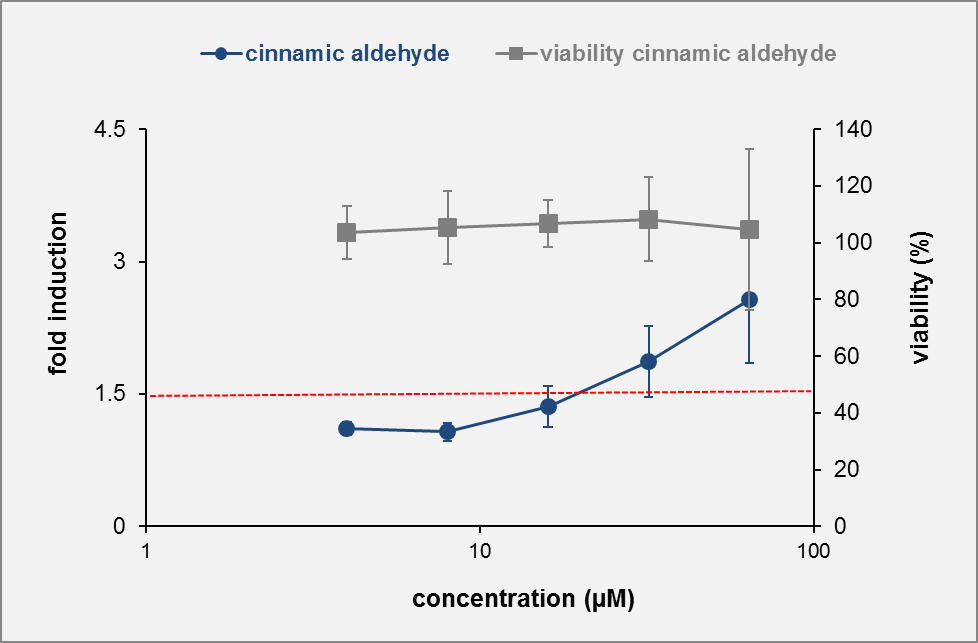
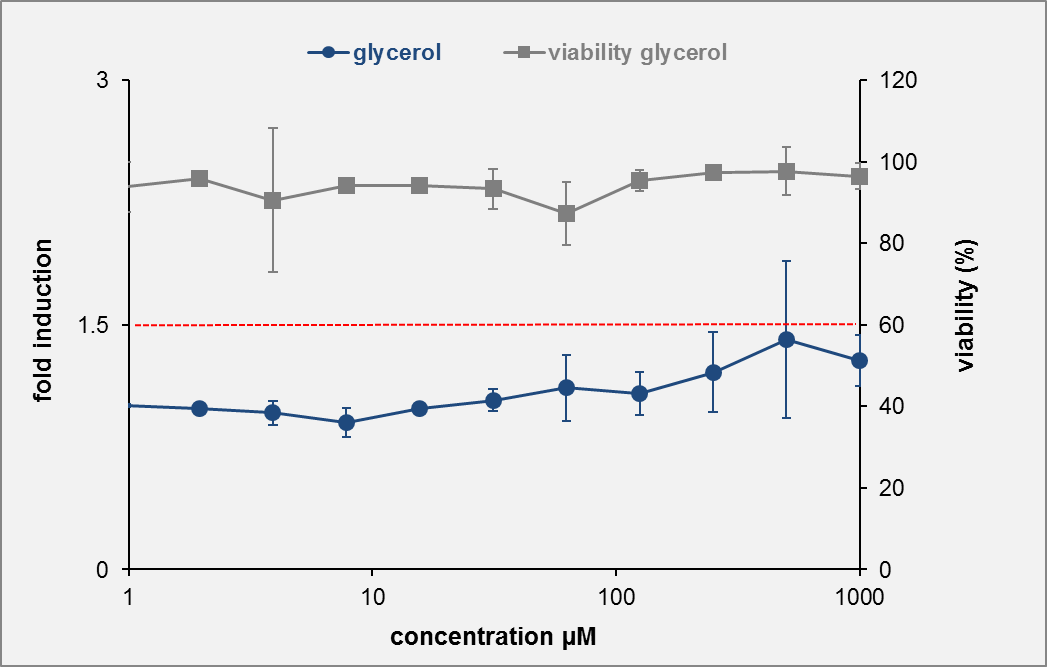
Figures 1 and 2: Eurofins Human Safety Testing KeratinoSens™ data of the fold induction and the viability of the sensitiser cinnamic aldehyde (Figure 1) and the non-sensitiser glycerol (Figure 2).
The graphs show the induction of the luciferase gene expression (blue line) and MTT data (grey line) used to determine cytotoxicity of the chemicals cinnamic aldehyde and glycerol. The red line represents the threshold of luciferase induction, at which chemicals are classified as sensitisers.
References
- OECD Guidelines for Testing of Chemicals, number 442d “In Vitro Skin Sensitisation: ARE-Nrf2 Luciferase Test Method” (adopted: June 25, 2018).
- UN (2015), United Nations Globally Harmonized System of Classification and Labelling of Chemicals (GHS), Sixth revised edition, UN New York and Geneva.
- EURL-ECVAM (2014). Recommendation on the KeratinoSens™ assay for skin sensitization testing, 42 pp.
- Emter R., Ellis G., Natsch A.(2010). Performance of a novel keratinocyte-based reporter cell lineto screen skin sensitizers in vitro. Toxicology and Applied Pharmacology 245, 281-290.