Microplastics – what we can offer

Analytical techniques
The Eurofins Environment Testing network of laboratories offer analytical methods ranging from microscopy, spectroscopy to thermal analysis that can be used to identify microplastic particles, each with their own capabilities and advantages. Across the network of Eurofins Environment Testing laboratories we are able to offer the following analysis techniques:
- Direct microscopy (USA, Norway)
- Fourier-transform infrared (FTIR) microscopy (USA, Germany)
- Laser Direct Infrared (LDIR) Imaging with Attenuated Total Reflectance (ATR) module (Melbourne, Australia)
- Pyrolysis GC-MS (Norway)
How can we help you?
The network of Eurofins Environment Testing laboratories can test microplastics utilizing the Laser Direct Infrared (LDIR) Imaging technique. Currently, we can provide the analysis of :
- Potable Water (bottled water, tap water)
As this is a relatively new field of analysis we are in the process of developing new methods for the following matrices:
| Surface water | Soil |
| Marine water | Sediment |
| Salt | Sands |
| Sewerage | Biosolid |
| Other beverages | Shellfish |
| Fish guts | |
| Powdered food products | |
| Foods | |
| Teabags | |
| Raw materials for packages |
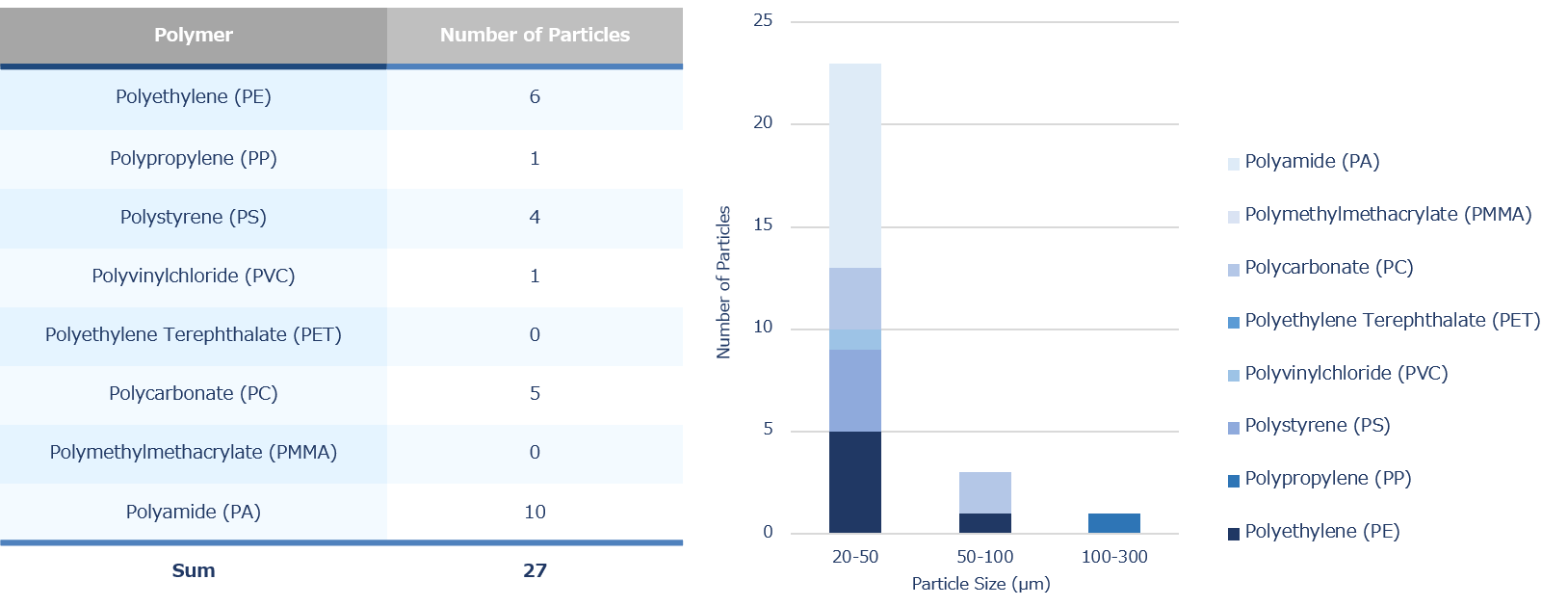
Results will be reported as total numbers of particles/volume and a size distribution (between 20 – 300µm). The lab will be able to determine the plastic type by using spectral data and can help to determine the source of the contamination. For particles >300µm the ATR module will be utilised for analysis.
We will provide all necessary bottles and coolers for sampling and shipping back to our laboratory. It is recommended that the samples be collected and returned back to the lab, stored at 2 - 6°C.
Technical enquiries to: MicroPlasticsAUS@eurofinsanz.com
Find a site near you!
 Clear Filters
 Reset Filters