Unlock the power of cannabis in cosmetics with expert testing and compliance.
Ensure the safety and efficacy of your cosmetic medical devices with our comprehensive testing services.
Perfumes must undergo rigorous testing to ensure safety, efficacy, consumer perception, stability, and regulatory compliance.
Rising demand for innovative, safe ingredients makes regulatory compliance crucial.
Ensuring safety and efficacy of sunscreen products with rigorous SPF, UVA, and claim‑support testing for global compliance.
Ensuring the safety, quality, and performance of hair care products with advanced testing services.
Ensure the safety and efficacy of your nutraceuticals with our expert regulatory support and comprehensive testing services.
Ensure the safety and efficacy of your pet care products with our comprehensive testing services.
Testing cosmetics and personal care products for sensitive skin to ensure safety and effectiveness.
Ensure the safety & compliance of tattoo and permanent make-up products.
Ensuring the safety, efficacy, and quality of makeup products with advanced testing solutions.
Cosmetic packaging is vital for product safety, stability, and efficacy.
Our pharmaceutical dermatology team guides strategic, regulatory & clinical development of dermatology products from early stage to market.
Ensuring the safety, efficacy, and marketability of skincare products with advanced testing services.
Ensure compliance and safety with our comprehensive regulatory and toxicology solutions.
Ensure your cosmetic products’ environmental safety with our ecotoxicity and biodegradability testing.
Experience precise and reliable efficacy tests using ex vivo human skin explants to evaluate the effects of your cosmetic products.
Gain actionable insights into consumer preferences and sensory experiences.
Ensure global compliance and optimise operational efficiency with tailored auditing, consulting, and training solutions.
Our expert analytical testing verifies raw materials, products and packaging for safety, quality and compliance.
Discover personalised skincare solutions with advanced genomic analysis to enhance your skin's health and beauty.
Conduct robust in vivo clinical trials to ensure product safety, efficacy, and consumer satisfaction.
Measure the emotional impact of your products with cutting-edge techniques.
Enhance operational efficiency, ensure compliance, and achieve exceptional results with our dedicated on-site teams.
Microbiological quality is critical in cosmetics product safety. Contamination affects safety, stability and reputation.
Explore our comprehensive in vitro testing services to ensure the safety and efficacy of your cosmetic products.
Substantiate efficacy claims with cutting-edge digital imaging technologies and our in-house software.
Support your green claims with trusted testing, from biodegradability to recycled packaging.
Discover our monthly bulletins and exclusive insights from our international network of laboratories
Subscribe to our newsletter and receive the latest news, expert insights, and upcoming events from Eurofins C&PC.
Contact us for expert advice and tailor-made solutions to ensure the quality and safety of your products.
Eurofins C&PC is a global leader in cosmetic & personal care product testing. Discover our global locations!
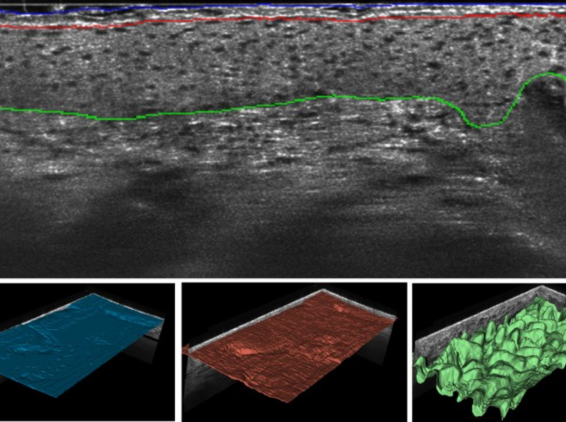
Eurofins Cosmetics and Personal Care has recently integrated Line-field Confocal Optical Coherence Tomography (LC-OCT) into its portfolio, strengthening its in vivo imaging capabilities for cosmetic efficacy assessment. Initially validated in dermatological oncology, LC-OCT is now attracting growing interest in cosmetic science due to its ability to visualise skin microarchitecture non-invasively and with near-histological resolution.
LC-OCT provides high-resolution, real-time imaging of the epidermis and superficial dermis, enabling detailed qualitative and semi-quantitative analyses of structural changes induced by cosmetic products. This is particularly relevant for before/after comparisons and for monitoring dermal remodelling processes following topical application.
From a biological standpoint, the technique is well suited to studying the papillary dermis, where metabolically active fibroblasts and dynamic collagen turnover are predominantly located. In contrast, the deeper reticular dermis contains thicker, more structural collagen fibres with lower reactivity. LC-OCT therefore offers meaningful insight into superficial dermal architecture, where many cosmetic claims are expected to manifest.
As with any imaging modality, LC-OCT has inherent limitations, including a penetration depth of approximately 500 µm, operator-dependent image acquisition and interpretation, and the inability to fully characterise functional or molecular skin parameters on its own. Consequently, its added value is maximised when combined with complementary biophysical, biochemical or clinical evaluation methods.
Overall, the acquisition of LC-OCT represents a significant asset for study design, provided its indications and limitations are fully understood. Looking ahead, LC-OCT will be applicable to ex vivo skin explants, opening new perspectives for translational and mechanistic cosmetic research.