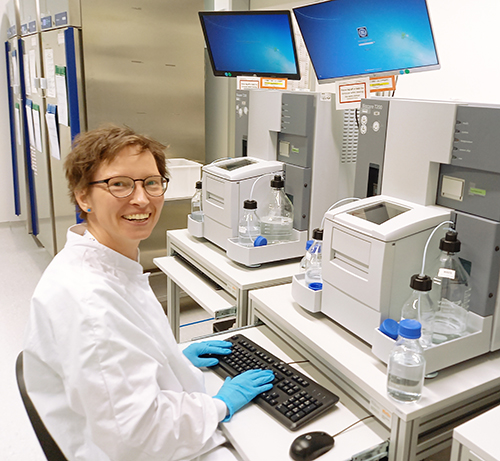
 Surface Plasmon Resonance (SPR) using the Biacore™ (Cytiva) platform and Bio-Layer Interferometry (BLI) using the Octet® (Sartorius AG) platform are powerful, label-free, optical biosensor technologies that produce real-time analysis of biomolecular interactions. Unlike traditional methods, such as ELISA, both SPR and BLI eliminate the need for labelling with fluorescent or enzymatic tags, allowing the direct assessment of kinetic parameters and binding affinity with high sensitivity and reproducibility.
In a comparative case study, assays were established on both platforms using the same ligand and a therapeutic monoclonal antibody as analyte. The reference standard representing 100% nominal potency was included in both setups.
In the first assay, varying concentrations of the analyte were evaluated for binding to human recombinant CD32 ligand. A linear regression model was fitted using PLA 3.0 software (Stegmann Systems) to determine the relative potency.
In the second assay, the association and dissociation of the analyte with the recombinant CD16a ligand were assessed using various concentrations of the reference standard and the sample. Binding affinities (KD values) were then calculated using instrument-specific software.
Both technologies demonstrated high accuracy and precision in determining relative potency and binding affinities. This provides major advantages over label-based technologies such as ELISA. When comparing both technologies we found that SPR was more precise than BLI, making it particularly well-suited for applications requiring detailed kinetic resolution. In contrast, BLI technology has a shorter assay run time, making it advantageous for high-throughput screening workflows.
In summary, both SPR and BLI offer distinct benefits. Based on our experience, the rapid assay format of BLI is ideal for screening applications, while SPR provides precise kinetic and affinity data, and in some cases, higher sensitivity. Both technologies represent robust, label-free alternatives to traditional endpoint assays, enhancing the reliability and efficiency of biopharmaceutical characterisation and potency assessment.