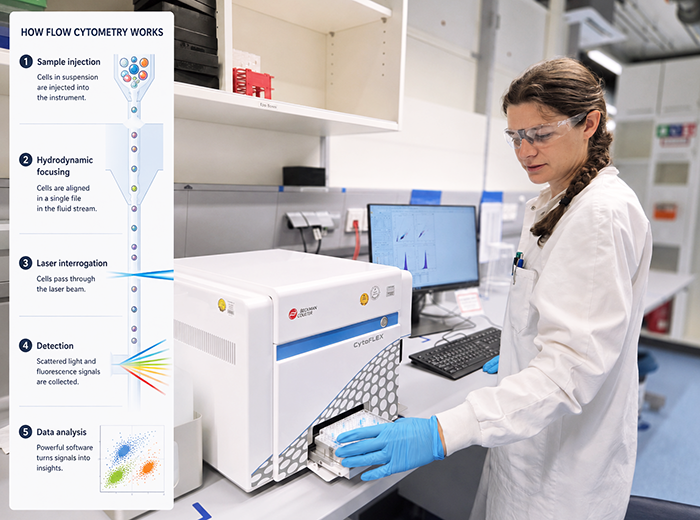
 Flow cytometry is an advanced technique used to measure physical and biological characteristics of particles such as cells. By analysing optical and fluorescence signals as cells pass through a laser beam, multiparametric measurements can be performed at the single-cell level. This provides information on cell populations, protein expression, and molecular interactions. Technological advances during the past 10–15 years have enabled the detection of up to 30 parameters while significantly reducing instrument footprint, making flow cytometry an essential tool in everything from research to GMP quality control.
At Eurofins BPT Munich, we developed a cell-based potency assay using flow cytometry to assess the binding of a therapeutic monoclonal antibody to target cells expressing the relevant antigen. This approach provides a physiologically relevant readout in a native cellular environment, capturing the initial target interaction; while complementary potency assays evaluate functional activity. Following validation according to ICH Q2(R1), the guideline effective at the time, the method proved robust for routine GMP testing, supporting the analysis of more than 1,500 stability and release samples with a low failure rate.
A major challenge arose when the original flow cytometer was decommissioned. Initially, bridging to a replacement instrument failed to meet predefined acceptance criteria due to increased variability and reduced accuracy, despite no changes to the assay. A comprehensive root cause investigation was conducted to evaluate instrumentation, gating strategies, washing procedures, analyst performance, and materials. The results indicated that increased instrument sensitivity led to fluorescence signal saturation and increased variability. To address this, both therapeutic and detection antibody concentrations were reduced.
Following re-optimisation, all validation criteria - accuracy, precision, linearity, and range - were met, with performance comparable to the original method, confirming suitability for continued GMP potency testing. Even well‑established bioassays require careful assessment following instrument changes, as increased sensitivity can significantly impact assay performance. For more information, visit: Large Molecules Biologics - Eurofins Deutschland