Securing the Clinical Development of Combined Medical Devices from the Earliest Stages
Combined Medical Devices (CDM) are playing an increasingly important role in healthcare innovation. However, their clinical development is complex and requires careful methodological planning from the earliest stages.
Insights from AFCROs experts Alizé Fargier (Eurofins Optimed), Carla Lippens and Khalil Ben Yahia.
Securing the clinical development of combined medical devices from the earliest stages
Combined medical devices are playing an increasingly important role in healthcare innovation. However, their clinical development is complex and requires early methodological planning. Insights from AFCROs experts.
By Alizé Fargier, Carla Lippens and Khalil Ben Yahia
A combined medical device (CMD) combines a medical device with another category of healthcare product within a single product, most commonly a medicinal product, and less frequently a biological product or an active substance. The product is designed to be used as one integrated whole rather than as two separate products.
This combination offers major therapeutic opportunities, including drug-eluting coronary stents, antimicrobial dressings and antibiotic-impregnated catheters. However, it also significantly increases the complexity of clinical development requirements.
Under Regulation (EU) 2017/745 (MDR), these products are systematically classified as Class III devices, requiring a high level of evidence regarding safety, performance and clinical benefit. Even minor methodological mistakes can lead to significant delays or even the need to repeat studies.
As a result, securing the clinical development programme from the earliest stages is no longer optional; it is a prerequisite for success.
Understanding the nature of the combined medical device: a strategic prerequisite
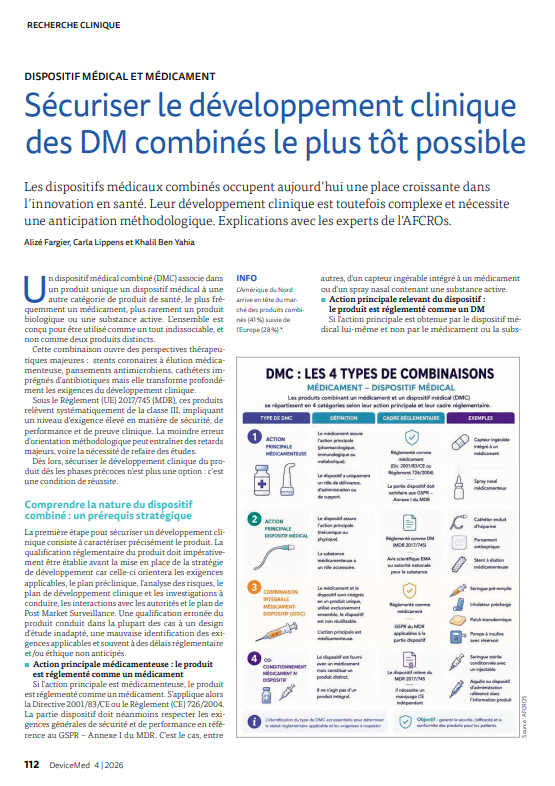
The first step in securing clinical development is to accurately characterise the product. The regulatory qualification of the product must be established before defining the development strategy, as it determines the applicable requirements, preclinical programme, risk assessment, clinical development plan, investigations to be conducted, interactions with regulatory authorities and the post-market surveillance strategy. An incorrect qualification often results in an inappropriate study design, failure to identify applicable requirements and unanticipated regulatory and/or ethical timelines.
- Medicinal product as the primary mode of action: regulated as a medicinal product
If the primary mode of action is pharmacological, the product is regulated as a medicinal product under Directive 2001/83/EC or Regulation (EC) No 726/2004. The device component must nevertheless comply with the General Safety and Performance Requirements (GSPR) set out in Annex I of the MDR. Examples include an ingestible sensor integrated into a medicine or a nasal spray containing an active substance.
- Medical device as the primary mode of action: regulated as a medical device
If the primary mode of action is achieved by the medical device itself rather than by the associated medicinal or biological substance, the product is regulated as a medical device under the MDR. A medicinal or biological substance may still be present, but only with an ancillary action. In this case, a specific assessment is required, including a scientific opinion from the EMA or a national competent authority. At the same time, a notified body is responsible for the overall assessment of the device.
- Integral Drug-Device Combinations (iDDCs)
In certain situations, the medicinal product and the device are intended to be used exclusively together and the device is not reusable. The product is then classified as an Integral Drug-Device Combination (iDDC). Where the principal mode of action is pharmacological, immunological or metabolic, the iDDC is regulated as a medicinal product, while the device component must comply with the MDR General Safety and Performance Requirements (GSPR).
- Co-packaged medicinal products and devices: separate but associated products
When a device is supplied together with a medicinal product but does not form an integral product, or is obtained separately and merely referenced in the product information, it falls under the MDR framework and must bear CE marking.
Clinical development strategies
Two approaches can be considered: a clinical evaluation of the device independently from the medicinal product; or a combined evaluation through integrated clinical studies.
- Separate evaluation of the two components
This approach is possible provided that both the medical device and the medicinal or biological substance can be tested independently. Clinical studies are conducted separately in accordance with the applicable regulations. Clinical data from each component are then used to assess the relevant clinical requirements. The rationale for combining the components is built using existing evidence from the literature and/or previous clinical studies and is supported by data demonstrating component interactions, such as compatibility, stability, combined efficacy and combination-specific risks including toxicity or altered bioavailability. This approach is generally limited to low clinical impact situations and specific cases where the interaction between the device and the substance is minimal or negligible. However, as soon as the interaction may affect performance, safety or release kinetics, regulators generally expect a combined study, which remains the preferred approach.
- Combined clinical studies
Combined studies assess both the medicinal or biological component and the medical device within a single investigation. Such studies must simultaneously comply with:
- Regulation (EU) 536/2014 on clinical trials of medicinal products (CTR);
- Regulation (EU) 2017/745 on medical devices (MDR);
- Where applicable, Regulation (EU) 2017/746 on in vitro diagnostic medical devices (IVDR).
The coordinated and accelerated multi-state assessment of combined investigations by the EMA and national competent authorities is currently being tested through the COMBINE (Coordinated Assessment of Combined Investigations)1 pilot project launched in June 2025. In France, the ANSM is participating in the assessment of eight pilot applications selected on the basis of innovation, clinical potential and alignment with public health priorities. Initial feedback is expected by the end of 2026.
- The critical role of usability studies (Human Factors Engineering)
For combined medical devices, particularly iDDCs intended for patient use or use by non-specialist healthcare professionals, usability studies are essential. These studies aim to demonstrate that the device can be used safely and effectively, that instructions are understood and that critical use errors are identified, assessed and mitigated.
Two types of usability studies are typically conducted:
- Formative studies, performed during development to identify and correct use errors and improve device design;
and
- Summative studies, conducted before marketing authorisation or CE marking to validate safe use and, where appropriate, incorporated into a pivotal clinical study.
Safe use cannot be assumed; it must be demonstrated. A practical example involves an autoinjector intended for elderly patients. During a formative study, researchers observed that users removed the cap too early, making the device ineffective. The syringe was redesigned so that the cap could only be removed at the appropriate time, eliminating the error during the subsequent summative study.
For iDDCs, conducting formative and summative usability studies before designing the clinical trial helps identify product-use constraints and anticipate common use errors that could affect clinical outcomes.
Building a robust clinical investigation plan from the outset
The French National Authority for Health (HAS) highlights the importance of a structured clinical investigation plan tailored to the specific characteristics of medical devices and the constraints of small patient populations.
For a combined medical device, this requirement is even more critical due to the complexity of interactions between the device and the active substance.
A robust clinical plan is built on several key pillars:
- A clear definition of the combined mode of action. The mechanical action of the device, the pharmacological action of the substance and, most importantly, the interactions between them must be fully characterised.
- An integrated risk assessment covering risks associated with the device, the substance and those arising from the combination itself.
- Enhanced preclinical data, particularly regarding material biocompatibility, drug stability within the device, physicochemical interactions and release kinetics through integrated in vitro and in vivo testing.
Early dialogue with regulatory authorities remains one of the most effective ways to secure successful product development and optimise clinical trial design.
Early scientific advice allows developers to validate methodological choices, confirm clinical objectives, align their strategy with regulatory expectations, avoid divergent interpretations and ensure that preclinical and usability data will be considered adequate.
Authorities including the ANSM, EMA and HAS strongly encourage such interactions, particularly for complex products such as combined medical devices.
Conclusion: secure early to succeed faster
Combined medical devices represent one of the most innovative categories of healthcare products, but they are also among the most demanding from a regulatory perspective. Their clinical development requires early methodological planning, regulatory coordination and integrated risk management from the earliest stages. Clinical strategy must be fully aligned with the product's regulatory qualification.
Clinical studies for combined medical devices are not limited to demonstrating therapeutic efficacy. They must also document device performance, safety of use and the device's direct contribution to the overall clinical benefit. Even apparently minor device modifications during development may affect release kinetics, user safety or exposure conditions, potentially invalidating previously generated data and leading to additional regulatory requirements or even new studies.
By securing clinical development from the earliest stages, manufacturers maximise their chances of obtaining rapid, robust and sustainable CE marking while ensuring patient safety and the quality of clinical data.
This involves early engagement with authorities and the integration of preclinical evidence, usability considerations and risk management from the outset, turning complexity into a decisive competitive advantage.
It should also be noted that the regulatory landscape continues to evolve, particularly with the forthcoming European Biotech Act, which aims to simplify the regulatory framework for innovative healthcare products.