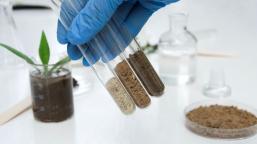
Growing on the cutting edge with renewable growing media
Manufacturers of professional growing media are increasingly providing blends that incorporate renewable raw materials. "Growing on such mixtures requires special attention to fertilisation with nitrogen or trace elements and irrigation, among other things," explains Jan Hardeman, Account Manager Horti at Eurofins. "The analyses carried out by Eurofins show that the new mixtures have very different characteristics from the traditional growing media."
Manufacturers and growers are exploring diverse substrate mixtures that include existing and new materials within horticultural crops, such as cocopeat/coir, wood fibres, green compost, tree bark, fibres from elephant grass (Miscanthus), flax, and sphagnum.
Hardeman says: "The use of these renewable raw materials presents a number of challenges for cultivation. We often find that the pH is rather high, and the pH buffer of these materials is smaller than that of peat. We also see nitrogen deficiencies due to nitrogen immobilisation, and trace elements such as manganese can be unexpectedly high. In addition, many of the new raw materials have different physical properties due to their larger pores. On the one hand, this is an advantage for aeration, but on the other hand it means that water retention is much lower in many cases."
Hardeman also points out that other specific fungi, such as Leucocoprinus and Sphearobolus, can also grow in renewable substrates. He adds that new blends may behave differently in terms of loss of structure and smearing at the bottom of the pot.
More control over cultivation
Growing on new mixtures therefore requires adjustments to fertilisation and watering schedules. "It starts with mapping what has changed in the medium.” explains Hardeman. “It will often turn out that there is a need to adjust the starting schedule and pH control. You also need to consider the possibility of nitrogen immobilisation and different ratios of potassium, manganese, and zinc. In practice, this means that single fertiliser applications are often more appropriate. It is also important to adjust irrigation (length and frequency of turns). It may also make sense to use different A and B trays for different parts of the crop.”
He continues: "In essence, the bottom line is that when using renewable energy, crop management needs to become more precise. In the beginning, this means adjusting the cultivation step by step. More frequent measurements (especially at the beginning of the crop) will give insight and help to control the crop where necessary. Eurofins offers several analysis packages for this purpose. In addition to the Potting Soil Check package, regular analysis of the nutrient solution provides indispensable data for targeted cultivation control.”
Want to know more?