New DNA Multiscan protocol for water samples
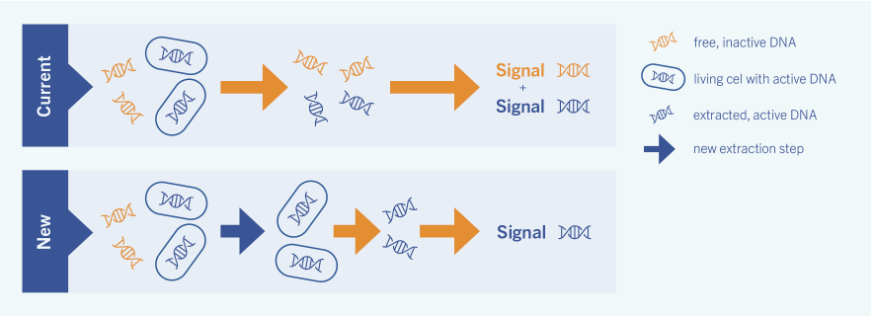
Current DNA analyses generally do not distinguish between DNA from living cells—integrated into the cell structure—and free, inactive DNA from dead cells. This free DNA can be present in a sample and contribute to a positive test signal, but it has no impact on the crop. With the new protocol, this free DNA is removed from the sample, eliminating any interference in the signal. This increases the reliability of the test, especially in water samples.
Updated Protocol
For the DNA Multiscan, each sample—whether it’s water, soil, substrate, or plant tissue—is pretreated. The result is a purified extract containing active DNA from living fungi and bacteria, but it may also include free, inactive DNA from dead material. In the current test, this free DNA can generate a misleading signal, particularly in water samples. This is less relevant for soils and substrates, where free DNA is rapidly degraded.
Free DNA Removed
The updated protocol includes an additional step to remove free DNA. As a result, a purer signal is obtained, allowing for more accurate detection of pathogens. In some cases, DNA may still be present that is encapsulated in cell material. This DNA is no longer part of a living cell, but it can still produce a signal. Such encapsulated DNA is often found in water that has been disinfected with, for example, UV or H₂O₂.
Although this DNA breaks down over time, it can still generate a signal in the DNA Multiscan immediately after disinfection. The rate of degradation depends on several factors, such as time, temperature, and microbial activity in the sample. Therefore, DNA Multiscan is not suitable for assessing the effectiveness of a disinfectant.
Want to know more?