Drought 2026 in Southern Europe: Harvest results and soil upheavals
By Clément Fontaine, Manager Agronomy Development and Innovation in France
In this series of Eurofins Agro Testing articles on drought and changing weather conditions, we turn our attention this time to Southern Europe.
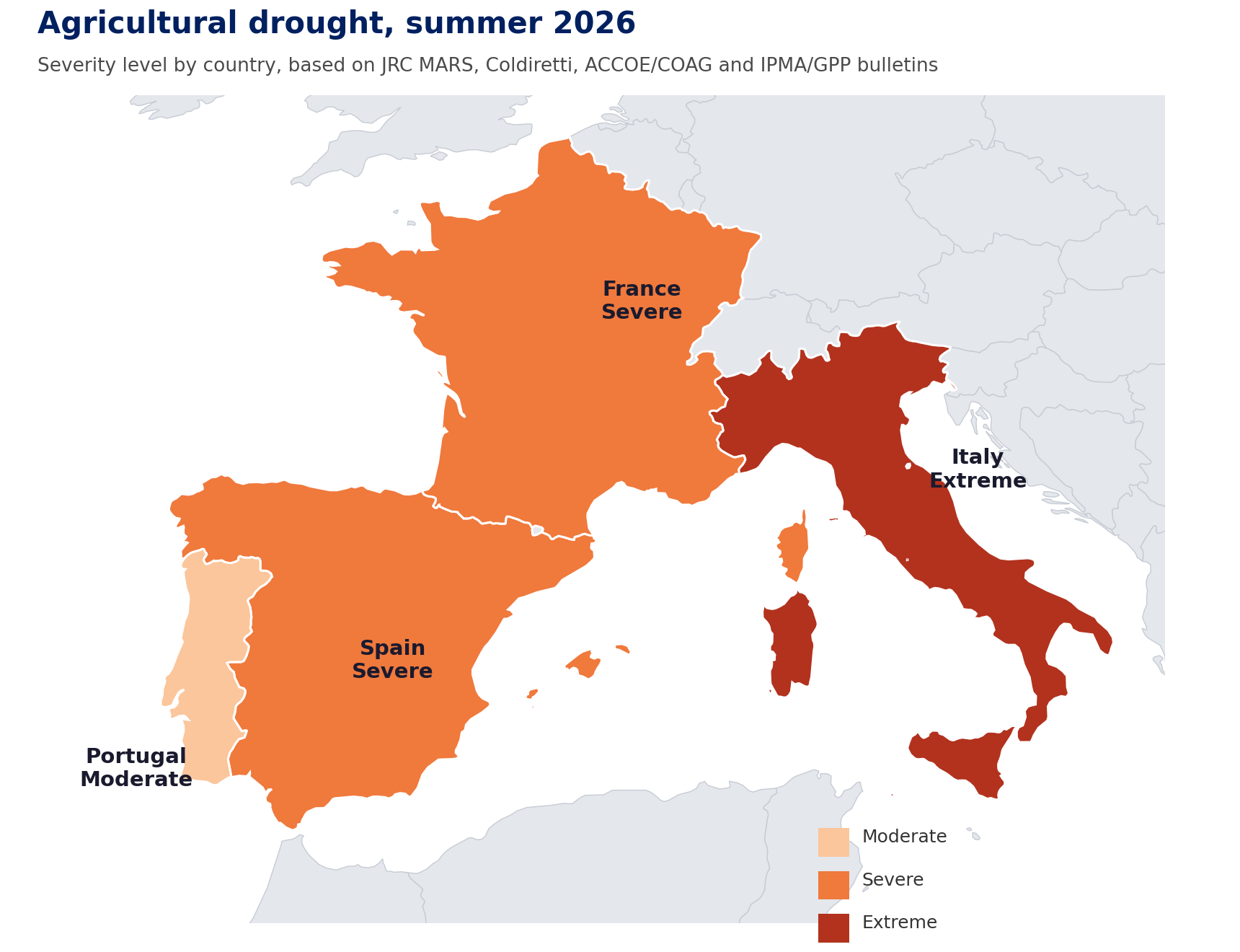
The drought affecting France since spring 2026 is not an isolated event. The August 2026 JRC MARS bulletin confirms a summer marked, across the whole European Union, by exceptional heat and drought: summer crop yields came in up to 14% below the five-year average. France, Spain, Italy and Portugal each illustrate, in their own way, just how decisive water availability and soil condition have become for the outcome of a growing season — before, as we will see further on, shaping the one that follows just as much.
France: the 2026 season under strain
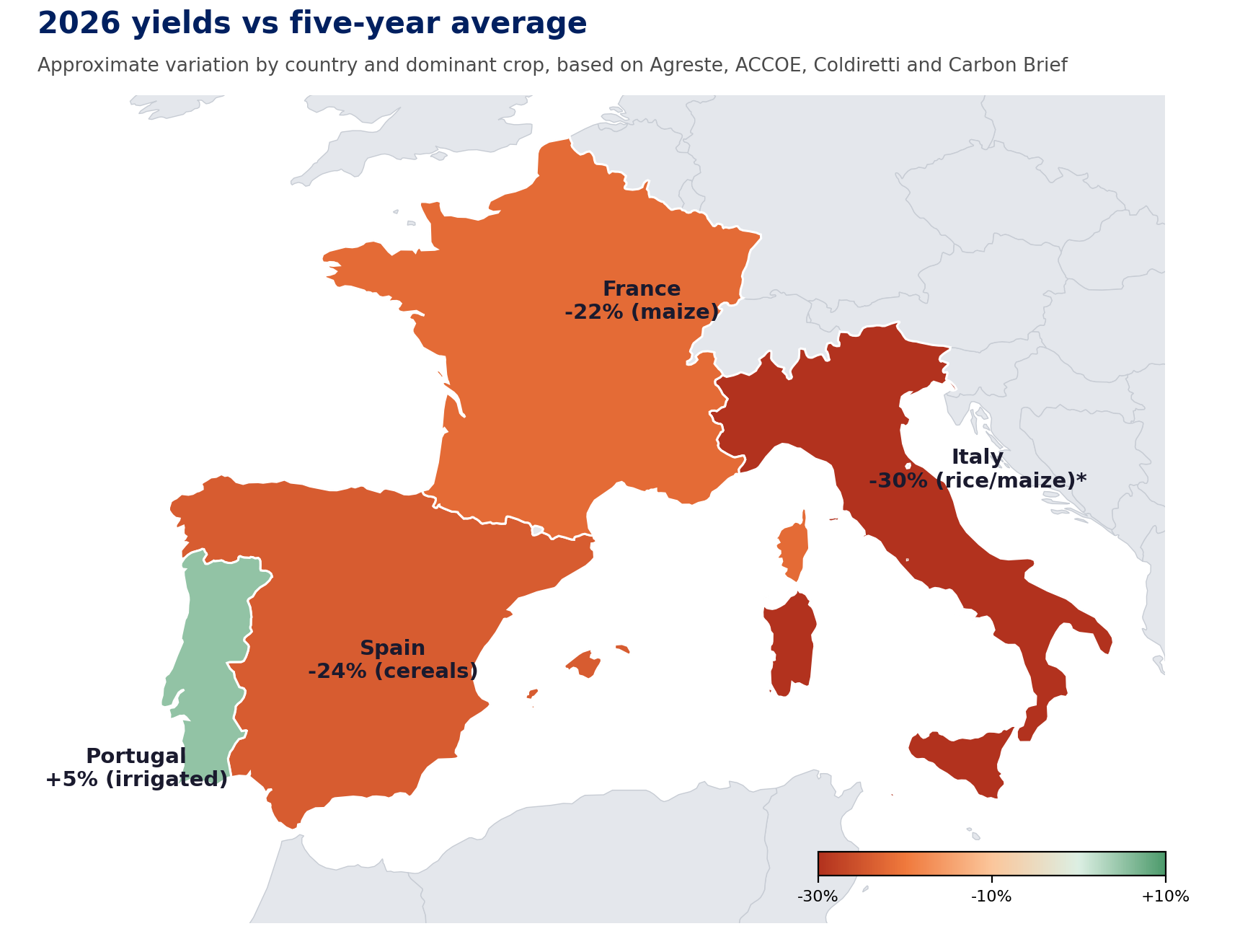
As of 3 September 2026, 75 French départements were classified in drought crisis (VigiEau), 17 under heightened alert, 4 under alert and 3 under watch. Grain maize, particularly exposed, has never produced so little since 1980: 9.0 million tonnes expected, against 13.7 Mt in 2025 — a 35% drop in a single year. Average yield (70.3 q/ha) is down 22.5% on the 2021-2025 average, and planted area itself has fallen by 14.9%. Burgundy is the hardest-hit region, with yields down around 50%, ahead of Nord-Pas-de-Calais, Auvergne and Pays de la Loire (around -37%).
More broadly, French cereal production is down 7.7 Mt year-on-year, and income losses from the June heatwave alone are estimated at €891 million.
Spain: heading toward a net importer position
Estimates of the 2026 cereal harvest range between 16.5 and 18.6 million tonnes depending on the source (ACCOE, Revista Campo, July 2026), against 21 to 22 Mt in a normal year — a decline of up to 24%. Castile and León, Aragon and Extremadura, historically the leading cereal-growing regions, are the most affected. Soft wheat and barley account for most of the yield losses (20 to 40% depending on the plot), while irrigated maize is holding up better, subject to the water restrictions in force in some autonomous communities.
Olive groves around the Mediterranean coast have also suffered from the heat, and cereal income losses linked to the June heatwave are estimated at €276 million. The cumulative effect: Spain could become a net cereal importer again for the 2026-2027 season.
Italy: over 60% of the country in drought
Italy is the hardest-hit country in the region: Coldiretti puts summer 2026 agricultural damage at over €3 billion, with more than 60% of the national territory affected by drought conditions ranging from mild to severe. The Po Valley is on the front line, with water reserves 30% below normal in Piedmont and down by as much as 50% in Lombardy. The great northern lakes illustrate the strain: Lake Como stands at just 7% of capacity, Lake Maggiore at 3%, Iseo at 11%, with only Lake Garda holding up somewhat better at 46%. The Po itself, at Pontelagoscuro, sits 6.90 m below its hydrometric zero.
Rice yields are down by as much as 40%, maize by up to 70% in some areas, and forage by 20 to 30% in central Italy; milk production has fallen 10 to 20% under heat stress on livestock. One structural figure illuminates this vulnerability: Italy today retains only 11% of its annual rainfall, according to Coldiretti.
Portugal: resilience built the previous winter
Portugal offers an instructive counterpoint. After a severe drought and historically low reservoirs at the end of 2025, a particularly wet winter and early spring in 2026 allowed the Algarve's main reservoirs (Bravura, Funcho, Arade, Odelouca, Odeleite, Beliche) to refill from as early as March. The result: Portugal's irrigated summer crops are, according to data compiled by Carbon Brief, among the only ones in Europe posting a yield increase in 2026. Vigilance nonetheless remains warranted in the Algarve and the Alentejo, the structurally most exposed regions, where the Portuguese state maintains specific water-management measures.
One lesson, four different paths
A France in widespread water-stress crisis, a Spain tipping toward imports, an Italy where more than one hectare in two is suffering, and a Portugal saved by the previous winter's rains: these four trajectories tell, from different angles, the same story. Water availability and soil condition have become, even ahead of the technical route chosen, the primary determinants of a season's outcome.
But this assessment, drawn from the crops themselves, does not stop at harvest. Beneath the surface, the drought has altered soil structure, chemistry and biology in ways that are sometimes lasting — and the return of autumn rain does not erase these imbalances, it often reveals them abruptly. Here, mechanism by mechanism, is what needs checking before committing to the 2027 season.
A weakened soil structure
Clay shrinkage caused by desiccation creates cracks and macropores, particularly in the clay and clay-limestone soils most exposed this summer. These cracks can temporarily improve infiltration, but they often close up poorly: the first autumn rains, falling on bare, hardened soil, favour the formation of a surface crust that, in turn, reduces infiltration and increases runoff and erosion risk — just when deep water penetration is most needed.
Tillage carried out under dry, hard conditions also raises the question of plough pans and deep compaction, which are harder to correct than simple surface compaction. Finally, biological porosity — the channels dug by earthworms and mycorrhizal networks — has also declined along with the soil's biological activity, a point developed below.
Soil chemistry thrown off balance, then abruptly reactivated
As noted for France, drought limits leaching and favours the build-up of nutrient salts — potassium and magnesium in particular — which can generate osmotic stress and cationic antagonisms (notably K/Mg) that should be checked before deciding on new applications. Nitrogen and sulphur mineralisation also slows down, without the mobilisable organic stock disappearing: it stays in reserve, waiting for water.
This is where the least-anticipated phenomenon plays out: the return of rain triggers a rewetting shock that abruptly reactivates microbial activity and organic-matter mineralisation — a mechanism well documented in soil science under the name "Birch effect". The result is a spike in available nitrate, sometimes within days, carrying a double risk: that of availability poorly captured if no crop or cover is in place to take it up, and that of leaching toward groundwater if rainfall is intense. On this point, Arvalis notes that even light rain (a few millimetres) is enough to dissolve residual fertiliser and redistribute nitrogen through the profile — a useful reminder to plan final applications rather than waiting for a hypothetical rain to apply everything at once.
Phosphorus deserves particular attention: its diffusion in the soil solution is strongly slowed under dry conditions, which can create the impression of a deficiency when the soil's stock actually remains adequate. A hasty interpretation, made without analysis, carries the opposite risk — over-fertilising a soil that does not need it.
Biological activity put to the test
Soil microbial biomass undergoes direct water stress, with partial mortality under prolonged drought — but also a capacity for rapid rebound as soon as moisture returns, which is precisely what drives the mineralisation spike described above. Symbiotic nitrogen fixation in legumes is penalised by the lack of water, as is the activity of soil fauna (earthworms foremost), whose recovery time frequently outlasts the return of rain alone. This biological dimension, invisible in the field, nonetheless determines how quickly the soil can return to normal functioning.
From drought to soil: three agronomic phases
What happens beneath the surface, from summer to autumn recovery of 2026
|
During the drought (summer 2026) |
When rain returns ("Birch effect") |
This autumn: re-test before acting |
|
Structure: cracking, crusting risk rising |
Rewetting shock |
Post-harvest N reserves |
|
Chemistry: concentrated salts, slower mineralisation |
Flush of organic matter and soil CO2 mineralisation |
pH, CEC, exchangeable bases |
|
Biology: microbial stress, reduced activity |
Spike in available nitrate |
Salinity (irrigated plots) |
|
Leaching risk if soil is bare or poorly covered |
Organic matter |
|
|
Plant Status |
A twofold uncertainty heading into autumn
These mechanisms combine differently from plot to plot, which rules out any blanket rule for the 2027 season. Post-harvest nitrogen reserves may be higher than usual where slowed mineralisation preserved an intact organic stock, or conversely lower where summer storms leached available nitrogen before crops could take it up. This heterogeneity adds to the one already discussed above, linked to texture, rooting depth and each plot's management history. On irrigated land in Spain and Italy in particular, residual soil salinity should also be checked before any new planting, especially where irrigation water was high in sodium.
Why analysis becomes essential again this autumn
Mechanically repeating the 2026 fertilisation plan based on the usual benchmarks risks either over- or under-fertilisation. Several checks are needed before committing to the 2027 season:
– nitrogen reserves (end of winter and, depending on the situation, start of winter) to adjust applications rather than repeat the usual doses;
– a standard soil analysis (pH, CEC, exchangeable bases, phosphorus, potassium, magnesium) to put real numbers on the imbalances actually accumulated;
– a check of electrical conductivity and salinity on the most exposed irrigated plots;
– an assessment of organic matter and biological activity, to calibrate organic inputs or structural amendments (gypsum in particular);
– a plant analysis to assess in real time the nutritional status of autumn crops and cover crops, independent of visual symptoms often blurred by the summer's water stress.
A France in widespread water-stress crisis, a Spain on the verge of becoming an importer, an Italy affected across two-thirds of its territory, a Portugal owing its resilience to the previous winter's rains: whatever the starting point, the message coming out of this crisis is the same — measure before you decide, rather than mechanically repeating a technical approach designed for a normal year.
Sources: JRC MARS bulletin, August 2026; Carbon Brief; Coldiretti / AgenSIR; ACCOE, via Le Courrier d'Espagne; Agreste, via Réussir; IPMA/GPP; Arvalis, via La France Agricole; see also the articles by our colleagues at Eurofins Agro Testing Europe: "Drought in Europe: When soil changes, decisions must change" and "The story of Bulgarian farmer Venelin Delgyanski".