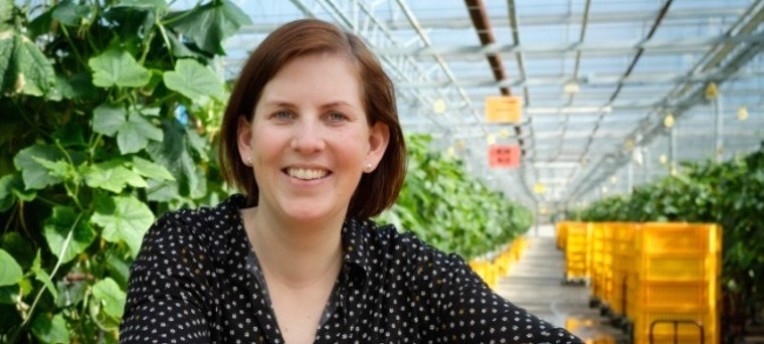
“If you want to move towards circular horticulture, you must analyse,” says Inge Bergsma - de Vries of Drenthe Growers
Customer speaks: Smart reuse of substrate and water starts with proper analyses
“If you want to move towards circular horticulture, you must analyse,” says Inge Bergsma - de Vries of Drenthe Growers. “You need to know exactly what’s in your substrate and water if you want to reuse it. In the project 100% Duurzaam Geteeld (translation 100% Sustainably Grown), we are investigating, among other things, whether we can use the substrate after cucumber cultivation for other crops, or whether residual water can be used as fertiliser, for example on grassland.” Analyses by Eurofins Agro Testing play a key role in this process.
Bergsma - de Vries calls herself a "future thinker". Together with her partner and brothers, she runs an 18-hectare cucumber farm in Erica. It is a modern company with 11.1 hectares of high-wire cultivation and 6.9 hectares of traditional cultivation. Regular sampling and analysis of water and nutrient solutions are standard parts of their growing process and are carried out by Eurofins Agro Testing.
She explains: “Cucumber is a difficult crop; its growth is highly dependent on light conditions and the plants are sensitive to diseases. We still depend on crop protection agents, but the number of permitted products is rapidly decreasing, and in a few years, we’ll really have to do without. That’s why we’re participating in 100% Duurzaam Geteeld - to learn how to grow both profitably and sustainably.”
'If you want to reuse water or slaps you need to know the values'
In this project, seven greenhouse vegetable companies are working together in a pilot to develop cultivation systems in which fruit and vegetables are grown in greenhouses with little or no chemical crop protection agents, artificial fertilisers, or other environmentally harmful inputs. Now in its second year, the project was initiated by the Federation of Fruit Vegetable Organisations (FVO). The participating growers receive support from various specialists.
Things have to change
“We believe things must change, which is why we’re part of this project. We’re especially focused on the role of rockwool in cucumber cultivation. After all, the environmental impact of rockwool is significant. In part of our greenhouses - 5.5 hectares to be precise - we’ve replaced rockwool slabs with organic mats from Lensli. That was quite a leap, but the first year went well. Now we’re looking for ways to reuse the organic mats after cultivation. At the end of a growing cycle, a cucumber greenhouse must be completely cleaned due to disease risk.”
“Double cropping on the same substrate is not an option with cucumbers. By November, the greenhouse must be cleared. But the organic mats are still in good condition and can be repurposed in horticulture, for example for other crops such as bedding plants, or as a base for composting. In either case, you need to know the values involved. That’s why Eurofins Agro Testing performs these analyses for us.”
However, it's not just the mats that can find a second life. Bergsma - de Vries also sees potential in the drain water: “We’ve gained experience using residual water from our farm as fertiliser for a dairy farmer’s grassland. The grass really turned a nice green. Again, you need to know which nutrients the water contains,” she emphasises.
Keeping a close eye
Moreover, analysis is not only important for reuse but also during the growing season, especially when fewer inputs are utilised. Cucumber growers therefore take weekly water and nutrient samples. The analysis results are carefully monitored by crop specialists so that adjustments can be made in a timely manner.
“We’re true growers and don’t rely solely on computers. Resilient cultivation is the future. I’m convinced that within a few years we’ll be able to grow completely without chemicals. We’re learning every day,” she concludes with a smile.
Want to know more?
Related

Rapid soil test for assessing soil health
Dutch Dairy Update
Differences in microbiome may be the cause of pepper plant wilting
Circular fertilisers for greenhouse horticulture

Graining more insight by linking analysis data