Marine Chemistry
What is marine chemistry analysis?
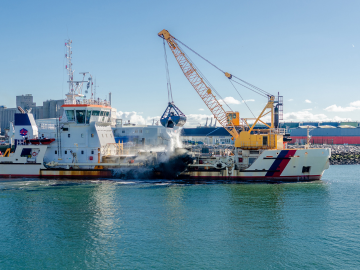
Seeking more efficiency and lower costs of international trade, cargo carriers continue to build larger ships and waterways must modernize to accommodate the deep draft ships. Port construction and maintenance activities have an impact on the marine environment and invoke testing and monitoring programs. Eurofins Environment Testing supports an array of sediment programs including dredged material projects, contaminated sediment remediation projects, sediment capping and water quality assessment, Total Maximum Daily Load (TMDL) studies and compliance initiatives.
Dredging activities may require the following testing protocol:
- Bulk sediment physical/chemical analysis
- Bioaccumulation
- Elutriate Testing
- Water column toxicity
- Benthic Toxicity
Why perform marine chemistry analysis?
Testing of sediments is necessary as:
- Impacted sediments provide a source of ongoing contamination to the aquatic environment
- Contaminants in sediment can harm aquatic organisms and/or accumulate in their tissues
- Species can be threatened
- Bioaccumulation may occur in marine organisms
- Organisms may be consumed by humans
Bioaccumulation is synonymous with “tissue testing” and is generally performed only if sediment bioaccumulation triggers are exceeded. Testing of marine tissue is the most direct method of determining if contaminants of emerging concern (CECs) are present in aquatic organisms.
Matrices have included sediments, surface waters, tissues, pore water, groundwater, and soils.
What analytes are included in marine chemistry testing?
The tests commonly performed for marine sediments and tissues include trace metals, Total Organic Carbon (TOC), petroleum hydrocarbons, sulfides, pesticides and polychlorinated biphenyls (PCBs), grain size, Alkylated Polycyclic Aromatic Hydrocarbons (PAHs), Pyrethroids, and other semi-volatile compounds.
Achieving the low reporting limits required for these parameters requires special sample cleanup/preparation procedures developed by Eurofins Environment Testing and incorporated into our standard operating procedures (SOPs). The low-level analysis of sediment, tissues, pore water, and elutriates requires specialized instrumentation that Eurofins Environment Testing houses in our dedicated marine chemistry laboratories.
What are Total Maximum Daily Loads (TMDLs)?
When a water body is assessed to be impaired for one or more reasons, Total Maximum Daily Loads (TMDLs) are developed by state agencies to determine the total amount of a pollutant that a body of water can handle without resulting in an impaired status.
TMDLs are typically implemented through National Pollutant Discharge Elimination System (NPDES) permits. Point source discharges must be controlled through the use of water quality-based effluent limits in permits issued to point source dischargers. Non-point source load reduction actions are implemented through a wide variety of programs at the state, local and federal level.
These programs may be regulatory, non-regulatory or incentive-based. Each state develops TMDLs for water bodies that they include on their list of impaired waters and then submits them to the U.S. Environmental Protection Agency (EPA, USEPA) for approval. EPA reviews and either approves or disapproves the TMDL. If EPA disapproves the TMDL, EPA must develop a replacement TMDL.
What is elutriate testing?
Elutriate testing is a bench-scale test designed to simulate and predict the water quality impacts from dredging or dredged material disposal. Dredging operations are routinely conducted in local ports and coastal areas and in inland waterways. Elutriate testing involves mixing site sediment and overlying water, followed by testing of the supernatant. This testing has been routinely applied for decades to support navigational dredging and disposal.
Eurofins Environment Testing has supported dredging and dredged material disposal projects over the years, and has developed procedures for the following elutriate tests:
- SET–Standard Elutriate Test (Open Water Disposal)–Often referred to as the “Open Water” Elutriate Test, simulates the release of the dissolved constituents into the receiving water during open water disposal.
- MET/EET–Modified Elutriate Test / Effluent Elutriate Test (Confined or Diked Disposal)–Simulates the quality of water discharged as effluent from a confined disposal facility (CDF).
- DRET–Dredging Elutriate Test (Point of Dredging)–Accounts for geochemical charges occurring in the CDF during active disposal operations. Predicts both dissolved contaminant concentrations and fraction of contaminants in the suspended solids.
Each of these procedures can be tailored to meet the specific objectives of a project. For any elutriate testing project, chemical analysis of the following sample sources can be provided: site sediment, site water, and the elutriate, including the filtered supernatant and unfiltered supernatant.
What is Eurofins Environment Testing's experience with marine chemistry?
For more than 25 years, Eurofins Environment Testing has supported dozens of marine chemistry studies and remedial programs. Our marine chemistry testing services have supported dredging operations at major port facilities and marinas on both the East and West coasts, but also include sediment capping investigations, and pilot programs.
When the Delaware River Basin Commission (DRBC), joined the EPA and states New Jersey, Pennsylvania, and Delaware, for a cooperative effort to evaluate and control PCBs in the Delaware Estuary, Eurofins Environment Testing helped to determine input from tributaries through 1668A analysis alongside the US Geological Survey.
As a result, 60 point source dischargers were required to develop and implement Pollutant Minimization Plans (PMPs) and to monitor their PCB discharges. Eurofins Environment Testing assisted several dischargers with the development of their plans and provided the supporting analytical programs.





Start your testing now
Contact us to discuss your project goals and learn how our testing solutions can support your data and regulatory needs.