Rethinking Whole Blood Processing: Evaluating Alternatives to PBMC Isolation in Clinical Trials
In today’s clinical trials and bioanalytical testing landscape, consistency is everything. Yet one of the most persistent challenges in immunogenicity testing and flow cytometry assays is the stability of samples—particularly when working with peripheral blood mononuclear cells (PBMCs). Variability introduced during collection, shipping, and delayed processing can significantly impact bioanalytical data quality.
Recent research from Eurofins Clinical Trial Solutions explores a critical question:
Can we reduce variability and improve sample integrity by rethinking how we process whole blood for clinical trial bioanalysis?
The Challenge: PBMC Stability in Clinical Bioanalysis
PBMCs are widely used in immunogenicity assays and clinical biomarker testing because they provide access to key immune populations such as T cells, B cells, and monocytes. However, they come with a drawback—they are sensitive to delays in processing.
In multi-site clinical trials, samples may spend hours in transit before reaching a central bioanalytical lab. During this time:
- Neutrophils begin to degranulate
- Reactive oxygen species and enzymes are released
- Cellular environments shift away from their original state
- T cell function and antigen expression can change
Even when cell proportions appear stable, functional and phenotypic changes can compromise downstream flow cytometry and ELISpot assays.
The Role of Centralized Sample Processing
For studies that rely on PBMC-based workflows, Eurofins Central Laboratory offers flexible PBMC processing solutions to support diverse clinical trial requirements. Using established standard operating procedures or client-specific isolation protocols, samples can be processed consistently across global studies, helping to reduce operational variability. Following isolation, PBMCs can be cryopreserved and stored for future analysis, then distributed to sponsor-selected laboratories or testing facilities worldwide. This approach enables isolated PBMCs to be used in wide range of downstream applications while helping sponsors maintain sample integrity, simplify logistics, and support centralized biobanking throughout the clinical trial life cycle.
The Opportunity: Improving Whole Blood Stabilization at Collection
To address these challenges, we explored whether whole blood preservation and stabilization at the point of collection could be used as an alternative to PBMC processing for phenotypic analysis.
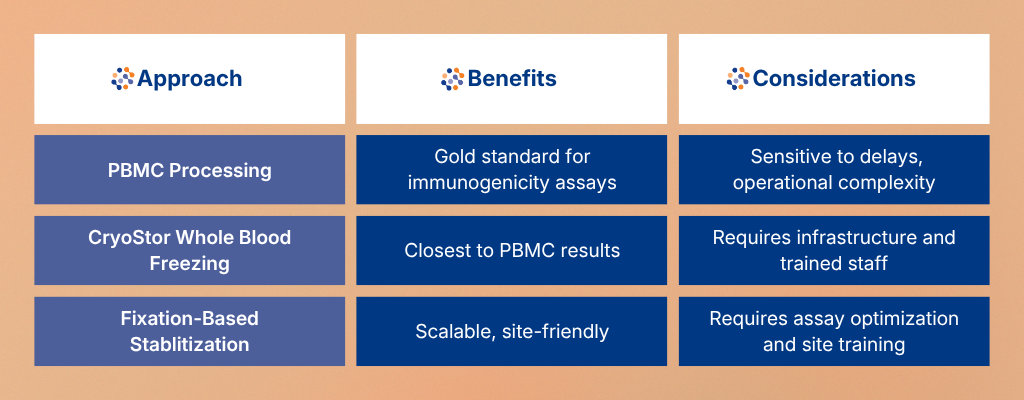
Several alternative approaches were evaluated:
1. Variable Whole Blood Freezing (CryoStor CS10)
- Uses DMSO-based media similar to standard PBMC cryopreservation workflows
- Maintains cell viability for functional assays and immune profiling
- Requires controlled conditions (aseptic technique, freezing equipment)
- Frozen to allow for batch analysis
- Storage in liquid nitrogen.
2. Fixation-Based Whole Blood Stabilization (Cytodelics, Smart Tubes)
- Pre-filled tubes simplify clinical site workflows
- Preserve and fix cells for flow cytometry-based phenotypic analysis
- Do not maintain viability for functional assays
- Frozen at -80℃ to allow for batch analysis
Study Design: Comparing PBMC Processing to Whole Blood Preservation Methods
To evaluate these approaches, whole blood samples were:
- Collected and processed at 3 hours post-collection
- PBMC samples were isolated at 3 hours and 30 hours post-collection
- Alternative matrices were compared against PBMCs isolated at 30 hours (representing real-world clinical trial conditions)
- Analyzed across key immune cell populations and markers relevant to immunogenicity and biomarker studies
The goal: Determine whether whole blood stabilization methods can match or improve upon traditional PBMC-based bioanalysis.
Key Findings for Clinical Trial Bioanalysis
CryoStor Shows Strong Alignment with PBMC Bioanalysis
CryoStor CS10 demonstrated the closest alignment with standard PBMC workflows:
- Comparable resolution of T cell populations (CD3, CD4, CD8)
- Reliable detection of key immune markers such as PD-1, TIGIT, and KLRG1
- Minimal impact on overall bioanalytical assay performance
However, implementation challenges remain:
- Requires specialized handling at clinical sites
- Less scalable for decentralized trials
Fixation-Based Methods Offer Scalable Clinical Trial Solutions
CytoDelics and Smart Tubes provide a more practical solution for global clinical trial sample management:
- Enable consistent whole blood processing at collection sites
- Preserve immune cell populations for flow cytometry-based bioanalysis
- Introduce additional cell populations (e.g., granulocytes), offering broader biological context
Some limitations include:
- Slight reductions in staining intensity
- Need for method optimization and antibody re-titration
Reducing Variability in Clinical Trial Samples
Across all methods, one conclusion is clear: Sample processing time significantly impacts bioanalytical data quality.
However, early stabilization of whole blood:
- Reduces variability from shipping and transit delays
- Improves consistency across multi-site clinical trials
Donor Variability Remains a Key Consideration
The study also highlights an important factor in clinical bioanalysis and biomarker research:
Donor-to-donor variability remains significant—even under controlled conditions.
This reinforces the need for:
- Larger validation cohorts
- Robust assay development strategies
- Fit-for-purpose bioanalytical method validation
What This Means for Bioanalytical Services and Clinical Trials
These findings support a growing shift in the industry toward end-to-end bioanalytical solutions that reduce variability at the source.
The Future of Whole Blood Bioanalysis in Clinical Trials
As large molecule therapeutics, biologics, and biosimilars continue to drive innovation, the need for reliable, scalable bioanalysis has never been greater.
Emerging trends include:
- Standardized whole blood preservation methods
- Increased adoption of decentralized clinical trial models
- Integration of high-dimensional flow cytometry and biomarker platforms
Final Thoughts: Advancing Bioanalytical Reliability
Sample integrity is foundational to successful clinical trials and biologics development. As the industry evolves, innovative whole blood stabilization strategies offer a path to:
- Improved data consistency
- Reduced operational complexity
- Enhanced confidence in clinical outcomes
The future of clinical bioanalysis may not replace PBMC workflows—but it will certainly transform how we approach sample collection, stabilization, and processing in modern drug development.
Take the Next Step
If you’re evaluating how to improve sample integrity, reduce variability, or modernize your bioanalytical approach, our team can help. Connect with the experts at Eurofins Viracor BioPharma to explore fit-for-purpose whole blood stabilization strategies, assay optimization, and end-to-end central lab solutions tailored to your study.
Improve sample integrity