Beyond Sensitivity: Lessons from Developing a Robust Multi-Matrix qPCR Assay for AAV Vector Shedding
How matrix-specific extraction strategies, rigorous validation, and reagent lifecycle management strengthen gene therapy bioanalysis.
A growing need for robust vector shedding studies
Adeno-associated virus (AAV)-based gene therapies continue to transform the treatment landscape for genetic diseases, offering the potential for long-term therapeutic benefit from a single administration. As these therapies advance through clinical development, understanding vector shedding profiles remains a critical component of clinical development. Regulatory agencies and sponsors require comprehensive shedding assessments to evaluate potential transmission risks to family members, caregivers, healthcare workers, and the environment.
Generating reliable shedding data, however, is far from straightforward. Biological matrices such as whole blood, serum, semen, urine, and saliva differ considerably in cellular composition, nucleic acid content, and the presence of PCR inhibitors. Consequently, developing a single qPCR assay that performs consistently across multiple matrices requires more than analytical sensitivity. It demands carefully optimized extraction workflows and rigorous validation.
A recent validation study conducted by Vikas Singh and colleagues at Eurofins Viracor BioPharma Services highlights key considerations for designing and validating sensitive, reproducible AAV shedding assays across multiple sample types.
Why comprehensive shedding assessments matter:
AAV vectors are among the leading platforms for gene delivery due to their favorable safety profile and ability to provide long-term therapeutic expression. Despite these advantages, sponsors must understand whether vector particles are shed following treatment and, if so, through which biological routes. Potential transmission pathways may include respiratory, gastrointestinal, sexual, and, theoretically, vertical transmission.
To generate a complete shedding profile, studies often evaluate multiple matrices, including:
- Whole blood
- Serum
- Semen
- Urine
- Saliva or buccal swabs
Each matrix presents distinct extraction and analytical challenges that can significantly impact assay performance.
Building a robust multi-matrix qPCR assay
One assay does not fit every matrix
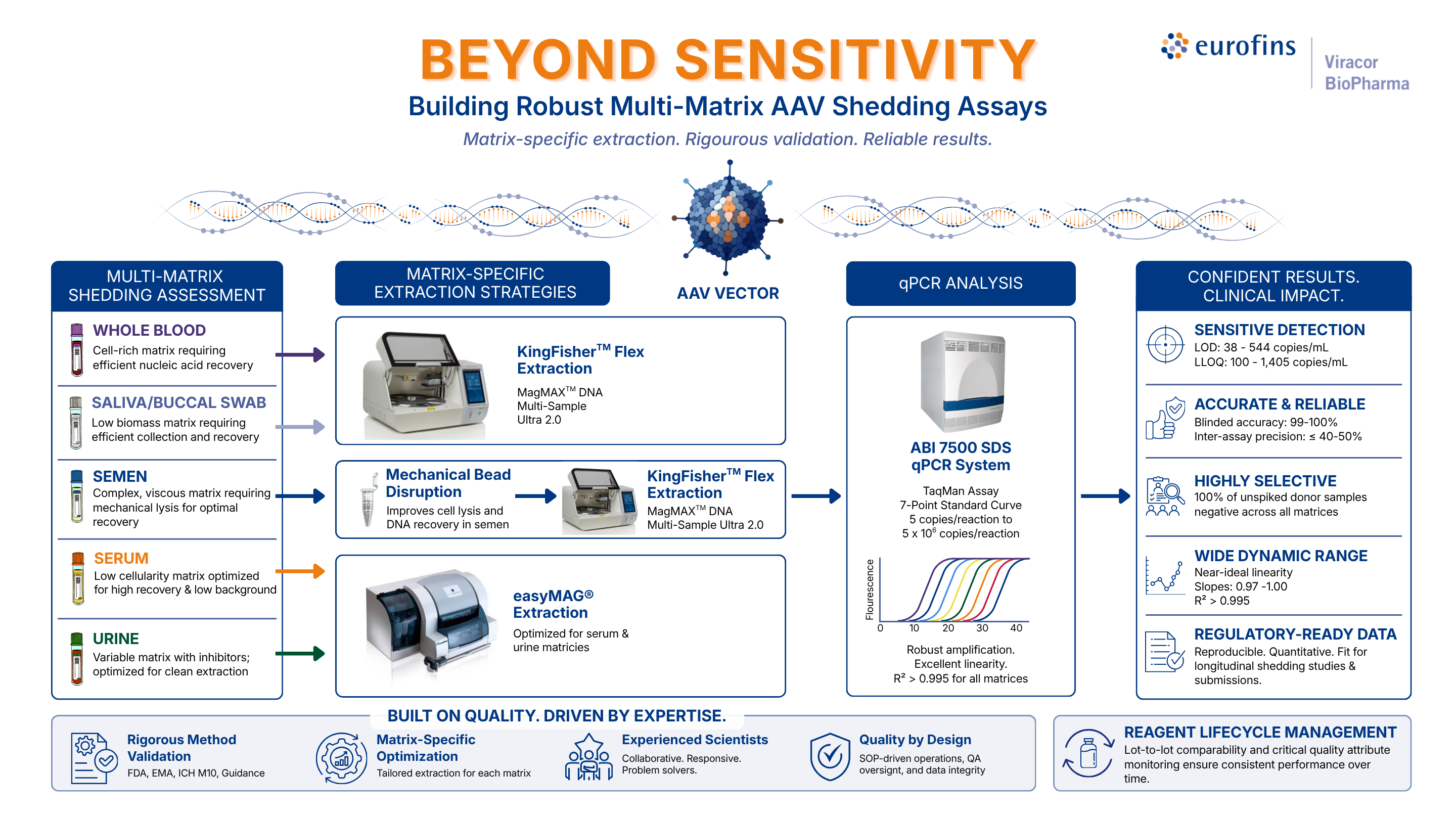
The study focused on development, optimization, and validation of a client-specific AAV qPCR assay across five matrices: whole blood, serum, semen, urine, and saliva swabs. A common misconception is that a validated qPCR assay can simply be applied across all specimen types. In reality, sample preparation often has a greater impact on assay performance than PCR amplification itself.
Cell-rich matrices such as whole blood and semen present unique extraction challenges because nucleic acids must be efficiently recovered from complex biological material. By contrast, relatively cell-free matrices including serum and urine require different extraction strategies to maximize recovery while minimizing background interference.
Recognizing these differences, the validation incorporated matrix-specific extraction workflows rather than relying on a universal approach. Whole blood, semen, and saliva swabs were processed using the KingFisher™ Flex platform with the MagMAX™ DNA Multi-Sample Ultra 2.0 chemistry, while serum and urine were extracted using the easyMAG® system. Semen samples also underwent mechanical bead disruption to improve DNA recovery before extraction.
Matching the extraction method to each matrix proved essential for achieving consistent analytical performance across the entire shedding program. And therefore, different extraction workflows were selected based on the biological characteristics of each sample type.
Amplification was performed on the ABI 7500 SDS qPCR platform using a seven-point standard curve ranging from 5 copies per reaction to 5 × 10⁶ copies per reaction.
Strong analytical performance across diverse sample types
The optimized workflow demonstrated robust analytical performance across all five matrices.
The assay achieved low limits of detection ranging from 38 to 544 copies/mL and lower limits of quantification between 100 and 1,450 copies/mL. All matrices except semen achieved quantification below 1,000 copies/mL, with semen exhibiting a higher LLOQ because dilution before extraction was necessary to manage its biological complexity.
When normalized to total DNA recovery, whole blood and semen demonstrated particularly strong analytical sensitivity, underscoring the importance of evaluating assay performance using matrix-appropriate reporting approaches rather than relying solely on copies per milliliter.
Beyond sensitivity, the assay demonstrated:
- Excellent inter-assay precision at or below 40–50%, within acceptable validation limits.
- Blinded accuracy rates of 99–100% across all matrices.
- Excellent selectivity, with 100% of unspiked donor samples testing negative across all matrix types.
- Near-ideal linearity (R² > 0.995), with slopes ranged from 0.97 to 1.0 for every matrix evaluated.
Collectively, these findings demonstrated that the assay could generate reproducible, quantitative data suitable for longitudinal clinical shedding studies. These results indicate that the assay could differentiate true vector signal from matrix background while maintaining consistent performance during repeated testing. Such characteristics are essential for generating confidence in longitudinal shedding studies that may span several months of clinical monitoring.
The assay also maintained a wide dynamic range and delivered highly proportional results across varying concentrations of AAV genetic material. While semen demonstrated a slight intercept bias relative to other matrices, overall performance remained within acceptable validation expectations.
A valuable lesson came after validation.
While the validation successfully established assay performance, one of the most important findings emerged during routine laboratory investigations.
An unexpected shift in qPCR results led to a detailed evaluation of extraction reagent performance. Working collaboratively with manufacturer, investigators identified acidification of the bead binding solution during storage as the probable source of lot-to-lot variability.
The newer reagent lot produced Ct values approximately four cycles earlier than the older lot. Because a difference of only 3.3 Ct corresponds to roughly a tenfold change in measured copy number, this degree of variability could substantially influence clinical interpretation and increase the risk of false-positive or false-negative results depending on assay decision thresholds. The manufacturer was able to address and resolve this reagent performance issue.
This observation highlights an often-overlooked aspect of assay robustness: validation alone does not guarantee long-term analytical performance. Continuous reagent qualification, lot-to-lot comparability assessments, and monitoring of critical quality attributes such as buffer pH should be incorporated into routine assay lifecycle management.
Key takeaways for gene therapy developers
This case study demonstrates that successful shedding programs require more than a sensitive qPCR assay; they also depend on matrix-specific extraction strategies, rigorous validation, and ongoing reagent lifecycle management.
Key lessons include:
- Tailor nucleic acid extraction workflows to each biological matrix rather than applying a single universal approach.
- Evaluate analytical performance using matrix-appropriate reporting metrics, particularly for complex specimens such as whole blood and semen.
- Validate sensitivity, precision, accuracy, selectivity, and linearity across every intended specimen type.
- Incorporate reagent qualification and lifecycle monitoring into routine laboratory practice to detect subtle changes before they affect clinical results.
As gene therapy pipelines continue to expand, comprehensive multi-matrix shedding programs will remain an essential part of demonstrating safety. By combining optimized extraction strategies with rigorously validated qPCR methods, sponsors can generate the high-quality shedding data needed to support regulatory submissions and advance innovative therapies to patients.

Need a partner for gene therapy shedding studies?
Designing shedding studies requires more than a sensitive assay. It demands matrix-specific expertise, robust validation strategies, and operational processes that ensure data integrity throughout the study lifecycle. Eurofins Viracor BioPharma Services supports gene therapy developers with comprehensive qPCR assay development, validation, and multi-matrix testing solutions to generate reliable shedding data for regulatory submissions and clinical decision-making.
Connect with our scientific team to discuss your AAV shedding strategy and learn how our end-to-end bioanalytical services can support your program.