Human skin model test

Assessment of skin corrosion potential for medical devices
Reconstructed human epidermis testing according to OECD 431
At Eurofins Human Safety Testing the human skin model test can be used for detection of skin irritation potential of medical devices. The prediction and classification can be done by the assessment of the effect on EpiDermTM model or SkinEthicTM model.
The modified human skin model test for medical devices is a reliable in vitro test method and is performed in accordance with the draft ISO guideline 10993-10 Part 10 at our laboratory1.
Human skin model test: in vitro Skin corrosion (EpiDerm™ and EPISKIN-SM™)
The prediction and classification of skin corrositivity potential of substances can be performed by the assessment of the effect on EpiDerm and EPISKIN-SM™ models.
The human skin model test is validated by the EURL ECVAM (European Union Reference Laboratory for Alternatives to Animal Testing) and is performed in accordance with the OECD guidance (OECD 431) at Eurofins Human Safety Testing1 with chemicals, cosmetics or personal care products and pharmaceuticals.
Assessment of skin corrosion potential
- Corrosion represents irreversible tissue damage of the skin (visible necrosis) after application of a substance. The underlying mechanisms are either the destruction of the skin penetration barrier or the rapid penetration of highly cytotoxic chemicals through the skin without its destruction.
- The EpiDerm™ and EPISKIN-SM™ represent a reconstituted three-dimensional human epidermis (RhE) model which consists of human epidermal keratinocytes. This in vitro model mimics biochemical and physiological properties of the upper human skin.
- To determine skin corrosion potential chemicals are applied directly on the skin tissue surface and the cell viability is measured by MTT assay.
- The EpiDerm™ and EPISKIN-SM™ human skin model test can be used as a reliable in vitro method to distinguish between corrosive and non-corrosive chemicals. Additionally, sub-categorisation in "Category 1A" or a combination of sub-categories "1B" and "1C" is possible with this test².
- The skin corrosion test can be performed subsequently to a positive skin irritation test for a final classification. If the skin corrosion test is performed at first, a negative result can be followed by an irritation test to conclude if the chemical has irritant potential or not.
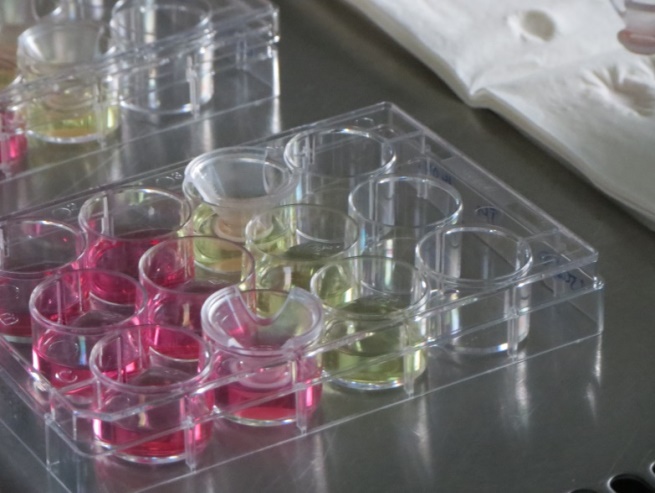
Corrosion represents irreversible tissue damage of the skin (visible necrosis) after application of chemicals. The underlying mechanisms are either the destruction of the skin penetration barrier or the rapid penetration of highly cytotoxic chemicals through the skin without its destruction.
Procedure: Principles of the human skin model test
Protocol |
||
| Model |
EpiDerm |
EpiSkin |
| Supplier |
MatTek |
Skin Ethic |
| Analysis |
Corrosivity potential: cytotoxicity measurement with MTT (mean tissue viability compared to negative control) |
|
| Test chemical concentrations |
|
|
| Exposure time |
3 min and 60 min incubation with dose groups |
3 min, 60 min and 240 min incubation with dose groups |
| Quality controls |
|
|
| Pre-tests |
To determine if additional controls are needed: NSMTT*: mixing of test item with MTT medium to determine if test item alone can reduce MTT à blue colouring: in main experiment two killed tissues treated with test item and two untreated killed tissues were added as controls NSCliving#: mixing of test item with H2O or isopropanol to determine if strong own colour of test item can discolour at contact with this liquids à optical discolouring (measuring of spectrum): in main experiment two living tissues without incubation with MTT medium were added as controls NSCkilled§: if the two other controls were determined à in main experiment two killed tissues without incubation with MTT medium were added as controls |
|
| Application |
Direct topical application of chemicals on skin tissue Two tissue replicates per dose group |
|
| Data delivery |
Optical density (OD) value with microplate spectrophotometer at 570 nm |
|
*NSMTT: non-specific MTT reduction
#NSCliving: non-specific colouring of living tissues
§NSCkilled: non-specific colouring of killed tissues
Procedure: Prediction model of the human skin model test
| Prediction EpiDerm™ |
Prediction EPISKIN-SM™ |
||
|
Mean tissue viability (% negative control) |
Prediction optional sub-categorisation |
Mean tissue viability (% negative control) |
Prediction optional sub-categorisation |
|
Step 1 |
-- | ||
|
< 50% after 3 min exp. |
Corrosive |
< 35% after 3 min exp. |
Corrosive Optional sub-category 1A (risk of over-prediction) |
|
³ 50% after 3 min exp. and < 15% after 60 min exp. |
Corrosive A combination of optional sub-categories 1B and 1C |
³ 35% after 3 min and < 35% after 60 min exp. or ³ 35% after 60 min and < 35% after 4 h exp. |
Corrosive A combination of optional sub-categories 1B and 1C |
|
³ 50% after 3 min exp. and |
Non-Corrosive |
³ 35% after 4 h exp. |
Non-Corrosive |
|
Step 2 |
-- |
||
|
< 25% after 3 min exp. |
Optional sub-category 1A |
||
|
≥ 25% after 3 min exp. |
A combination of optional sub-categories 1B and 1C |
||
Exp. = exposure
Table 1: Prediction model of the corrosivity potential of the EpiDermTM and the EPISKIN-SMTM tissues dependent on the mean tissue viability.1
Based on the mean tissue viability, chemicals can be classified with the skin corrosion test into corrosive and non-corrosive and can be furthermore sub-categorised.
Eurofins data for demonstration technical proficiency of the human skin model test (EpiDerm™ and EPISKIN-SM™)
| Chemical | UN GHS category | EF category for EpiDerm™ | EF category for EPISKIN-SM™ |
|
Corrosive chemicals (sub-category 1A) |
|||
|
Bromoacetic acid |
1A | 1A | 1A |
|
Boron trifluoride dihydrate |
1A | 1A | 1A |
|
Phenol |
1A | 1A | 1A |
|
Dichloroacetyl chloride |
1A | 1A | 1A |
|
Corrosive chemicals (combination of sub-categories 1B and 1C) |
|||
|
Glyoxylic acid monohydrate |
1B and 1C | 1B and 1C | 1B and 1C |
|
Lactic acid |
1B and 1C | 1B and 1C | 1B and 1C |
|
Ethanolamine |
1B and 1C | 1B and 1C | 1B and 1C |
|
Hydrochloric acid (14.4%) |
1B and 1C | 1B and 1C | 1B and 1C |
|
Non-corrosive chemicals |
|||
|
Phenethyl bromide |
NC | NC | NC |
|
4-Amino-1,2,4-triazole |
NC | NC | NC |
|
4-(Methylthio)-benzaldehyde |
NC | NC | NC |
|
Lauric acid |
NC | NC | NC |
EF = Eurofins Munich GmbH NC = Non-Corrosive
Table 2: Eurofins data of in vitro skin corrosion with EpiDerm™ and EPISKIN-SM™ of twelve tested proficiency chemicals compared to the data of the OECD guideline 431 1.
In Table 2 the obtained data from the in vitro skin corrosion with EpiDerm™ and EPISKIN-SM™ of eight corrosive and four non-corrosive chemicals are shown. The prediction of all tested chemicals was correct in comparison to the classification of the OECD guideline 431.
References
- OECD (2016). OECD Guideline for the Testing of Chemicals. No. 431: In Vitro Skin Corrosion: Reconstructed Human Epidermis (RHE) Test Method, 29 July, 2016
- UN (2015), United Nations Globally Harmonized System of Classification and Labelling of Chemicals (GHS), Sixth revised edition, UN New York and Geneva