XXT test
Quantitative assessment of cell viability
Measurement of viable cells through metabolic activity.
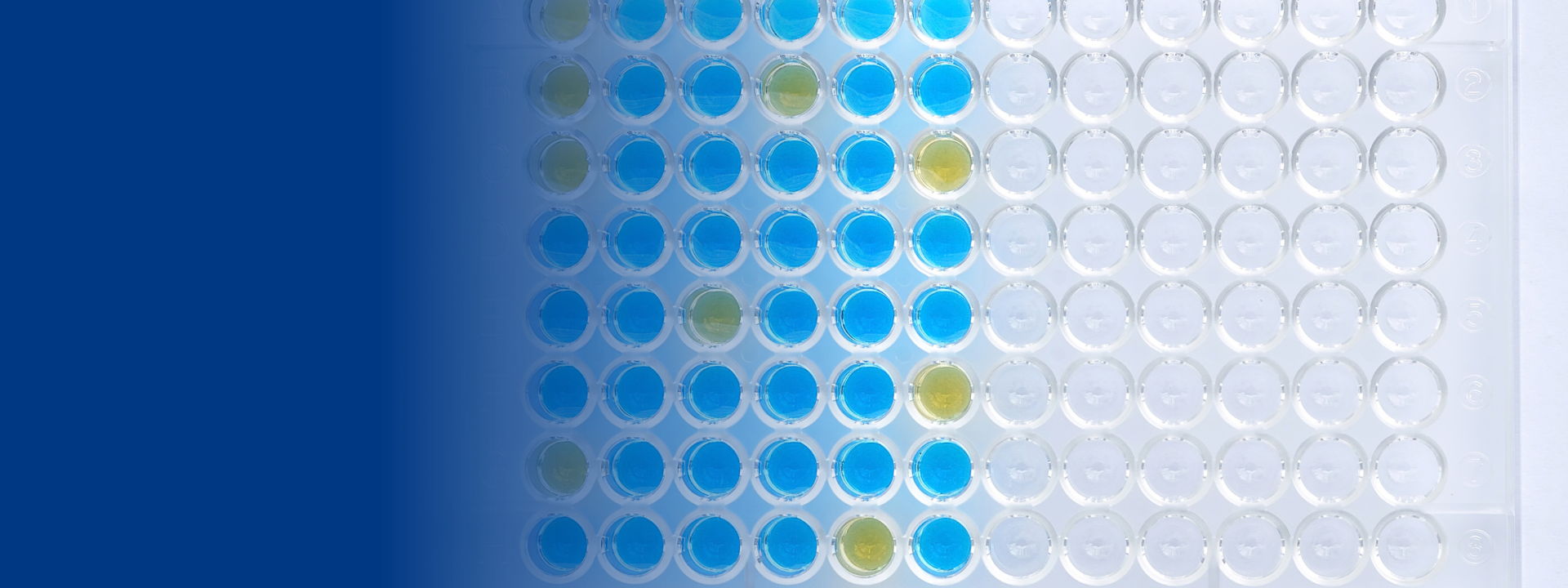
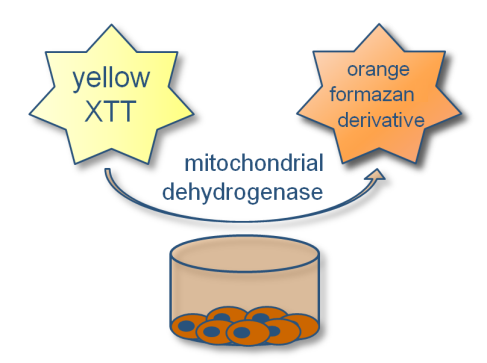
The XTT test is an in vitro cytotoxicity assay based on the cleavage of the yellow tetrazolium salt XTT into an orange, water-soluble formazan product by dehydrogenase activity in active mitochondria.
A decrease in the number of viable cells results in reduced mitochondrial dehydrogenase activity within the sample. This reduction directly correlates with the amount of orange formazan formed, which is measured by absorbance.
Using the XTT assay, cell viability and proliferation following treatment with the test item are determined colorimetrically.
Assessment of mitochondrial dehydrogenase activity by extraction method and XTT dye
- The test item is extracted under agitation for a defined period in DMEM supplemented with 10% FBS at 37 ± 1°C, and L929 cells are incubated with the extract.
- At the end of the incubation period, the cells are evaluated microscopically and the XTT reagent and electron coupling reagent are added.
- Cells are incubated for a further 1 to 2 hours, and absorbance is measured at 450 nm (reference wavelength 650 nm).
- Dehydrogenase activity below 70% compared with untreated control cultures (solvent control) is considered a clear cytotoxic effect according to ISO 10993-5.
XTT test protocol
Protocol |
|
|
Cell line |
L929 cells (ATCC No. CCL1, NCTC clone 929; connective tissue mouse cell line, clone of strain L, DSMZ) |
|
Analysis |
The XTT test is based on the cleavage of the yellow tetrazolium salt XTT to form an orange water-soluble formazan product by dehydrogenase activity in active mitochondria |
|
Concentrations |
4 extract concentrations: 29.6%, 44.4%, 66.7% and 100% |
|
Extraction time |
4 - 72 h at 37 ± 1°C
|
|
Incubation time |
24 - 72 h at 37 ± 1°C |
|
Quality controls |
Solvent Control: DMEM 10% FBS Negative control: Polypropylene extracted in DMEM 10% FBS Positive control: Latex extracted in DMEM 10% FBS |
|
Data delivery |
Mitochondrial dehydrogenase activity is determined through the absorbance at 450 nm (reference wavelength 650 nm) |
|
Positive prediction |
Dehydrogenase activity of less than 70% compared to untreated control cultures (solvent control) is considered as a clear cytotoxic effect |
References
- Scudiero, P. A.; Shoemaker, R. H.; Paull, K. D.; Monks, A.; Thierney, S.; Nofziger, T. ; Currens, M. J.; Seniff, D.; Boyd, M. R.: 1988, “Evaluation of a soluble Tetrazolium/Formazan assay for cell growth and drug sensitivity in culture using human and other tumor cell lines“. Cancer Res., 48, 4827 – 4833
- ISO 10993-5: 2009, “Biological evaluation of medical devices – Part 5: Tests for in vitro cytotoxicity“
- ISO 10993-12: 2012, “Biological evaluation of medical devices – Part 12: Sample preparation and reference materials“