Elution test

Assessment of cytotoxic effects from material extracts
Evaluation of cellular responses to substances released from the test material.
The elution test is an in vitro cytotoxicity test that evaluates the cytotoxic potential of a test item through microscopic assessment according to USP <87> (USP 41).
In this method, pre-seeded cells are cultured with an extract of the test material. Following an incubation period of 48 hours, the biological reactivity of the cells is examined and assessed microscopically.
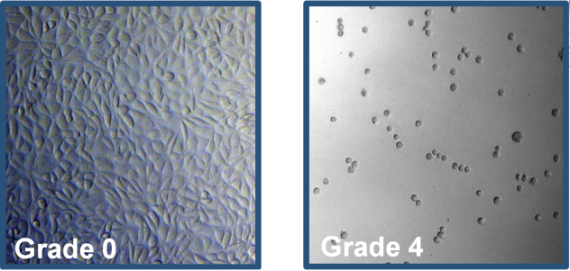
Assessment of growth inhibition of cells by extraction method and microscopic evaluation
- The test item is extracted for 24 hours under agitation in MEM supplemented with 10% FBS at 37 ± 1°C.
- After the incubation period, cells are examined microscopically for morphological changes. Biological reactivity, including cellular degeneration and malformation, is described and assigned a score from 0 to 4 (see table below).
- Responses observed in cultures treated with the test item extract and the corresponding controls are evaluated.
- The test item meets the test requirements if the response to the test item extract is not greater than Grade 2 (mildly reactive).
Biological reactivity grading
Grade |
Reactivity |
Conditions of all cultures |
|
0 |
None |
Discrete intracytoplasmic granules; no cell lysis |
|
1 |
Slight |
Not more than 20% of the cells are round, loosely attached, and without intracytoplasmic granules; occasional lysed cells are present |
|
2 |
Mild |
Not more than 50% of the cells are round and devoid of intracytoplasmic granules; no extensive cell lysis and empty areas between cells |
|
3 |
Moderate |
Not more than 70% of the cell layers contain rounded cells or are lysed |
|
4 |
Severe |
Nearly complete destruction of the cell layers |
Elution test protocol
Protocol |
|
|
Cell line |
L929 cells (ATCC No. CCL1, NCTC clone 929; connective tissue mouse cell line, clone of strain L (DSMZ)) |
|
Analysis |
Microscopic evaluation |
|
Extraction time |
24 h |
|
Incubation time |
48 h |
|
Quality controls |
Solvent Control: MEM 10% FBS Negative control: high-density polyethylene material (HDPE) Positive control: 0.1% Zinc-diethyldithiocarbamate (ZDEC), 0.25% Zinc-dibutyldithiocarbamate (ZDBC) |
|
Data delivery |
Biological Reactivity of test material according to USP <87> (USP 41) |
|
Positive prediction |
The test item meets the requirements of the test, if the response to the test item extract is not greater than grade 2 (mildly reactive) |
References
- Guess, W.L.; Autian, J. (1966). Toxicity Evaluation of Lexan, Kyonar, Rilsan, Short-Term Studies. Journal of Oral Therapeutics and Pharmacology Vol 3, No.2, pp 116 – 123
- United States Pharmacopeia and National Formulary (USP 41), Chapter <87> (2018). Biological Reactivity Tests, in vitro - Elution Test