Colony forming assay

Assessment of cell survival and colony formation
Evaluation of the ability of cells to survive, proliferate and form colonies.
The colony forming assay is an in vitro cytotoxicity test used to assess the cytotoxic effects of leachable substances released from a test item. Cytotoxicity is evaluated by measuring the colony-forming ability of cells following treatment with various concentrations of the test item extract compared with untreated controls.
The dilution that reduces colony formation to 50% (IC50) can be determined by plotting the relative colony-forming rate (%) against the dilution of the test extracts (%).
The mean number of colonies formed in treated cultures represents the colony-forming ability of the cells and reflects cell survival following treatment. Cultures incubated with fresh culture medium serve as the 100% control.
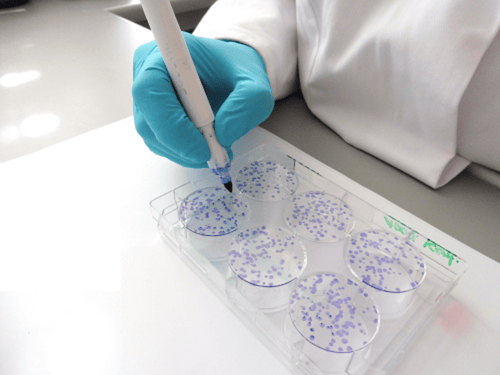
Assessment of cytotoxicity by colony-forming ability
- The test item is extracted for a defined period in cell culture medium at 37 ± 1°C, and V79 cells are incubated with the extract for several days.
- Following incubation, the cultures are examined microscopically and carefully washed with PBS buffer.
- After fixation with methanol, colonies are stained using Giemsa staining solution.
- The stained colonies are dried at room temperature and colonies consisting of more than 50 cells are counted manually.
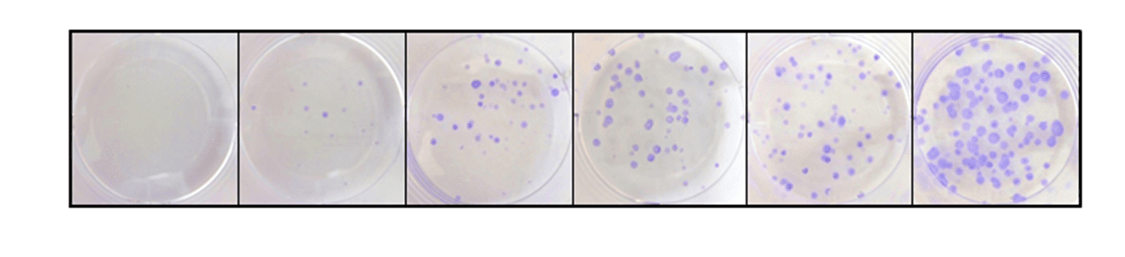
Test item acceptance criteria
- IC50 acceptance limit according to MHLW: ≥ 90%
- A reduction of relative plating efficiency at 100% test solution concentration of more than 30% is considered a cytotoxic effect.
Colony forming assay protocol
Protocol |
|
|
Cell line |
V79 cells (ATCC, CCL-93) |
|
Analysis |
The mean number of colonies formed in cultures reflects the colony-forming ability and survival of cells following treatment with the test item. |
|
Concentrations |
6 concentrations of the test extract |
|
Extraction time |
24 h at 37 ± 1°C |
|
Incubation time |
6 - 7 days at 37 ± 1°C |
|
Quality controls |
100% control: Fresh MEM 10% FBS Solvent control: MEM 10% FBS Negative control: High-density polyethylene extracted in MEM 10% FBS Positive controls: ZDEC- and ZDBC- polyurethane film extracted in MEM 10% FBS |
|
Data delivery |
Colony-forming ability |
|
Positive prediction |
IC50 acceptance limit according to MHLW: < 90% A reduction of relative plating efficiency at 100% test solution concentration of more than 30% is considered a cytotoxic effect. |
References
- ISO 10993-12: 2012 “Sample preparation and reference materials”
- MHLW (Ministry of Health, Labour and Welfare, Japan) Notification by Director of OMDE Yakushokuki-hatsu No. 0301-20, “Basic Principles of Biological Safety Evaluation Required for Application for Approval to Manufacture/Market Medical Devices”, March 1, 2012
- MHLW (Ministry of Health, Labour and Welfare, Japan) Ministerial Notification by Director of Health, Labour and Welfare Yasuhisa Shiozaki No. 64, The Japanese Pharmacopoeia, Seventeenth Edition, March 07, 2016, chap.7.03, 4. “Cytotoxictity test”