How we test
Testing for microplastics is a fascinating and complex field and the appropriate method will depend on the purpose of the test and the material (water, sludge, cosmetic products, etc.) to be tested.

What are microplastics and why should you care?
Plastics have become deeply integrated into our daily lives due to their versatility. Since 1950, over 9.2 billion tons of plastic have been produced, and this number continues to rise rapidly. However, plastic waste management has not kept pace, leading to significant buildup in the environment. Due to their remarkable durability, plastics gradually break down into smaller particles, known as microplastics, through weathering and disintegration. These microplastics eventually end up in oceans, streams, and other ecosystems.
Microplastics are also intentionally added to a wide range of products, including fertilizers, cosmetics, household items, detergents, cleaning products, paints, and products used in the oil and gas industry. They are also released from artificial turf fields. The European Chemicals Agency (ECHA) reports that the European Union/European Economic Area alone uses about 145,000 tons of intentionally added microplastics annually (ECHA, 2021). In September 2023, the European Commission adopted new measures under the EU Registration, Evaluation, Authorization and Restriction of Chemicals (REACH) legislation to restrict the intentional use of microplastics in products. These measures are expected to prevent the release of approximately half a million tons of microplastics into the environment over the next 20 years.
Microplastics have been found in marine and freshwater ecosystems, as well as in terrestrial environments. Once they enter the environment, they accumulate in animals, eventually making their way back to humans through food and drinking water. Additionally, an international study led by the Eurofins Environment Testing microplastics peer group uncovers the extent of microplastic contamination in the air across three continents. Read more here: https://plasticdustcloud.com/
The impacts of microplastics are still being investigated, but it is clear they negatively affect ecosystems, water quality, and potentially human health. This is due not only to their physical presence but also to associated chemical and biological risks, such as the accumulation of toxic chemicals and the potential transport of harmful pathogens. In April 2026, the U.S. Environmental Protection Agency announced that it is adding microplastics to its draft Contaminant Candidate List (CCL) under the Safe Drinking Water Act for the first time. This places microplastics on a list of contaminants the agency will study for potential future regulation in public drinking water systems.
Matrices we can test
Who we support
Testing for microplastics is a fascinating and complex field and the appropriate method will depend on the purpose of the test and the material (water, sludge, cosmetic products, etc.) to be tested.
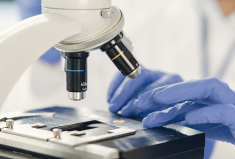
Before the sample is analysed on the instrument, it needs to undergo some form of sample preparation or clean-up. The goal of this preparation is to isolate the microplastic, separate it from any interfering compounds in the sample, and make it compatible with the desired measurement technique. The specific process varies between techniques and sample types.

All our state-of-the-art microplastic analysis methods provide qualitative results to identify the different polymer types in the samples. Furthermore, we can quantify the number of microplastics, using spectroscopy (Raman, FTIR and LDIR), and report the total mass of particles, using Pyrolysis-GC/MS. See below for some of the most common measurement techniques used to test for microplastics.

| Method | Information Obtained | |
| Microscopy | Light Microscopy | Number, Size, Morphology, Color |
| Spectroscopy | Raman Spectroscopy | Type in size range 5-500 µm |
| Fourier Transformation Infrared Spectroscopy (FTIR) | Type in size range 25-5000 µm | |
| Laser Direct Infrared Imaging (LDIR) | Type in the size range 20-5,000 µm | |
| Thermal Analysis | Pyrolysis (PYR) GC-MS | Type as concentration |

Please reach out to one of our global specialists to find out more about microplastics testing in your region.
Eurofins Environment Testing Bergen | Sandviksveien 110, Bergen, NO-5035, Norway | Tel:+47 94 50 42 42, Fax:+47 55 54 92 80, bergen@etn.eurofins.com
Eurofins IPROMA | Av. de Los Pirineos nº 9 - Nave17, 28703, S.S. de los Reyes (MADRID), Spain | Tel:+34 916 587 440, atencioncliente@iproma.com
Eurofins Analytical Services Hungary Kft. | Anonymus u. 6, Budapest 1045, Hungary | Tel:+3618723600, kornyezet@laboratorium.hu
Eurofins Environment Testing Australia Pty Ltd. | 6 Monterey Road, VIC 3175, Dandenong South Australia | Phone: +61 3 8564 5000, MicroPlasticsAUS@eurofinsanz.com
Eurofins Environment Testing - Sacramento | 880 Riverside Parkway, West Sacramento, CA 95605 | Phone: 916-373-5600, Env.Marketing@ET.EurofinsUS.com
Eurofins Consumer Product Testing Vietnam | 1/4 Tan Thoi Nhat 18 Street, Tan Thoi Nhat Ward, District 12, Ho Chi Minh City, Vietnam | Phone: +84 28 7109 8828, Email: CPTVNcs@cpt.eurofinsasia.com


