
For compliance managers and brand leaders in cosmetics and personal care, ensuring accurate sunscreen claims is no longer optional—it’s essential for consumer trust and regulatory compliance.
Traditional in vivo SPF testing, which relies on human volunteers, has been the gold standard for decades. Yet, this approach is increasingly criticized for being expensive, ethically questionable, and inconsistent, with studies showing up to 50% variability between labs.
Recent news has amplified the urgency: in Australia, CHOICE revealed that 16 out of 20 sunscreens failed to meet their SPF claims, triggering recalls and reputational impact. These failures highlight why the industry is evaluating in vitro SPF testing as a faster, more ethical, and more reproducible alternative.
In this article, we’ll examine the evolution of SPF testing methods, highlight the new ISO 23675 and HDRS protocols, compare them with traditional approaches, and explore what brands must know to stay compliant and trusted.
Understanding SPF Testing Methods: In Vivo vs. In Vitro Approaches
To understand the shift, it’s important to contrast how SPF testing methods work:
In Vivo Testing (Human-based)
- Defined under ISO 24444.
- Requires human volunteers to apply sunscreen; researchers then measure the skin’s UV response.
- Limitations:
- Ethical concerns over exposing humans to UV radiation.
- High cost and time-intensive.
- Large variability between labs—undermining reliability.
In Vitro Testing (Lab-based)
- Conducted on synthetic substrates like PMMA plates rather than human skin.
- Uses spectrophotometry to measure how sunscreen absorbs or reflects UV light.
- Advantages:
- Non-animal, ethical approach.
- Faster and lower cost compared to human trials.
- Improved reproducibility when standardized methods are followed.
In Silico Testing (Computer Modelling)
- Uses algorithms and simulations to predict SPF performance.
- Still experimental and not currently recognized by regulators.
Among these, in vitro SPF testing has gained momentum as the middle ground between ethical responsibility and scientific reliability.
Technical Analysis: Comparing In Vitro SPF Testing Methods
Not all in vitro methods are the same. A technical comparison follows:
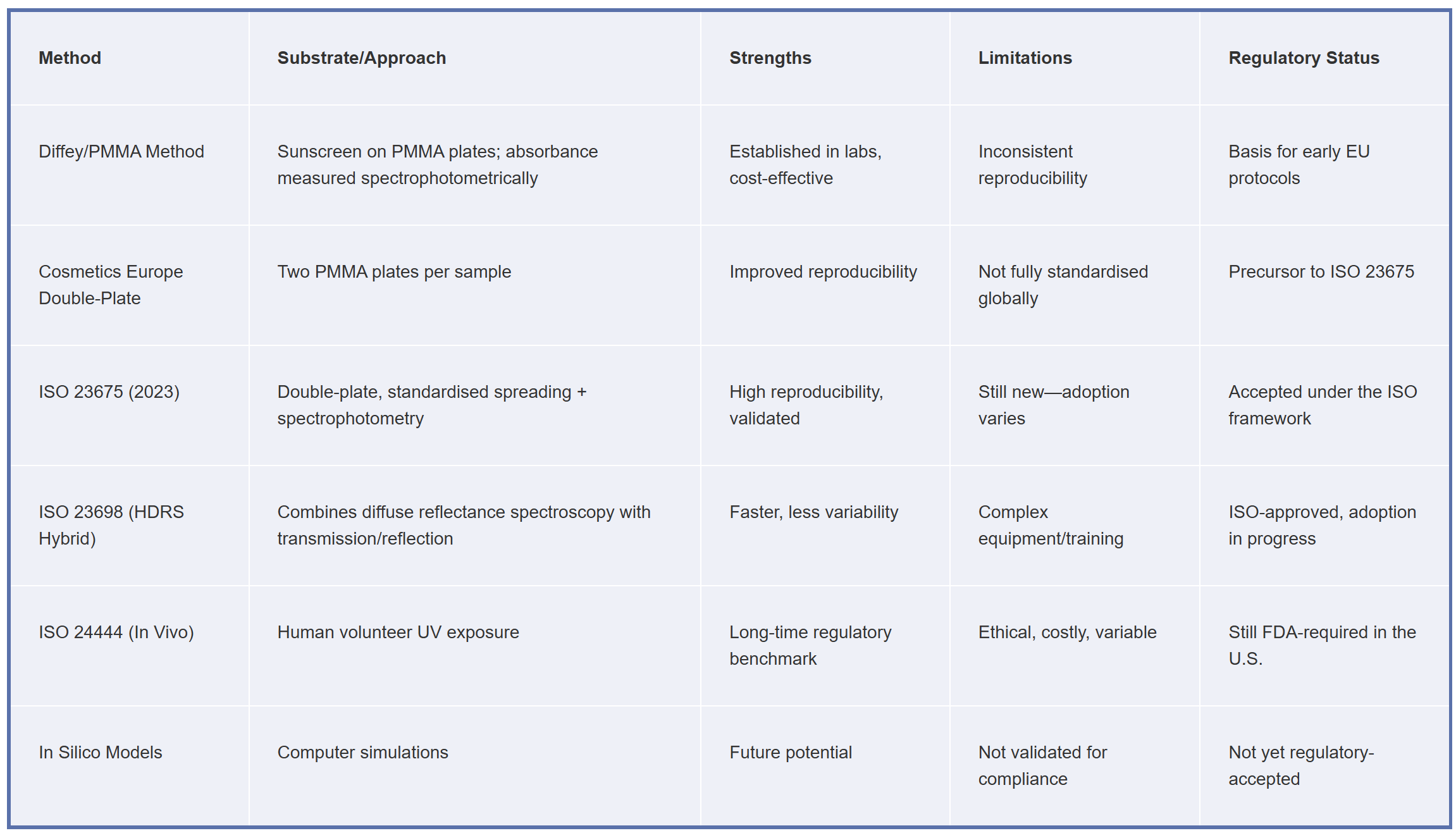
These advances mark a significant development: ISO 23675 and HDRS (23698) finally bring standardization to lab-based SPF determination, addressing the reproducibility gap that regulators long criticized.
Regulatory & Industry Adoption: Where Are We Now?
The regulatory landscape is evolving, but uneven:
- United States (FDA)
- Still requires in vivo ISO 24444 for SPF claims.
- FDA cites reproducibility concerns with in vitro methods.
- Movement is slow, though industry pressure is mounting.
- European Union (EU)
- Long emphasized UVA protection via the “1/3 UVA rule.”
- Supports in vitro testing for UVA-PF (ISO 24443).
- Adoption of ISO 23675 and HDRS is expected to grow.
- Australia (TGA)
- High-profile sunscreen failures have raised scrutiny.
- While in vivo remains the legal benchmark, regulators are considering in vitro to restore consumer trust.
- APAC & Other Regions
- Japan and South Korea actively research hybrid methods.
- Some markets allow in vitro results as part of dossier submissions, though not for label claims yet.
For compliance managers, the implication is evident: global alignment is coming, but timelines differ. Proactive adoption of ISO in vitro methods positions brands ahead of the regulatory curve.
Consumer Trust & Brand Risk: Why Accuracy Matters
SPF represents a quantified measure of photoprotection. When products underperform:
- Recalls and litigation: The Ultra Violette recall in Australia underscores the financial and reputational stakes.
- Consumer skepticism: Repeated SPF failures erode public trust in sunscreen efficacy.
- Retailer requirements: Global retailers increasingly demand evidence of standardized testing, even beyond regulatory minimums.
For compliance managers, ensuring accurate SPF labelling is both a legal safeguard and a brand differentiator. In vitro SPF testing helps reduce variability and builds confidence with regulators, retailers, and consumers alike.
In Vitro SPF Testing Method: A Technical Overview
The following outlines the ISO 23675 double-plate methodology of the ISO 23675 double-plate method:
- Prepare PMMA Plates: Synthetic plates designed to mimic the skin surface.
- Apply Sunscreen: Precisely measured dosage spread evenly using standardized techniques.
- Set Up Spectrophotometer: Instrument calibrated to measure UV absorption.
- Measure Absorbance: UV transmission recorded across wavelengths.
- Calculate SPF: Values determined using algorithms like Diffey & Robinson.
- Validate Results: Repeatability confirmed across duplicate plates.
This repeatable process allows labs to deliver consistent and auditable results, something in vivo trials often fail to achieve.
Conclusion: Strategic Implications for Compliance Managers
The sunscreen industry is at a crossroads. In vitro SPF testing is no longer just a technical option; it’s the future of reliable, ethical, and globally harmonised photobiological testing. With ISO 23675 and HDRS now providing reproducible frameworks, forward-thinking brands can mitigate risk, reduce costs, and restore consumer trust.
For compliance managers, waiting for regulators to mandate change is risky. A strategic approach involves adopting in vitro methods now, strengthening internal compliance frameworks, and building resilience against recalls or retailer scrutiny.
To explore ISO-compliant in vitro testing, connect with the Eurofins Cosmetics & Personal Care network of companies today and take the first step toward more reliable SPF compliance.