When water leaves, nature steps in, and microbiology becomes the new blueprint for safe, high-performance solid cosmetics. This guideline provides scientific and formulation-oriented guidance on interpreting the microbiology of waterless and solid cosmetic formulations. With the personal-care industry shifting towards sustainable formulations, reduced water usage, and products with no water content (solid bars, concentrated serums, and water-free balms, etc.), these products are becoming more popular. This paper identifies the microbiological, preservation, and formulation dynamics pertinent to these formats, enabling safe, stable, and high-quality innovation.
Background: Why the Microbiology of Anhydrous Formats Matters
Consumer choice for waterless cosmetics, reduced packaging, and a lower transportation footprint are among the factors driving the shift toward them. Although the risk of microbial growth is reduced by reducing the amount of water per se, the risk of microbial hazards is not eliminated. Water activity (aw) is an important concept in water-free or low-moisture matrices. Survival and contamination via microbial pathways are also vastly different from those in traditional aqueous cosmetics.
Microbial Behavior on Waterless Solid Cosmetics
The microbiological profile is different with formulations containing little or no free water:
- Low-aw conditions cause some microorganisms to go into their dormancy state and can be activated once the product is moistened (e.g., upon use).
- The danger shifts from bulk growth during storage to surface contamination and ingress after opening.
- The oil-rich, wax-rich, and solid-powder matrix determines microbial viability and preservative activity.
- Packaging and user handling contribute a greater share of exposure and contamination, particularly when used or stored in bathrooms.
Preservation Strategies in Waterless & Solid Formats
A powerful preservation plan would be necessary even in dry systems:
- Apply a hurdle technology method: use low aw + physical barrier (solid matrix) + compatible antimicrobial actives.
- Measure preservative efficacy testing, i.e., preservative efficacy test (PET), adapted to low-moisture systems.
- Perform microbiological stability challenge tests under realistic use conditions (e.g., recurring user contact, humidity cycles, etc.).
- Think about packaging design (sealed vs open-jar) and user behavior as the main contamination sources.
Natural Ingredients & Compatibility with Microbiology
Many waterless/solid products are very natural and environmentally friendly. Nevertheless, they still need careful microbiological examination:
- Botanicals and butters may contain microbial loads and spores of natural origin.
- Natural preservatives have to be confirmed by an antimicrobial efficacy test (AET) to a protocol that establishes their sufficiency in non-aqueous matrices.
- The matrix's moisture content is so low that it may hinder the diffusion of the preservative; the formulation matters.
- Storage behavior (temperature, humidity) determines how the product will absorb moisture and, thus, the microbial risk.
Regulatory & Testing Considerations
While brands are innovating with waterless and solid formats, regulatory and testing frameworks are still equally necessary:
- The new style of the product does not free it from the need for microbiological safety, which includes challenge testing and preservation checks.
- It would be better to use a term like “microbial growth potential” rather than giving an impression of zero risk.
- Also, it would be helpful if technical documents included terms such as “microbiology testing," "microbial stability," "low water cosmetics,” and “anhydrous formulation” to reflect the shift in scientific focus.
- Make sure of the correct claims, e.g., “reduced water content” instead of “water-free” (unless it is really a case of no water), and be cautious with giving too much credit to “self-preserving” systems without providing the documentation as proof.
Understanding Contamination Pathways Unique to Waterless & Solid Formats
The misconception that “no water = no microbes” can create safety holes that go unnoticed. In contrast to emulsions and aqueous serums, the contamination sources in waterless formats are less straightforward and accumulate over time. Because internal water content is reduced, microbes usually do not multiply within the product. Still, they can be present on the surface and survive for a long time, especially in solid bars stored in humid bathrooms.
Repeated hand contamination, particularly when the product is rubbed or moistened before use, is a common trigger.
- Residual shower water dripping over solid shampoo/conditioner bars
- Spore-forming bacteria brought in by natural powders, clays, starches, and botanicals
- User-to-user sharing, especially in hotels and gyms
- Being exposed to airborne humidity and microorganisms in spa or steam-room environments
Therefore, safety is not about eliminating microbes, but about reducing microbial viability through multiple formulation and packaging approaches.
Product Formats & How Microbiology Behaves Differently in Each
Their microbiology is very different from one another, although they are all classified as "waterless cosmetics" and use different formats and matrices.
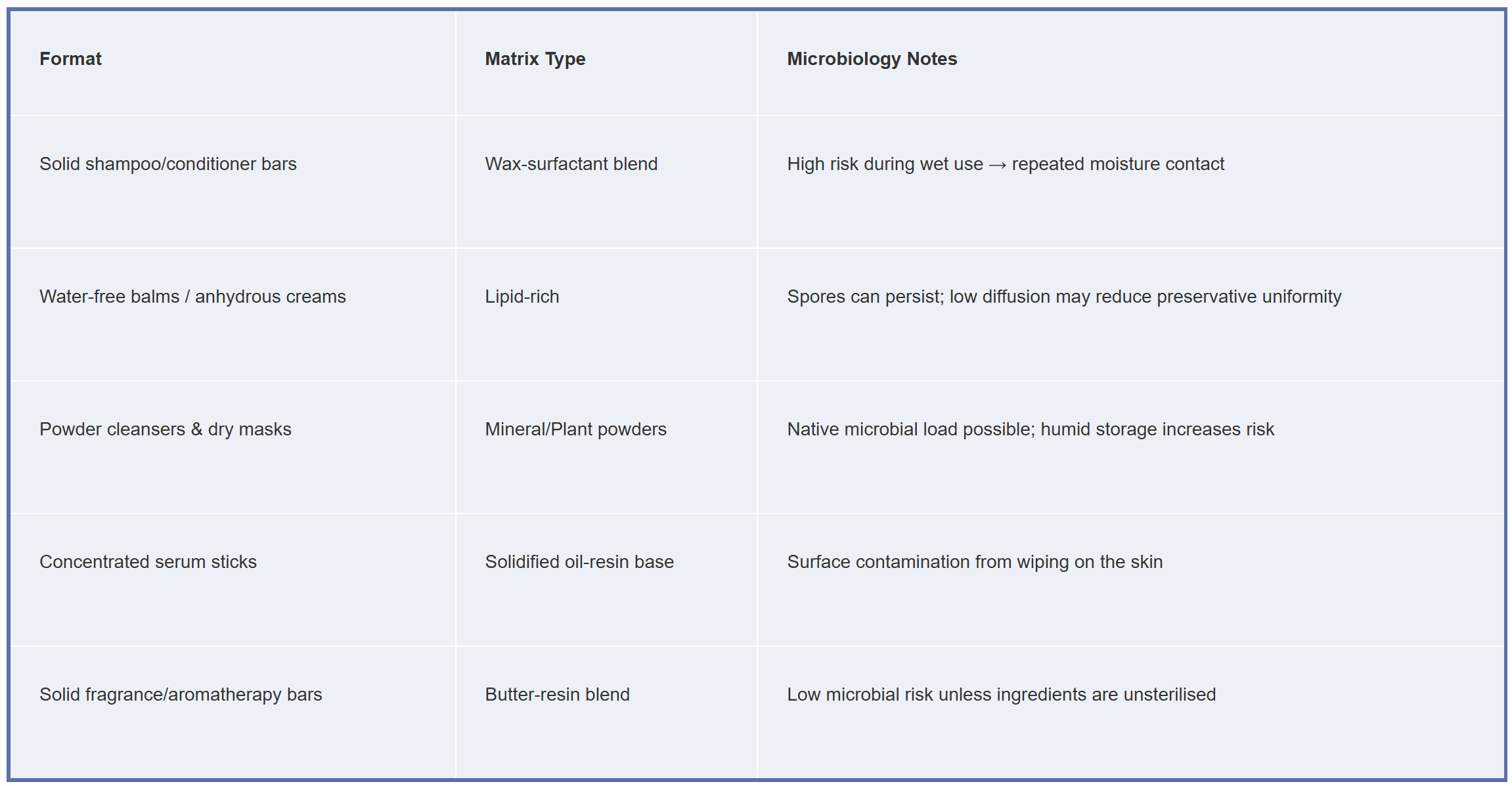
An advanced microbiological methodology understands that water activity (aw) varies according to the manner in which the product is utilized, and not only its storage.
Key Ingredients & Microbiological Precautions
Formulators that use sustainability-driven marketing (for example, "natural solid cosmetics", "clean beauty bars", "low water cosmetics") should not compromise the natural aspect of their products for the sake of microbiological safety. Some of the critical steps to ensure this are:
- Preparing raw materials before use (heating, irradiation, or filtration)
- Choosing ingredients that have antimicrobial properties naturally, such as a few essential oils, medium-chain triglycerides, and herbal extracts
- Not using allergens or causing sensitization by unnecessarily increasing the essential oil content while still aiming for antimicrobial preservation.
- Maintaining pH stability in products like cleansing bars is important because pH affects microbial susceptibility
- Selecting powdered botanicals without contamination of pathogenic spores
The goal is not merely a preservative efficacy test (PET) result but also endurance in everyday usage.
Packaging & UX as Part of the Preservation Strategy
Since the microbiological risk is something that happens during the use of the product and not during the storage, the packaging has to be a preservation shield. Modern high-performance brands are introducing:
- Drainable trays for shampoo bars
- Twist-up sticks to reduce surface touch
- Airtight butter cases with low humidity transfer
- Travel pods to discourage direct shower moisture exposure
- Magnetic wall-mount holders to promote faster drying after use
These choices directly affect microbial stability. Microbiology and UX are two sides of the same coin — sustainability messaging should not be at the forefront of product safety.
Consumer Education — A Silent but Powerful Safety Layer
Consumer education is a necessary element if we want the product to work safely in the real world:
- Help users remember to dry the bar thoroughly between uses
- Warn against the use of personal bars by several people
- Suggest that the product be stored outside the wet zone of the shower
- Tell consumers that color or scent changes, which are sometimes quite normal for high-botanical products, should not be considered spoilage.
Such brands can raise recognition of their products and enhance their trustworthiness by using keywords such as "solid beauty innovation", "anhydrous formulation safety", "microbiology of solid cosmetics", and "eco-friendly beauty bars".
Conclusion
Waterless and solid cosmetics are an amazing new frontier in formulation design - essentially, they are sustainable, made from natural ingredients, and have novel product architectures. However, their success depends entirely on a very thorough understanding of microbiology. When water is removed or reduced, the rules change, but the risk of microbiology is not eliminated. With careful design, confirmed preservation, rigorous microbiology of solid cosmetics, and strong, user-friendly packaging, formulators can guarantee safety, efficacy, and customer confidence.
Wherever there is a need for the utmost microbiological safety and compliance of each formulation, the formulators can count on the premium microbiology services provided by Eurofins' network of companies. Their precise testing - such as challenge tests, preservative efficacy validation, and microbial stability analysis, especially designed for waterless and solid formats - is a great help to the brands in achieving the safe, trustworthy, and regulation-compliant-ready innovations they desire to take to market.
Frequently Asked Questions
Are waterless and solid cosmetics completely free from microbial risk?
No. While the absence of free water significantly reduces the likelihood of microbial growth, it does not eliminate contamination risk. Microorganisms can survive on the product surface and become activated when moisture is introduced during use, particularly in humid environments such as bathrooms.
Why is water activity (aw) important in anhydrous cosmetic formulations?
Water activity determines how much free water is available for microbial survival and growth. Even in waterless products, environmental moisture can increase aw during use, creating conditions where dormant microbes may become viable, making aw a critical factor in microbiological risk assessment.
Do waterless products still require preservatives and microbiological testing?
Yes. Waterless and solid cosmetics still require preservation systems and validation through preservative efficacy testing (PET) and microbial challenge testing. These tests confirm that the formulation remains safe under real-world usage conditions, including repeated handling and moisture exposure.
How does packaging affect the microbiological safety of solid cosmetics?
Packaging plays a crucial role in reducing contamination. Features such as drainable trays, airtight containers, twist-up mechanisms, and moisture-reducing designs help limit microbial transfer and surface moisture retention, thereby enhancing product stability and safety.
Can natural waterless products be considered inherently safe?
Not necessarily. Natural ingredients may carry native microbial loads or spores. Without proper processing and validation, even “clean” or “natural” formulations can pose microbiological risks. Safety must be demonstrated through scientifically validated testing, not assumed based on ingredient origin.