
For any sunscreen brand selling in the United States, FDA SPF testing is a regulatory requirement rather than a promotional activity; this directly determines whether a product can legally remain on the market. Misunderstanding regulatory SPF testing requirements is one of the most common reasons brands face delayed launches, relabeling costs, failed audits, or forced retesting.
Unlike cosmetic claims, SPF is a drug claim under US law. It must be generated using a specific, prescriptive in vivo protocol defined by the Food and Drug Administration (FDA). Formulation performance, clinical execution, statistical variability, and documentation all influence whether a study is accepted or rejected.
This blog explains FDA SPF testing requirements, why brands encounter compliance challenges, and how a strategic testing approach can mitigate regulatory risk and avoidable costs.
What SPF means under FDA regulation
In the United States, sunscreens are regulated as over-the-counter (OTC) drug products. As a result, SPF is legally defined as a measure of drug efficacy, not cosmetic benefit.
Under FDA regulations, SPF represents:
The ratio of ultraviolet (UV) energy required to produce minimal erythema (sunburn) on sunscreen-protected skin compared to unprotected skin, under controlled test conditions.
This definition has several critical implications for brands:
- SPF claims must be supported by in vivo human testing
- Test methods are not flexible or negotiable
- Label claims must reflect measured performance, not formulation theory
Any deviation from FDA expectations can render a sunscreen misbranded, even if the product performs well in internal or international testing.
FDA regulatory framework for SPF testing
SPF testing requirements are established and enforced by the Food and Drug Administration through the sunscreen OTC monograph framework.
Key principles of the FDA approach include:
- Numeric SPF claims are mandatory to substantiate
- Testing methods are highly prescriptive
- Data must be reproducible, statistically valid, and inspection-ready
FDA does not “approve” individual sunscreen products before sale, but it does enforce compliance through inspections, warning letters, and post-market review.
Core FDA SPF testing requirements
1. In vivo testing on human subjects
FDA SPF testing must be conducted in vivo using human volunteers. In vitro or predictive SPF methods are not accepted for regulatory labeling in the US.
Key requirements include:
- A defined minimum number of evaluable subjects
- Specific skin phototype inclusion criteria
- Controlled UV exposure using calibrated solar simulators
- Strict subject exclusion rules (e.g., recent sun exposure, photosensitizing medications
Subject selection and management are frequent failure points when studies are not conducted by experienced regulatory laboratories.
2. Minimal Erythema Dose (MED) determination
SPF testing is based on determining the Minimal Erythema Dose (MED):
- MED on unprotected skin
- MED on sunscreen-protected skin
FDA specifies:
- UV spectral output requirements
- Exposure dose increments
- Timing and method of erythema evaluation
Variability in product application, subject response, or exposure uniformity can significantly affect outcomes.
3. Standardized sunscreen application
FDA protocols strictly define how sunscreen must be applied:
- Application rate: 2 mg/cm²
- Defined application timing before exposure
- Controlled, treated, and untreated test sites
Formulations that spread unevenly, migrate, or dry inconsistently can introduce variability that increases the risk of inconclusive or failed studies.
4. Statistical calculation and labeling constraints
SPF values are calculated using FDA-defined statistical methods across all evaluable subjects.
Important compliance considerations include:
- Excessive variability may invalidate results
- Outliers can trigger study rejection
- The labeled SPF must align with the FDA SPF categories
High-SPF products face increased scrutiny because small performance inconsistencies can have outsized regulatory consequences.
Regulatory SPF testing vs. development testing
Many compliance issues arise when brands confuse regulatory SPF testing with formulation screening or development studies.
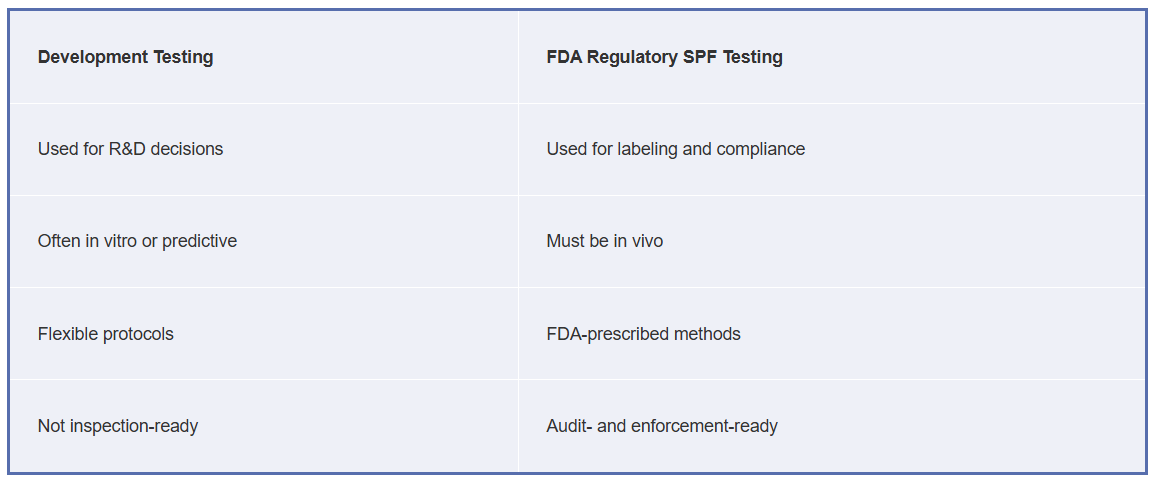
Relying on development data for labeling decisions constitutes a significant compliance risk.
Common SPF compliance challenges for brands
Formulation-related failures
SPF studies often fail due to formulation behavior rather than protocol errors. Typical issues include:
- UV filter photoinstability
- Phase separation during application
- Poor film formation on the skin
These issues may not appear during bench testing but become apparent under clinical exposure conditions.
Protocol misalignment
Even minor deviations from FDA test requirements, such as exposure timing or subject handling, can invalidate an entire study.
Brands working with non-specialist laboratories often discover these issues after data collection is complete.
Cost and retesting risk
Failed SPF studies result in a significant financial impact. Associated costs include:
- Repeat in vivo clinical testing
- Reformulation and revalidation
- Label redesign and packaging waste
- Delayed market entry
Proactive regulatory alignment typically costs far less than reactive remediation.
How SPF testing fits with other FDA sunscreen requirements
Broad-spectrum testing
SPF testing alone does not support “broad-spectrum” claims. Products must also pass FDA-defined UVA testing to demonstrate proportional UVA and UVB protection.
SPF and broad-spectrum strategies should be coordinated to avoid conflicting performance outcomes.
Water resistance testing
Claims such as “Water-Resistant (40 minutes)” or “Water-Resistant (80 minutes)” require additional FDA-defined testing. These studies interact with SPF performance and must be carefully sequenced.
Photosafety considerations
While not part of SPF testing, the FDA expects manufacturers to assess photosafety for light-absorbing active ingredients. Phototoxicity or photoallergy risks can influence overall product acceptability, particularly for high-exposure products.
Why FDA SPF testing creates challenges for brands
Technical analysis identifies three recurring operational challenges in FDA SPF testing:
- Regulatory complexity: Prescriptive rules leave little margin for error
- Cost sensitivity: In vivo testing is resource-intensive
- Time pressure: Seasonal launches magnify delays
Without early regulatory planning, SPF testing becomes a bottleneck rather than a validation step.
Strategic Management of FDA SPF Testing Protocols
Successful navigation of SPF testing typically involves:
- Assess formulation readiness before regulatory testing
- Align labeling strategy with achievable performance categories
- Integrate SPF, broad-spectrum, and water resistance testing plans
- Work with laboratories experienced specifically in FDA sunscreen requirements
SPF testing should be treated as a regulatory milestone, not a routine lab task.
How independent testing supports compliance
Independent laboratories play a critical role in producing objective, regulator-ready SPF data.
The Eurofins network of companies includes laboratories with experience in FDA SPF testing and broader sunscreen performance evaluation. The Consumer Product Testing network of companies supports sunscreen brands by providing:
- FDA-compliant in vivo SPF studies
- Study design aligned with labeling and claim strategy
- Integrated testing for SPF, broad-spectrum, and water resistance
- Data packages suitable for inspections and regulatory review
Independent testing helps reduce bias, improve data defensibility, and lower the risk of repeat studies.
Frequently asked questions
Is FDA SPF testing mandatory for all sunscreens?
Yes. Any sunscreen marketed in the US with an SPF claim must undergo FDA-compliant in vivo SPF testing.
Does the FDA approve individual sunscreen products?
No. The FDA does not pre-approve sunscreens but enforces compliance through post-market oversight and inspections.
Can in vitro SPF testing replace FDA testing?
No. In vitro methods may support development but cannot replace regulatory SPF testing in the US.
Why do SPF studies fail?
Common reasons include formulation instability, subject variability, and deviations from FDA protocols.
Conclusion
FDA SPF testing is a regulatory requirement with direct commercial consequences. For sunscreen brands struggling with compliance complexity, regulatory uncertainty, or rising testing costs, understanding FDA expectations is essential.
By approaching regulatory SPF testing strategically, and partnering with experienced, independent laboratories, brands can reduce risk, control costs, and bring compliant sunscreen products to market with technical certainty.
FDA SPF testing is not just about passing a study. It is about ensuring label accuracy, meeting timelines, and maintaining access to the US market.
The Eurofins CRL Research Laboratories network supports sunscreen manufacturers with scientifically robust SPF, photostability, and photobiological safety testing designed to withstand regulatory scrutiny and support confident OTC submissions.
Next steps:
- Validate SPF and broad-spectrum claims with FDA-aligned testing protocols
- Generate defensible photobiology data to support label accuracy
- Reduce regulatory risk during product launch, reformulation, or lifecycle updates
If you have regulatory or study-design questions related to SPF, photostability, or photobiological safety testing, consult directly with a photobiology expert at Eurofins CRL Research Labs to discuss FDA-aligned testing strategies and documentation expectations.