Texture classes
Definition
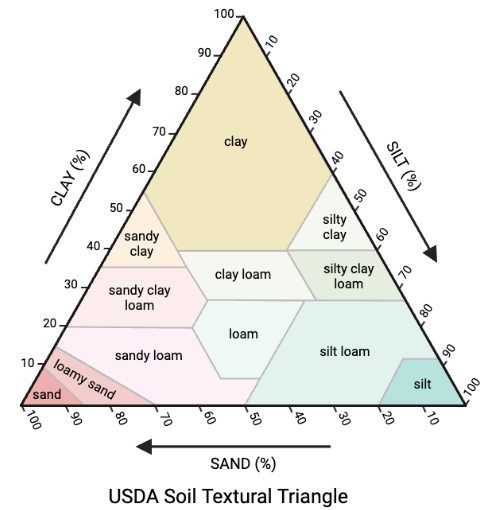
Soil texture refers to the proportion of different particle sizes within the soil: clay, silt, and sand.
Clay: particles smaller than 2 micrometres (µm)
Silt: particles between 2–50 µm
Sand: particles larger than 50 µm
Importance
The distribution of these particles influences soil behaviour, including water retention, aeration, and structural stability. One key aspect affected by particle distribution is the risk of slaking—the breakdown of soil aggregates when exposed to water.
Risk of slaking
- High risk: Soils with 10–20% clay combined with silt and sand have the greatest tendency to slake, leading to compaction and poor structure.
- Low risk: Soils dominated by either sand or clay particles show the least risk of slaking.
When slaking occurs, the soil becomes compacted as smaller particles (clay and silt) settle, reducing porosity and root penetration.
Historical classification
Previously, soils were classified based on their rate of siltation. Since the 1990s, this method has been replaced by measuring the percentage of clay (loam), which provides a more accurate assessment of soil texture and structural risk.
Key considerations
- Understanding soil texture helps in predicting structural stability and managing cultivation practices.
- Avoid practices that increase slaking risk in soils with balanced clay-silt ratios.
- Use texture analysis to guide irrigation and fertilisation strategies.