Applications, trends, and Eurofins CDMO India expertise in deuterium chemistry
The first deuterated drug, deutetrabenazine, was approved by the U.S. FDA in 2017 for its improved metabolic stability compared with undeuterated tetrabenazine
According to a market report, deuterated compounds are in high demand, with more than 70% of global research and development (R&D) institutions incorporating them into their research programs to improve drug stability. Over the past five years, industrial demand has increased by 42%, while contract research organisations (CROs) account for 36% of global consumption. Pharmaceutical-grade deuterated compounds hold a market share of 58%, whereas specialty chemicals and diagnostics account for 29% and 13%, respectively.
Deuteration is a seemingly simple modification that can influence metabolic stability and pharmacokinetic properties while preserving the biological activity of the parent compound. As a result, deuterium chemistry is increasingly being used as a valuable tool in modern drug discovery and development.
Recent reports indicate that more than fifteen deuterated drugs are currently in clinical trials, and more than six have received regulatory approval for commercial use.
In this blog, we discuss the fundamentals of deuterium, its applications, challenges, future opportunities, and how Eurofins CDMO India supports the development of deuterated compounds.
What is deuterium?
Deuterium (D or 2H) is a naturally occurring, stable, and non-radioactive isotope of hydrogen (H) with a natural abundance of 0.0156%. Like hydrogen, it contains one proton and one electron, but it differs by bearing an additional neutron in its nucleus. This additional neutron makes deuterium approximately twice as heavy as hydrogen.
Why replace hydrogen with deuterium?
In medicinal chemistry, replacing one structural element with another while maintaining biological activity is known as bioisosterism.
Hydrogen-to-deuterium substitution is one such approach of bioisosterism. Since deuterium forms a stronger and more stable carbon–deuterium (C–D) bond compared with the carbon–hydrogen (C–H) bond (with a difference of 1.2-1.5 kcal mol-1), bond cleavage can occur more slowly during metabolic processes. This phenomenon is known as the deuterium kinetic isotope effect (DKIE) and is expressed as the ratio of the rate constants (KH/KD) (Figure-1). A higher DKIE value indicates a slower breakdown of the C–D bond relative to its hydrogen counterpart.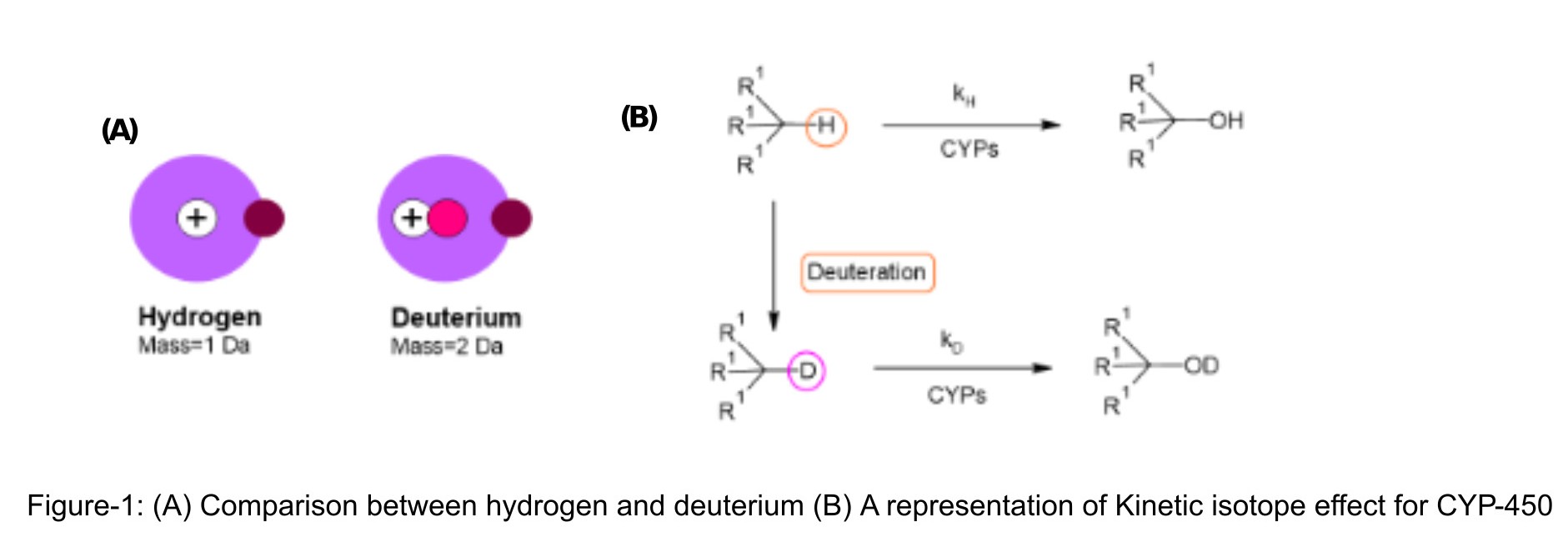
Applications of deuterium in drug development
- Enhanced pharmacokinetics: Deuterium slows CYP450-mediated metabolism through the deuterium kinetic isotope effect (DKIE), improving metabolic stability and reducing reactive or toxic metabolites. Hydrogen-to-deuterium substitution can increase half-life (t½) and maximum plasma concentration (Cmax), enabling less frequent dosing, better patient compliance, and more consistent drug exposure.
- Reduced undesirable metabolites: Deuteration can improve drug safety by limiting harmful metabolites. For example, dosimertinib, a deuterated analogue of osimertinib, reduces formation of N-demethylated metabolites while maintaining antitumor activity and is currently in clinical trials.
- Deuterium-enabled chiral switching (DECS): DECS is used to stabilise, isolate, and administer preferred stereoisomers (eutomers), helping optimise efficacy and safety.
- Influence on mechanism of action (MOA): RT001 and ALK001 are deuterated nutritional agents that are being developed for neurodegenerative and ophthalmic disorders, respectively. These compounds have been shown to slow dimerisation processes, thereby providing novel pharmacological activities. Both compounds are currently in clinical trials.
Early drug discovery integration
Deuterium is increasingly incorporated into early drug development to address pharmacokinetic challenges and improve efficacy. Deucravacitinib is the first approved de novo deuterated drug. In addition, there are two deuterium-labelled drugs in clinical development, namely deucrictibant (for hereditary angioedema), and VX-984 (an oncology radiosensitiser). A few approved deuterated drugs and their benefits are summarised below.
Approved deuterated drugs and their benefits
| Deuterated drug | Indication | Advantage by deuteration |
| Deutetrabenazine | Huntington chorea and tardive dyskinesia | Increase exposure to active metabolites |
| Donafenib | Hepatocellular carcinoma and other advanced solid tumours | Higher drug absorption and steady-state exposure with lower incidence of adverse effects |
| VV116 | COVID-19 and Respiratory Syncytial Virus (RSV) | Contribution to the switch from IV to oral administration |
| Deucravacitinib | Psoriasis and other autoimmune diseases | Avoidance of non-selective metabolites |
| Deutenzalutamide | Castration-resistant prostate cancer | Improved PK profile and reduced formation of metabolites associated with side effects |
| Deutivacaftor | Cystic fibrosis | Increased PK parameters (longer t½ and higher exposure) |
| Deuruxolitinib | Alopecia areata | Increase exposure and longer half-life |
The effects of deuteration on selected clinically approved drug molecules are presented in Figure-2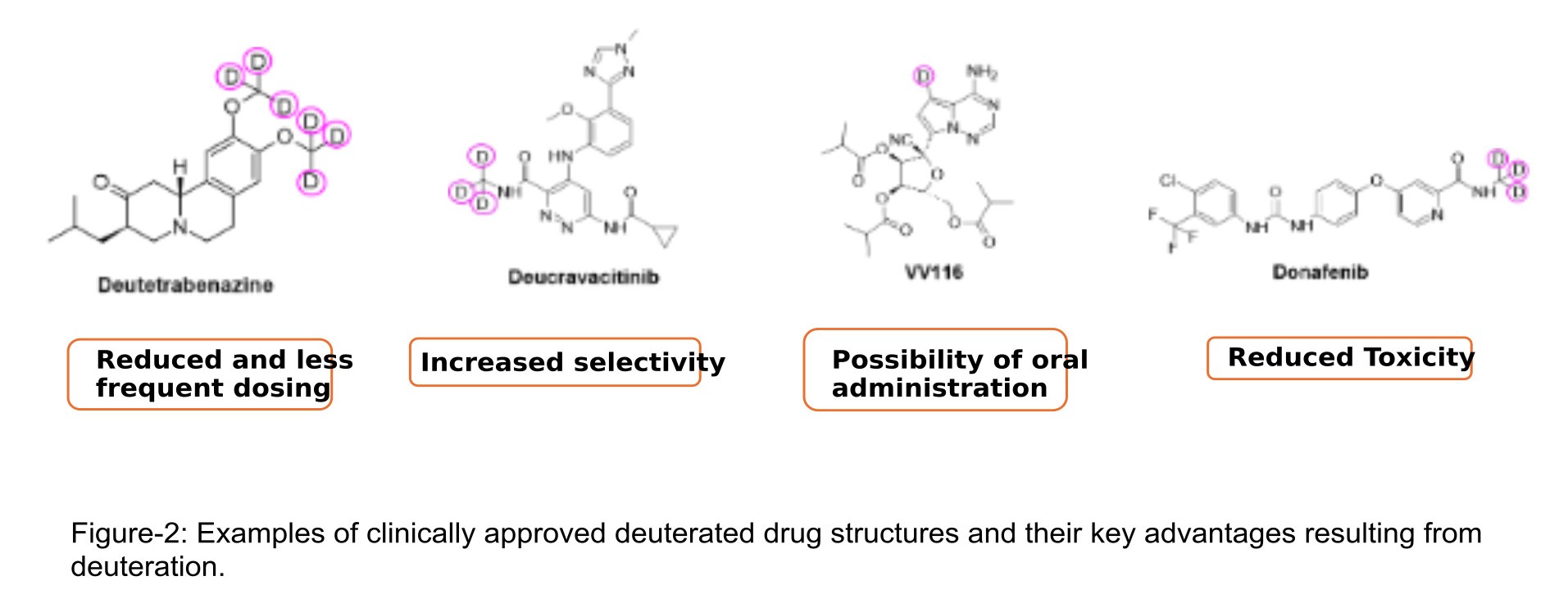
Synthesis of deuterated compounds
Deuteration can be achieved through multiple synthetic approaches.
One common strategy involves the use of commercially available deuterated reagents, often referred to as the deuterated pool, including:
- D2O Heavy water
- DMSO-D6
- CD₃I (Deuterated Methyl Iodide)
- CD₃OD (Deuterated Methanol)
- D₆-acetone (Hexadeuteroacetone)
Other approaches include:
- Hydrogen isotope exchange (HIE)
- Reductive deuteration of carbonyl compounds using NaBD₄ or LiAlD₄
- Acid catalysed hydrogen deuterium exchange
- Transition metal catalysed hydrogen deuterium exchange
- Biocatalytic reductive deuteration
- Photoredox chemistry
- Photocatalysis
- Electrochemistry
- Radical chemistry
The synthetic approach to deuteration depends on the chemical structure of the compound to be deuterated, the desired deuteration pattern (whether the compound is to be perdeuterated, polydeuterated, or selectively mono- or di-deuterated), and scale requirements.
Challenges and considerations
Despite its advantages, deuterium chemistry presents several challenges.
- Industrial-scale synthesis may require additional deuteration cycles to achieve target isotope incorporation.
- Deuterated reagents are often more expensive than their non-deuterated counterparts.
- Specialised technologies and expertise may be required for synthesis and analysis.
- Regulatory agencies require detailed isotope distribution data and characterisation.
- Metabolic switching may necessitate extensive toxicological evaluation.
Patent strategies involving deuteration patterns and impurity profiles can be complex.
These factors highlight the importance of selecting the right development partner with proven expertise in deuterium chemistry.
Beyond pharmaceuticals: Broader applications of deuterium
Although deuterium behaves chemically much like hydrogen, the difference in mass can influence certain reaction rates and bond strengths, giving rise to unique applications across multiple industries.
Deuterium has long been used in a variety of scientific and industrial applications, including:
- Heavy water for nuclear reactors
- Solvents for NMR spectroscopy
- Internal standards in mass spectrometry
- Tracers in biological and metabolic studies
- Thermo stabilisation applications
- Organic light-emitting diode (OLED) applications
One of the major challenges associated with OLED materials is limited operational lifetime. By replacing hydrogen with deuterium, degradation processes can be slowed, thereby helping o improve device longevity without significantly altering performance. Additional benefits of deuteration in OLEDs include enhanced chemical stability, superior oxidation resistance, and extended emission lifetime.
Outlook for deuterated drugs
Research efforts are actively exploring deuterium incorporation across therapeutic areas such as oncology, neurology, and infectious diseases. Deuteration is also being investigated in emerging modalities, including:
- Proteolysis targeting chimeras (PROTACs)
- Peptide therapeutics
- Oligonucleotide technologies
These areas represent exciting opportunities where improved metabolic stability and systemic exposure could provide meaningful therapeutic benefits.
Eurofins CDMO India capabilities in deuterium chemistry
Eurofins CDMO India offers integrated services for the synthesis, process development, scale-up, and characterisation of deuterated intermediates (Figure-3) and APIs.
Custom deuterium labelling
Experience in handling a broad range of deuterated reagents, including:
- DMSO-d₆ (Dimethyl sulfoxide-d6)
- CD₃NH₂ (Methylamine-d3)
- CD₃OTf (Methyl triflate-d3)
- CD₃I (Methyl iodide-d3)
- Formaldehyde-d₂
- NaBD₄ (Sodiumborohydride-d4)
- Specialty deuterated building blocks
Expertise across multiple scaffolds
Eurofins CDMO India’s capabilities in deuteration chemistry are illustrated in Figure-3.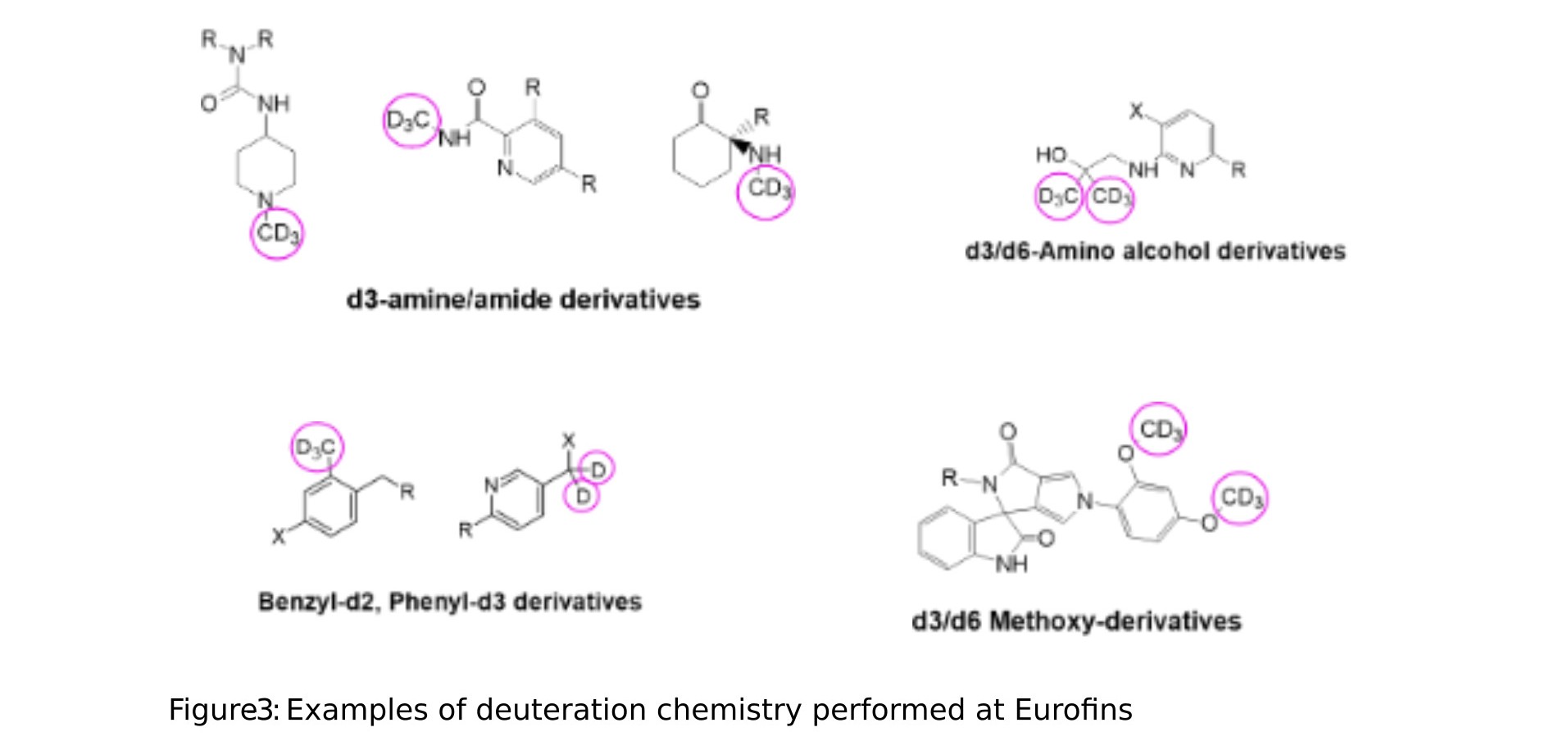
Flexible manufacturing scale
Capabilities ranging from milligram quantities for research applications to multi-hundred-gram quantities for development programs.
Comprehensive analytical support
- HPLC/GC purity assessment
- LC-MS identification
- ¹H NMR characterisation
- Deuterium incorporation (%D) analysis by NMR
Applications supported
- Deuterated APIs
- Stable isotope-labelled standards
- ADME and PK studies
- Metabolite identification
- Bioanalytical reference materials
From route design and deuteration strategy to scale-up manufacturing and analytical characterisation, Eurofins CDMO India supports the development of high-quality deuterated compounds with reliable isotopic incorporation and robust analytical packages.
Conclusion
Deuterium chemistry offers a powerful strategy for enhancing drug properties without altering molecular structure. As the demand for improved drug stability, safety, and pharmacokinetic performance continues to grow, deuterated compounds are becoming an important component of modern drug discovery, development, and materials science.